Johannesburg swimming pools by Professor Louis Grundlingh

Professor Louis Grundlingh - University of Johannesburg
 Louis Grundlingh

I  am doing research on the history of Johannesburg's public spaces. Currently, I am working on the history of the Johannesburg zoo.


One of the aims of Johannesburg's British-controlled town council after the South African War (1899-1902) was to provide open public leisure spaces for its white citizens. The establishment and development of Ellis Park as a major sports centre was one of these endeavours.

In 1908 the council bought disused land in New Doornfontein, taking the first step towards achieving this grand vision, namely the construction of a swimming bath that met all the requirements for an international tournament. The First World War interrupted any further development, but the 1920s witnessed impressive expansion to include tennis courts, cricket pitches and rugby football grounds. By the end of the 1920s, the council and the Transvaal Rugby Football Union which was a key stakeholder in the development, could proudly claim that they had achieved their dream of establishing an international sports arena for Johannesburg. Ellis Park became a significant urban marker, a symbol of prestige for the fast-growing city, as well as in the transformation of Johannesburg's urban fabric into a modern city.

Municipal modernity: the politics of leisure and Johannesburg's swimming baths, 1920s to 1930s

Published online by Cambridge University Press:  02 August 2021

Louis Grundlingh

Some often view swimming baths1 simply as functional structures, oblivious that they are historically constructed public social spaces and overlooking what they represent in a community, specifically in suburbs, and what they tell of a city's history.2 However, Van Leeuwen has prompted a scholarly interest in the swimming bath as a distinct and quintessentially modern form of urban space.3 Wiltse4 and Love5 continued Van Leeuwen's pioneering work. Wiltse traced the development of municipal swimming baths to elegant modern recreational spaces while Love's study investigated the competitive and recreational forms of aquatic sport. Recently, Kozma, Teperics and Radics rightfully claimed that ‘researchers have been paying increasing attention to study the connections between sport and urban development’.6 This is confirmed by similar scholars specializing in the history of swimming baths.7 Likewise, using a cultural, municipal and class lens, this article unlocks the establishment, design and usage of swimming baths for Johannesburg's white residents in a rapidly changing urban environment. It thus introduces an ignored piece of the history of Johannesburg's leisure facilities.

Until recently, the implicit acceptance of ‘race’ as the primary category of inquiry meant that most studies of Johannesburg interpreted the city as nothing but ‘the spatial embodiment of unequal economic relations and coercive and segregationist policies’.8 This scholarship is based on a long tradition focusing more on, inter alia, the geographies of poverty and less on the cartographies of affluence.9 Not denying this reality,10 these accounts envisioned the city not as an aesthetic project but as a space of division.

However, Parnell and Mabin were decidedly critical of what they saw as an ‘obsession with race’ in existing South African urban historiography.11 This approach obscured and impoverished an understanding of how modernist planning, a concern for ‘improvement’ as well as municipal power, had shaped South African cities. Recently, Bickford-Smith added that a history of South African cities, not focusing on race alone, is overdue.12 What was needed was a history from the perspective of powerful local politicians and bureaucrats: in this case, the role of the protagonist in Johannesburg's City Council, namely English-speaking, white, male, middle class and elite, shaping the urban fabric. Their crucial relationship with urban place has been neglected in existing historiography despite the fact that Britishness was the ‘prime nationalism of South Africa, against which all subsequent ones…reacted’.13 This article shares this concern and unpacks their role in providing swimming baths to selected areas of the city.

Cities were unmistakably the creation of their middle class, the theatre where this elite ‘sought, extended, expressed and defended its power’.14 For the purpose of this article, the ‘theatre’ was Johannesburg's suburbs.15 In explaining middle-class suburbs, Gunn's insights into ‘the distinction between centre and periphery’16 is as helpful as Beavon's explanation of the development of Johannesburg's suburbs. Beavon demonstrated how physical geography, economic forces and the relationships between space, race and class determined Johannesburg's layout of suburbs on the periphery.17 This crucial point helps to explain the council's decision where and when to build swimming baths, thus adding another important layer to the fabric of suburban facilities. In short, Johannesburg's swimming baths became a distinctly suburban phenomenon, changing suburbanites’ lives.

Studies of the histories of leisure and recreation only make fleeting reference to municipal sports provision.18 McShane and Katzer agree that, although sporting space reflects key shifts in thinking about town planning, sports architecture and physical infrastructure are likewise inadequately examined in the historiography of urban design.19 The corrective is, as Doyle reminds us, to emphasize the history of municipal governance, especially as the council is the agent of change.20

Whilst there is a dearth in the scholarship on this in South Africa, the history of local government and the wielding of political power has attracted heightened interest from urban and administrative historians.21 For example, in England, municipalities were the driving force and the sole provider of swimming baths,22 with the city of Manchester leading the way.23 In Victoria, Australia, the initiative also came from municipalities.24 This article likewise makes a contribution to this under-researched field.

In their reflections on urban development in South Africa, scholars used the prism of modernist planning.25 South African cities became ‘monuments to progress and modernity…equalling any modern counterpart in Europe and North America’. 26 Right from the start, the defining character of Johannesburg was its connection with the fabric, trends and cultural style of London, Paris and New York. Frisby's observation that ‘the culture of modernity became synonymous with the culture of the metropolis’27 rings true for Johannesburg. It was first and foremost a metropolis in every conceivable sense of the term. In fact, the entire history of its built structures testifies to ‘its inscription into the canons of modern Western urban aesthetics’.28

During the 1920s and 1930s, the council indeed embarked on a concerted effort at modernization,29 of which the construction of swimming baths was part. This article taps into this by demonstrating that the architectural form of swimming baths reflected these trends. As well as being functional – as manifested in contemporary design, facilities, construction, standardization and the implementation of new technologies – they became significant visible physical manifestations of the council's initiative to change white Johannesburg into a ‘modern city’. This notion is a leitmotiv throughout this article.

Finally, questions of ‘locality’, ‘place promotion’, ‘selling cities’ and ‘civic boosterism’ became a popular topic amongst geographers and historians.30 As public social spaces, swimming baths were physical manifestations of municipal grandeur and pride of the city. Indeed, the swimming bath, as a building type, was a cultural and architectural artifact31 to be celebrated. This article speaks to this aspect, emphasizing efforts to sell the Johannesburg of the 1930s.

Context

Subsequent to the South African War (1899–1902), Johannesburg experienced steady population growth and a marked economic upswing. However, it was especially after World War I that its economic potential was unleashed. The 1920s and 1930s witnessed major investment in the mines and expanding industries grew exponentially. Following the 1922 white miners’ strike, capitalists, supported by the government, were able to disempower the workforce.32 While the Great Depression impeded economic growth to a marked degree, Johannesburg experienced a massive economic boom after South Africa abandoned the gold standard in 1932. The world price of gold doubled and the Witwatersrand's mining-driven economy took off as a result of the reopening of previously marginal mines and the discovery of new reserves on the West Rand in 1935.33 Chipkin captured the economic mood and its impact: ‘it was part of that gold bondage that gave Johannesburg its exuberance and the trite name of “City of Gold”’.34

After this ‘economic miracle’, all economic records were broken.35 The sudden increase in wealth strengthened cultural and architectural connections with Europe and North America. Johannesburg entered the 1920s and 1930s with a bravura that supported its appetite for new – and preferably imported – ideas and trends.36 This was reflected in modernist multi-storey buildings, up-market retail stores and impressive skyscrapers, many built according to the Art Deco style. They became an ‘unmistakable imprint of contemporary New York of the 1930s’,37 and were given ‘favourable sobriquets such as “Wonder of the Modern World” and “Miracle of the Empire”’.38 ‘Place-sellers’ justifiably marketed Johannesburg as a ‘world city’.39 This mindset filtered down to the cultural landscape. Add theatres, cinemas, public parks, a zoo, racecourses and sport facilities, and a picture emerges of a city that worked hard, played hard and was not afraid to splash out on its pleasure palaces.40 Swimming baths and their design, built during this time, reflected this environment.

However, there was a darker side to this. The prosperity strengthened the geography of racial, cultural, economic and class segregation.41 Consequently, geographic expansion to accommodate the fast-growing population influx followed the same pattern. This arrangement had, of course, a major debilitating effect on the lives of Johannesburg's black population, reflecting the realities of racialized municipal politics. So, despite the enormous boost in Johannesburg's economy during the 1930s, little was spent on black recreational facilities. The council only opened the first public swimming bath for blacks at the Wemmer Hostel site in 1936.42

Johannesburg was thus fashioned as a British city. On a material level, architecture, monuments, naming of streets and suburbs were indistinguishable from those of Britain,43 reinforcing a sense of belonging. Similarly, British sporting culture heavily influenced South African sport, such as cricket and rugby. Swimming, likewise, was a British-inspired sport activity.44 All these factors impacted on the provision and design as well as structure of sport and leisure facilities, thus adding another component to Johannesburg's British identity.

Sharing the same identity, the so-called ‘labour aristocracy’, i.e. the English-speaking artisans and mine-workers with a ‘sense of “Britishness”’,45 settled in the south-east. Not at all part of this powerful identity were white Afrikaans-speaking miners and unskilled labourers. They lived mostly in the emerging suburbs to the south-west where housing was cheaper. They became known as the ‘poor whites’.46

Local political power was in the hands of English-speaking, middle-class males with extensive social and economic links to mining and trade47 and they controlled Johannesburg's municipal government for almost the entire twentieth century. They kept a tight rein on the management of the city. Aware of the latest technologies and practices and anxious to participate in international discourse, they embraced urban modernity and dominated public opinion on the architectural features of the city.48 Hence, political decisions on the layout and use of public open spaces – as well as swimming baths – were profoundly informed by British designs.49

Maud identified the core business of the council to ensure the wealth, health and happiness of its residents. However, according to him, until the late 1920s, the council neglected its obligation to health and happiness in favour of wealth.50 This criticism might have been too harsh. Since the 1900s, the council, as did the gold mining companies, accepted responsibility for allocating urban open spaces and building facilities for leisure activities.51 Indicative of the growing social awareness amongst council members, various types of recreational facilities such as tennis courts, bowling greens and, indeed, swimming baths were constructed.52

Further building and expansion

Maud earmarks 1928 as the year in which the council invested in major infrastructural improvements and community services. For example, storm water drainage and road construction were upgraded whilst building started on new gas works, a new electricity power station and a new library. Significantly, these projects were ‘the first-fruits of that fertilizing flood of capital expenditure which after 1927 the council poured out in more and more copious streams’.53

Bickford-Smith remarks: ‘By the early 20th century it had become the objective of civic authorities…to build aesthetically more pleasing cities, prompted by combined desire for private glory and communal benefit.’54 The building of six baths between 1927 and 1932 was part of this endeavour.55 As elsewhere, they would not solely be functional. They also became symbols of municipal modernity and tangible evidence of civic ideals and pride. Additionally, they were built for the public good and not for private gain. As in America and Britain, they would rank alongside town halls, parks, libraries and other major public buildings as showcases of municipal activity and place-selling.56 Not surprisingly then, Johannesburg obtained city status on 5 September 1928.57

Until 1921, Johannesburg only had one swimming bath for whites at Ellis Park, Doornfontein, built in 1908–09. Rising living standards amongst white suburbanites created an increase in the number of ratepayers who harboured demands of their own. For them, one swimming bath was inadequate for Johannesburg's fast-growing white suburbs. Hence, requests to build more baths became increasingly vociferous, especially in their demands that suburban school children should be catered for.58

In England, ratepayers’ associations indeed successfully contested but also supported plans for the built environment.59 Likewise, Johannesburg's white ratepayers’ associations became a force to be reckoned with. Their calls for higher-quality swimming facilities, such as treated water, and for an increase in the provision of municipal bathing facilities during the inter-war years, played an important role in realizing their demands.60

The first of these new baths was built at the so-called ‘Wemmer Pan’ in the suburb of Turffontein.61 Wemmer Pan was originally a quarry to the south of Johannesburg. Later, it became a popular leisure resort for fishing and yachting. The council readily approved the site,62 as the resort offered all the facilities for recreation in one convenient and accessible spot.63 In addition, the majority of the neighbouring suburbs favoured the development.64 It was envisioned that improvement plans ‘should rescue the Pan from its present comparative obscurity’.65 Subsequently, the council sanctioned £13,200 for the project.66 In addition, it acquired 35 acres of land adjacent to Wemmer Pan and the right to use the pan for pleasure boating.67

Councillor C.H. Brooks, chairman of the Parks and Estates Committee, was very proud of the transformation from a fairly underdeveloped pan to one that could now boast a ‘splendid bath’.68 The Star reported that the residents were soon to find that ‘Doornfontein is not the only pebble on the beach.’69 Members of the nearby communities had high hopes that the Wemmer Pan swimming bath and the other facilities on offer, such as the boats on the pan, would make it one of Johannesburg's principal pleasure resorts.70 This indeed happened. The popularity of the bath increased after a direct tram route from the city centre to Turffontein opened on 3 August 1923.71

In July 1927, courtesy of the administrator of the Transvaal Province,72 J.H. Hofmeyr,73 the council obtained a loan of £50,000, of which £25,000 was earmarked for additional swimming baths.74 This was a bonanza for the council because previously the municipal budget had to be balanced without any assistance from the provincial or the central government.75 The loan enabled the council to launch an extensive building programme to provide sporting facilities. The Rand Daily Mail lauded the administrator, who ‘recognized that Johannesburg is firmly resolved to keep abreast of the times in the matter of adequate facilities for improving the health and physique of its future residents’.76

Based on this additional income, construction of three additional baths, commenced: at Zoo Lake (see Figure 1), Rhodes Park and Paterson Park.77 They were all near English-speaking middle-classes suburbs and in line with the council's policy to provide swimming baths according to local demands.
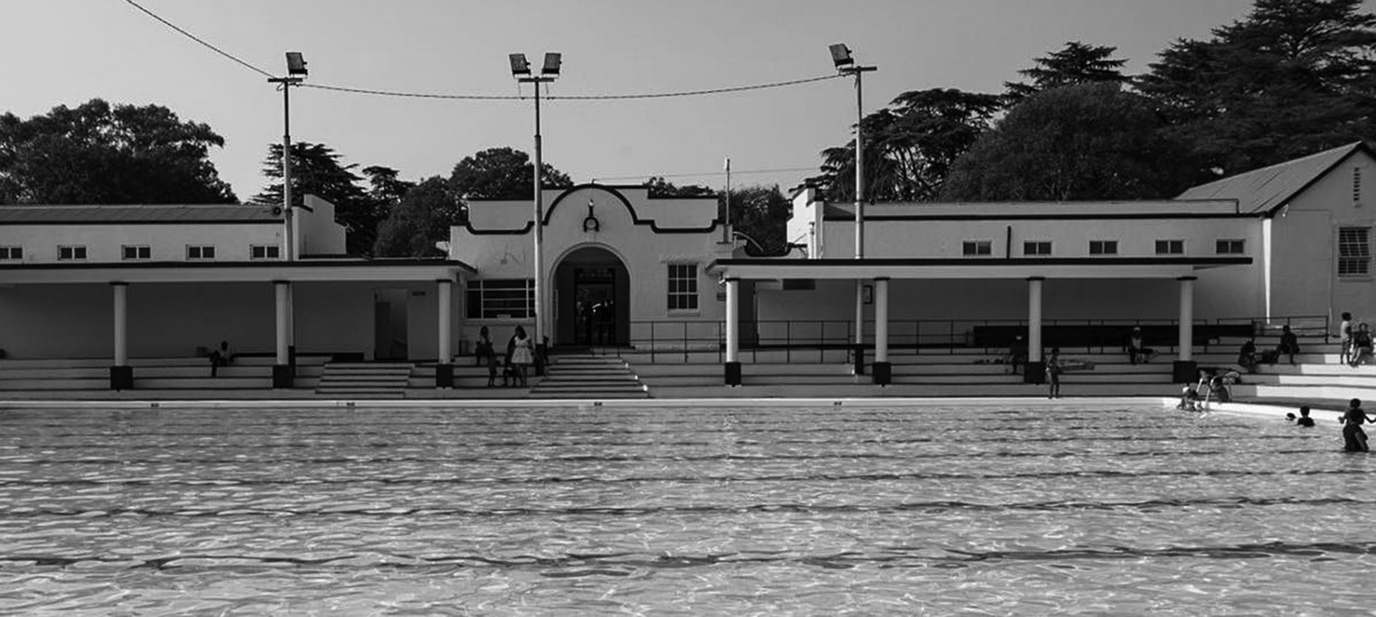
Zoo Lake

Figure 1. Zoo Lake swimming bath, 2020.

As was the case with similar purchases, the land thus served a dual purpose, for a park and a swimming bath.78 This was in keeping with the modern tendency to redefine the purpose of urban parks, as had become common practice in London.79 Ellis Park was the definitive example of a leisure space initially demarcated as a park and then being transformed into a space exclusively for sporting activities.80

Before the severity of the Great Depression impeded any ambitious economic development, a further three baths were constructed. The local sport clubs played a key role. For example, the Yeoville Sports Club used land already owned by the Johannesburg Consolidated Investment Co. The company was willing to transfer the land to the council, ensuring that a swimming bath could be built for use by residents of Yeoville and Observatory suburbs.81

The same philosophy that was followed in Yeoville was applied when the Mayfair and Malvern baths were built. Here, too, sport complexes were developed catering, inter alia, for football fields, cricket pitches and swimming baths.82 The council purchased the necessary land from the nearby Langlaagte Estate and Gold Mining Co. Ltd, an area of approximately 2½ acres, costing £50 per acre.83 Significantly, the Mayfair bath was the only one constructed in the south-western suburbs, where most of the residents were white working-class Afrikaans-speakers.84

As indicated earlier, the other swimming baths were in the prestigious northern and north-eastern suburbs, away from the industrial noise and grime of the city where white, middle-class English-speakers predominated. Ratepayers in these suburbs received preferential treatment in the provision of swimming baths from the council. This was in stark contrast to its provision in the poorer white Afrikaner working-class areas. Apart from the Mayfair swimming bath, only two additional swimming baths were built in these areas much later. Clearly, class and ethnic politics were at play in municipal circles. However, it must also be kept in mind that Afrikaners had no tradition of swimming. It was initially an English-speaking elitist sport, especially practised by the English-speaking communities on the coast, i.e. Durban and Cape Town. This tradition was maintained by English speakers in Johannesburg.

After negotiations with the Malvern Lawn Tennis Club, the council purchased two stands at £1,000.85 Despite the fact that the Malvern bath took another two years to complete, the Rand Daily Mail described it as yet another addition to Johannesburg's ‘generous number’ of baths.86 The total capital expenditure to construct all these baths was £160,000,87 indicating the commitment of the council to invest in the baths.

As indicated, after South Africa left the gold standard, the positive effect on Johannesburg's economic growth was dramatic. The property and the building industry reflected this with some prices quadrupling between 1930 and 1936 (Table 1).
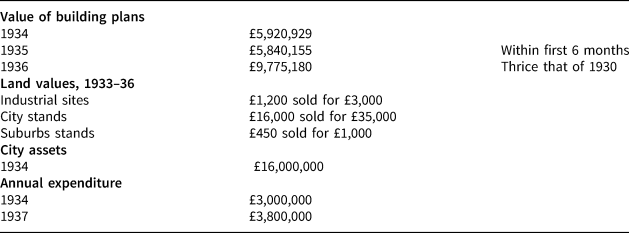
table 1

Table 1. An indication of Johannesburg's phenomenal economic growth in the mid-1930s

Source: Wits/WCL, Municipal Magazine, 17 (1934), 1; 18 (1934), 7; 18 (1935) 5, 11, 23; 19 (1936), 5, 7; and 20 (1937), 15.

Johannesburg thus became a city where there was plenty of money for such projects. Within this context, the further provision of swimming baths became possible, as the budget for 1930 reflected.88 However, this would take another few years to come to fruition and was realized only in two suburbs.89 A report laid before the council in June 1936 stated that because of the increase in the population in the north-western areas, the Mayfair swimming bath was inadequate. The upshot was that the council approved the construction of swimming baths in the Brixton and Melville suburbs.90

In Brixton, the land belonged to the council, which eased the pressure on its coffers significantly.91 However, this was not the case in Melville. The council had to purchase a site, of 7¾ acres for £285 per acre,92 for the construction of the proposed swimming bath. It would, however, take another three years to complete (see Figure 2).93 The Brixton and Melville projects wrapped up the council's major scheme of providing swimming baths.
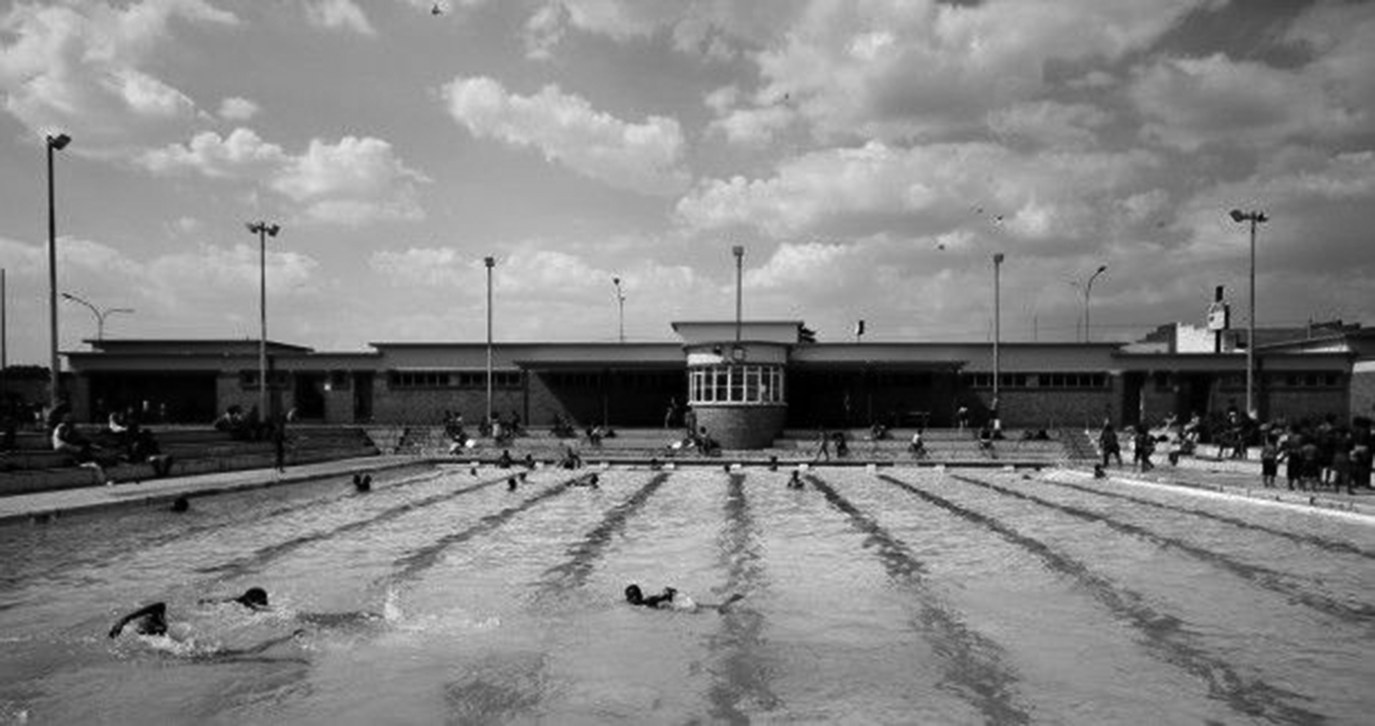
Brixton

Figure 2. Brixton swimming bath, reflecting Art Deco architectural style.

Design, construction and maintenance

The growth in aquatic sport and training, as well as recreational use of the baths, informed additional needs and demands for swimming baths in the 1930s. F.R. Long, president of the Association of Superintendents of Public Parks and Gardens, was well aware of the changing demands for parks and open spaces of the ‘leisured section’ of Johannesburg's ratepayers. Due to shorter working hours, leisure time and demand to spend these hours outdoors increased. Long acknowledged that ‘the phenomenal growth of our parks, open spaces and swimming baths has already caught us to some extent unawares…The ratepayers now also want their golf, bowls, tennis and bathing facilities.’94

The 1920s and 1930s can well be considered the most exciting era in swimming bath design.95 The popularization of swimming and of water polo as spectator sports had a marked effect on the design and accessorization of baths. New reinforced concrete construction and Art Deco style – that lent itself well to recreational architecture – ensured that swimming baths became an ‘iconic symbol of 1930s municipal glamour’.96 The purpose-built, open-air Tooting Bec Lido97 was representative of these modern ideas on hygiene, beauty of design, layout, comfort and recreation.98 In New York, no expenses were spared in the quality of the baths built during this time, ‘each pool turned out to be a “municipal marvel of the first magnitude”’.99 Although not as lavish, Johannesburg's swimming baths of the 1930s did not lag behind.

The council deliberately sanctioned additional funds for the layout of the grounds surrounding the swimming bath.100 A reporter of the Rand Daily Mail confirmed that, ‘Apart from the delights of the cool water, the baths are each year being made more attractive.’101 As sunbathing became increasingly popular, specific areas for this purpose now formed part of the layout.102 This replicated the New Brighton Lido, where a huge area was devoted to open benches and specific sunbathing zones, enabling people to develop ‘bronzed’ bodies.103

The director of the local Parks Department, D. Smith, in comparing these facilities with similar ones in England and Scotland, concluded that Johannesburg's baths were even better as few of the overseas baths, he claimed, had lawns, gardens and facilities for sunbathing.104 As form and function changed, the design, fabric and construction of baths adjusted accordingly.105 Clearly, the town engineer's recommendation that the best baths be constructed, conforming to international competitive standards, was adhered to.106 This was another attempt by the council to stake the city's claim as a ‘world class city’.

The amenities at the baths reflected a ‘differential architecture’ in two ways. First, there was a gendered differential, i.e. ‘male’ and ‘female’ sections. Secondly, separate changing cubicles (‘dressing boxes’) were installed around the bath's perimeter with clearly distinguishable private spaces. This resulted in what Crook describes rather quaintly as an ‘interplay of exposure and enclosure’.107 The amenities at the Wemmer Pan swimming bath, as well as subsequent baths, reflected both these requirements. With the introduction of mixed bathing,108 and the consequent need for more personal privacy, separate dressing cubicles were built for women and men. This planning had the additional advantage of ‘proper supervision’.109

One of the age-old problems in swimming bath management is water quality. Before the twentieth century, water quality was maintained through the so-called ‘fill and empty’ process. This meant that the baths were emptied on a Sunday and filled again on a Monday with fresh water. According to Bowker, this weekly water change meant that there were ‘fresh water days’ and ‘dirty water days’.110 As no other process was available at the time, this system was also implemented at the Ellis Park bath, necessitating the closure of the bath on a Sunday afternoon and the following Monday.111

By the late nineteenth century, the ‘germ theory’ and a growing corpus of bacteriological and chemical studies112 resulted in major technological advances in water purification, thus quelling concerns about ‘dirty water’.113 Furthermore, a system of recirculating to disinfect the water through filtration114 was developed.115 Well aware of the problem, Johannesburg's municipality installed such a water purifying system at the Ellis Park bath in October 1922, at a cost of £5,000.116 The introduction of chlorine in the 1930s was the final step in a process whereby baths brought hygiene to the masses. As a consequence, there was a rise in recreational swimming.

The Star quelled any doubts the public might have had, maintaining that the ‘water in which Johannesburg swimmers bathe is actually purer than drinking water’.117 Love's observation that ‘to bathe, wash or swim in clean water is an obvious antidote to contact with the dirt of contemporary urban life’118 rings true of Johannesburg, being afflicted by unhygienic air, often laden with mine dust. Throughout the 1920s and 1930s, a high standard of water quality seven days a week was maintained.119 This was another demonstration of the progress in new and modern technology of which Johannesburg was now part.

Furthermore, the council committed itself to frequent maintenance of the baths which were renovated and painted regularly.120 According to the Rand Daily Mail, few people realized the enormous amount of work necessary in maintaining the swimming baths. During the closed season, there were ‘armies’ of workmen busy with maintenance of the baths.121 This ensured that the baths were indeed an asset to the fabric of a respectable and modern city.

In 1928, the Ellis Park bath was earmarked for extensive modernizing in accordance with international requirements.122 Due to financial constraints,123 these improvements were only completed in 1938, but once completed did indeed include most of the envisioned improvements suggested in 1928.124 The new modernistic building now boasted, inter alia, a children's paddling pool, modern change cubicles, a three-tiered water cascade, an impressive fountain in the centre of an enlarged lawn and a special sunbathing porch, where ‘bathers and worshippers of “King Sol” may bask undisturbed’.125 Suntans, once derided in fashionable circles, ‘became a badge of health and glamour’, gaining momentum during the 1930s.126 This point did not escape Geo Neal Luntz. He linked the context of living in Johannesburg and the necessity for a swimming bath as follows: ‘In a climate such as ours…the hot weather enables bathers to remain much longer in the water, thus obtaining a double benefit from the exercise of swimming and for exposure to the sun – one of the great benefits of bathing.’127

Special attention was given to facilities for diving, the council approving a hefty £10,000 for a modern high-diving platform128 that complied with international regulations,129 making it possible for Ellis Park to host South African national and international diving events.130 A.C.C. St Norman, the superintendent of the baths, was astonished that the council had indeed been so successful in undertaking these extensive additions.131

According to Van Leeuwen, swimming baths ‘make an indispensable contribution to the reading of twentieth-century architectural modernism’,132 whilst Marino points out that they were seen as ‘grand gestures…demonstrating the municipal power of a progressive city’.133 When considering the attention to the layout, amenities, new water purification technologies and consciously ensuring that international standards were met, the same was true for Johannesburg's swimming baths as features of a modern city. In addition, a variety of the latest in modern durable materials were introduced into swimming bath construction either for the first time or in new ways. In a sense, the baths became modern, standard and commonplace at the same time. Smith had reason to believe that Johannesburg's swimmers had ‘as favourable and modern conditions as any in the world’.134 The fact that swimming baths were a very expensive item on the Parks and Recreation Department's budget underscores their importance to the council (see Table 2).135 Foster quotes Mitchell who situates the modern city as part of an ‘exhibitionary complex’, a product of bourgeois capitalism.136 The swimming baths were part of this complex, mirroring urban Johannesburg's modernity of the 1920s and 1930s.
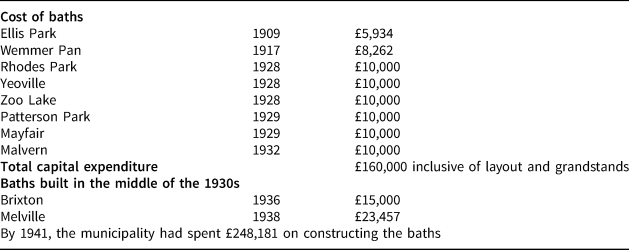
table 2

Table 2. Cost of building Johannesburg's swimming baths and an indication of rising prices

Sources: MO/Jhb/LL, MTC, 200th meeting 27 May 1908, 1224–7; 514th meeting 22 Jan. 1929, 36; 603th meeting 23 Jun. 1936, 822–3; 635th meeting, 28 Feb. 1939, 204; Wits/WCL/HP, AF 1913, JPLPC, file 447, RDM, 12 Aug. 1929, Star, 22 May 1930, Star, 18 Oct. 1938, Star, 30 Aug. 1941; file 513, RDM, 1 Sep. 1932; file 320, RDM, 10 Oct. 1932; file 452, RDM, 20 Nov. 1935, RDM, 4 Jul. 1936.

Bringing Johannesburg's swimming baths, and especially the Ellis Park bath, up to date with international standards137 was thus not incidental. Contextually, it was part of an elaborate project to showcase Johannesburg as a renowned, modern and international city, that reached its climax with Johannesburg's 1936 Empire Exhibition. Elaborate brochures from the Johannesburg Publicity Association and the Tourist Bureau of the South African Railways reflected, promoted and celebrated Johannesburg's ‘Metropiltan modernity’.138 The exhibition ‘was celebrating an urban modernity – the success of Johannesburg's progress’ frequently being described as a ‘wonder city’ or a ‘glorious new city’ on a grand scale.139 The modern swimming baths were thus one of the building blocks of the city's image and an important component of place-selling.140

Swimming lessons and training

By the late 1890s, the provision of swimming baths in most towns and cities in Britain meant that swimming was included in the school time table.141 Gradually, the necessity for more advanced training in swimming by professional trainers developed.142 In Johannesburg, even before the first swimming bath was built, the need for professional swimming instructors was acknowledged.143 The council appointed J. Hancock as the first municipal swimming instructor in 1931, thus making it possible for everyone to learn how to swim free of charge.

Five years later, realizing the importance of swimming lessons, the council appointed J.W. Harte, a well-known Olympic swimming coach from the United States, for two years at salary of £600 a year.144 Sue G. Womble145 congratulated the council on Harte's appointment, saying that his expertise was welcome because the bath superintendents were not as skilled in ‘the finer art of swimming’. For her, his appointment made sense as South Africa ranked very low in the world of swimming.146 By engaging Harte, the council hoped to popularize swimming and swimming competition, thus making full use of the swimming baths.147

Harte's coaching gave Johannesburg's swimmers, as well as swimming in South Africa, a major boost, resulting in 10 national records being broken in 1937 and placed South African swimmers and coaches on a par with their counterparts in other parts of the world.148 Johannesburg could now boast that its white swimmers could compete internationally and that its swimming baths matched international standards. This was another feather in its cap to its image as a modern progressive city.

Popularity

By 1924, the Ellis Park bath had already established its popularity among adults and children alike. So much so, that on Saturday afternoons and Sundays, the crowds caused considerable congestion.149 ‘Swimmer’ complained that Sundays were so crowded ‘that it is uncomfortable, not to say unpleasant bathing’.150 ‘Swimmer’ was indeed correct. For example, 1,600 people frequented the bath on one of the Sundays in March 1919,151 and on a Sunday in January 1927, ‘K.T.’ had to wait over an hour to get a booth because as many as 4,000 people ‘went into the water’.152 One Harry Melman looked at the positive side of the congestion, emphasizing that the swimming bath was ‘doing extremely well, as it is always crowded to the utmost’.153

In the 1930s, the municipal baths maintained their popularity, with many of the reports indicating that the baths were a major attraction and were usually crowded (see Table 3). For instance, the Star claimed that at the beginning of spring in September 1931, crowds flocked there to cool off not only on Sundays but in the late afternoons on other days.154 There were also large numbers of early swimmers who frequented the baths before breakfast.155 The swimming baths were becoming increasingly popular, reaching the 2 million mark for attendance during the 1946 season.156
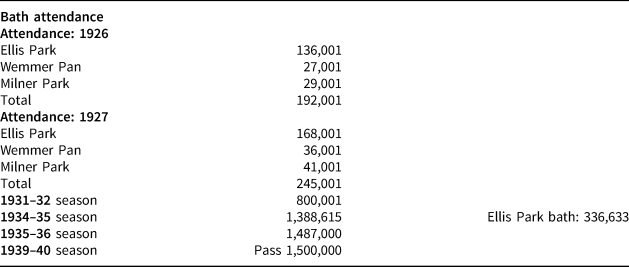
table 3

Table 3. Popularity of swimming baths, measured by growth in attendance

Source: Wits/WCL/HP, AF 1913, JPLPC, file 320, RDM, 4 Jan. 1928; file 513, RDM, 1 Sep. 1932, Star, 3 Sep. 1933, RDM, 1 Sep. 1943, RDM, 30 Aug. 1947; file 452, Star, 12 Nov. 1935, Star, 31 Aug. 1936; file 447, Star, 30 Aug. 1941; Wits/WCL, Municipal Magazine, 20 (1936), 11.

On the one hand, ‘going to the baths’ meant serious training for competitions while, on the other hand, the majority of patrons partook in the more quotidian forms of play – splashing, play fighting and flirting. The proximity and accessibility of the baths influenced the lifestyle of many: Saturdays and Sundays became ‘fun days’ for families.

Several factors contributed to the popularity of the swimming baths. From early on, the various swimming clubs,157 such as those run by Post Office and municipal staff, groups of ladies and many schools, ‘were the life-blood in maintaining the popularity of the baths’.158 Their regular patronage guaranteed the sustainability of the baths.159

Furthermore, petrol restrictions during World War II and consequent shortages contributed to these numbers. More people chose to visit the baths during the weekends than picnic in the country.160 A major debate raged in the 1930s over whether men should be allowed to wear trunks as swimwear. The council enforced a strict ban that was eventually lifted in the early 1940s. This did much to further increase the baths’ popularity.161

In assessing the popularity of the baths, the number of spectators should also be considered. The public enjoyed watching swimming galas,162 the numbers attending sometimes outstripping those actually using the bath. The baths evolved from being a place solely devoted to health, to one geared towards recreation, sport and, now, entertainment. For urban dwellers, it was an inexpensive amusement spectacle, somewhere that people could witness the abilities of talented professional swimmers. It became a convenient leisure activity and provided another opportunity for social integration. This was aided by the fact that the baths were designed as places for viewing and amusement as much as for swimming.163 Katzer's statement that ‘the stadium or whole ensembles of sports arenas, facilities and landscapes served as places of social transformation’164 comes to mind.

School galas, in particular, were very popular. The Melville bath is a case in point, being ‘the most popular bath in Johannesburg’.165 Its popularity with spectators increased as the bath was open on certain nights as well when the Swimming League gave demonstrations. Enthusiastic crowds attended competitive swimming such as the Transvaal Amateur Swimming championships held early in 1940.166 Gordon and Inglis remarked that, in Britain, ‘By tapping into the public's seemingly insatiable appetite for entertainment and sporting activity, baths…evolved into multi-purpose events venues.’ 167 This proved to be true for Johannesburg, as confirmed by the Ellis Park sport venue.

Conclusion

The growth in the number of swimming baths in the 1920s and 1930s was enabled by the rapid geographical expansion of the city and its economic growth – backed by mining and industrial development. Johannesburg's swimming baths reflected a divided society based on race, class and culture. Black Johannesburgers did not have access and all but three swimming baths were built in middle-class suburbs and steeped in an all-pervasive British ethos.

The council, as the main protagonist, comprising white English-speaking men, wielded enormous powers. Nevertheless, they had the well-being of the white residents at heart. The provision of services such as electricity, water and sanitation testified to that. Establishing leisure facilities turned out to be just as important. For example, by the 1920s, public parks had become a standard feature in Johannesburg's white suburbs.168 Swimming baths now became the prime focus adding another layer to the leisure facilities of these suburbs, changing the suburban landscape. Despite economic restrictions, especially in the late 1920s, the council was eager to drive the process and pushed ahead. Expenses on swimming baths comprised by far the main overhead of the city council's Parks and Recreation portfolio.

This was aided by the growing popularity of and interest in swimming and other aquatic sports. As such, the council had to take note of the pressure from suburban residential associations and sport clubs to build additional swimming baths. They fitted seamlessly into the council's plans and endeavours to modernize Johannesburg, mirroring modern designs, facilities, construction, standards and the implementation of new technologies similar to those in Britain and the United States. Accordingly, they became additional threads in a rapidly evolving modern urban tapestry which the council was eager to celebrate and showcase.

In addition to Johannesburg's parks, tennis courts and golf courses, swimming baths significantly added to the suburban landscape's leisure facilities. They indeed became, and henceforth remained, what Bale coins urban ‘sportscapes’.169 As residents were now close to the baths, they became very popular, frequented for competitive and recreational purposes. The council further invested in the swimming baths by making special arrangements to cater for the youth, such as providing coaching.

Doyle captured an emergent trend in urban studies by emphasizing that ‘the interaction of health and the environment is back on the agenda in a big way’.170 It is precisely in this relevant and topical area that the article sought to contribute.


References

1

On the use of nomenclature, whilst the secondary sources use the terms ‘lido’, ‘baths’ or ‘pool’, for this article, the term ‘baths’ was chosen as the primary sources used this term. They have all long been interchangeable.

2

R.E. Pick, ‘The development of baths and pools in America, 1800–1940, with emphasis on standards and practices for indoor pools, 1910–1940’, Cornell University Ph.D. thesis, 2010, 1.

3

  1. Van Leeuwen, The Springboard in the Pond: An Intimate History of the Swimming Pool(Boston, MA, 1998), 12.

4

  1. Wiltse, Contested Waters: A Social History of Swimming Pools in America(Chapel Hill, 2007).

5

  1. Love, A Social History of Swimming in England, 1800–1918: Splashing in the Serpentine(London, 2007).

6

Kozma, G., Teperics, K. and Radics, Z., ‘The changing role of sports in urban development: a case study of Debrecen (Hungary)’, International Journal of the History of Sport, 31 (2014), 1118CrossRefGoogle Scholar.

7

  1. Batstone, ‘Health and recreation: issues in the development of bathing and swimming, 1800–1970, with special reference to Birmingham and Thetford Norfolk’, University of Birmingham Ph.D. thesis, 2002; Kossuth, R.S., ‘Dangerous waters: Victorian decorum, swimmer safety, and the establishment of public bathing facilities in London (Canada)’, International Journal of the History of Sport, 22 (2005), 796–815CrossRefGoogle Scholar; Marino, G., ‘The emergence of municipal baths: hygiene, war and recreation in the development of swimming facilities’, Industrial Archaeology Review, 32 (2010), 35–45CrossRefGoogle Scholar; F.H. McLachlan, ‘Poolspace: a deconstruction and reconfiguration of public swimming pools’, University of Otago Ph.D. thesis, 2012; McShane, I., ‘The past and future of local swimming pools’, Journal of Australian Studies, 33 (2009), 195CrossRefGoogle Scholar; and Pick, ‘The development of baths and pools’, 1.

8

  1. Mbembe and S. Nuttall, ‘Writing the world from an African metropolis’, Public Culture, 16 (2004), 353.

9

Ibid., 356.

10

This is confirmed by the fact that the first swimming bath for black people was only built in 1936.

11

Parnell, S. and Mabin, A., ‘Rethinking urban South Africa’, Journal of Southern African Studies, 21 (1995), 39–62CrossRefGoogle Scholar.

12

Bickford-Smith, V., ‘Urban history in the new South Africa: continuity and innovation since the end of apartheid’, Urban History, 35 (2008), 300CrossRefGoogle Scholar; and Freund, B., ‘Urban history in South Africa’, South African Historical Journal, 52 (2005), 26CrossRefGoogle Scholar.

13

  1. Bickford-Smith, The Emergence of the South African Metropolis. Cities and Identities in the Twentieth Century(Cambridge, 2016), 8 and 19.

14

Gunn, S., ‘Class, identity and the urban: the middle class in England, c. 1790–1950’, Urban History, 31 (2004), 29CrossRefGoogle Scholar. Also see Lewis, R., ‘Comments on urban agency: relational space and intentionality’, Urban History, 44 (2017), 141–4CrossRefGoogle Scholar.

15

The suburb had become a significant object of study as confirmed by the recent work of Stone (D. Stone, ‘Suburbanization and cultural change: the case of club cricket in Surrey, 1870–1939’, Urban History, 44 (2017), 48). Also see M. Clapson, ‘The new suburban history, New Urbanism and the spaces in between’, Urban History, 43 (2016), 336–41.

16

Gunn, ‘Class, identity and the urban’, 39.

17

  1. Beavon, Johannesburg: The Making and Shaping of the City(Pretoria, 2004), 88–92. McManus and Etherigton repudiate the classic picture of the ‘bourgeois enclave’ (R. McManus, and P. Etherigton, ‘Suburbs in transition: new approaches to suburban history’, Urban History, 34 (2007), 317–18, 322). As indicated, however, this did not apply to Johannesburg where suburbs carried an exclusive race and class distinction.

18

  1. Bowker, ‘Parks and baths, sport recreation and municipal government and the working class in Ashton-under-Lyne between the wars’, in R. Holt (ed.), Sport and the Working Class in Modern Britain(Manchester, 1990), 84.

19

McShane, ‘The past and future of local swimming pools’, 195; and N. Katzer, ‘Introduction: sports stadia and modern urbanism’, Urban History, 37 (2010), 249.

20

B.M. Doyle, ‘A decade of urban history: Ashgate's Historical Urban Studies series’, Urban History, 36 (2009), 501–2, 505.

21

  1. Couperus, ‘Research in urban history: recent theses on nineteenth- and early twentieth-century municipal administration’, Urban History, 37 (2010), 322.

22

  1. Robinson and P. Taylor, ‘The performance of local authority sports halls and swimming pools in England’, Managing Leisure, 8 (2003), 1.

23

  1. Love, ‘Local aquatic empires: the municipal provision of swimming pools in England, 1828–1918’, International Journal of the History of Sport, 24 (2007), 620; and C. Love, ‘Holborn, Lambeth and Manchester: three case studies in municipal swimming pool provision’, International Journal of the History of Sport, 24 (2007), 630–42.

24

McShane, ‘The past and future of local swimming pools’, 195.

25

  1. Brooks and P. Harrison, ‘A slice of modernity: planning for the city and the country in Britain and Natal, 1900–1950’, South African Geographical Journal, 80 (1998), 93–100; and D. Scott, ‘“Creative destruction”: early modernist planning in the south Durban industrial zone, South Africa’, Journal of Southern African Studies, 29 (2003), 235–59.

26

Bickford-Smith, The Emergence, 79.

27

  1. Frisby, Cityscapes of Modernity: Critical Explorations(Cambridge, 2001), 161.

28

Mbembe and Nuttall, ‘Writing the world’, 361.

29

C.M. Chipkin, Johannesburg Style: Architecture and Society, 1880s–1960s (Cape Town, 1993), 10.

30

P.J. Larkham and K.D. Lilley, ‘Plans, planners and city images: place promotion and civic boosterism in British reconstruction planning’, Urban History, 30 (2003), 184; C.W.J. Withers, ‘Place and the ‘‘spatial turn’’ in geography and in history’, Journal of the History of Ideas, 70 (2009), 638. For South African cities, see Bickford-Smith, The Emergence, 131.

31

Van Leeuwen, The Springboard in the Pond, 12.

32

  1. Hyslop, ‘The imperial working class makes itself “white”: white labourism in Britain, Australia, and South Africa before the First World War’, Journal of Historical Sociology, 12 (1999), 398–421.

33

J.R. Shorten, Die Verhaal van Johannesburg (Johannesburg, 1966), 358.

34

C.M. Chipkin, Johannesburg Transition: Architecture and Society from 1950 (Newtown, 2008), 99.

35

Beavon, Johannesburg, 93 and 110. See Bickford-Smith for the growth in gold production. Bickford-Smith, The Emergence, 30.

36

  1. Foster, ‘The wilds and the township: articulating modernity, capital, and socio-nature in the cityscape of pre-apartheid Johannesburg’, Journal of the Society of Architectural Historians, 71 (2012), 43. In considering how to achieve greater urban order and improvement, municipalities constantly drew on ideas and practices from abroad. These informed initiatives like provision of recreational space. Bickford-Smith, The Emergence, 155.

37

G.-M. Van der Waal, From Mining Camp to Metropolis: The Buildings of Johannesburg, 18861940 (Melville, 1986), 168; and M. Latilla, Johannesburg: Then and Now (Cape Town, 2018), 73 and 29.

38

Van der Waal, From Mining Camp to Metropolis, 171–2.

39

Chipkin, Johannesburg Style, 90; and Bickford-Smith, The Emergence, 189.

40

  1. Van Rensburg, Johannesburg. Eenhonderd Jaar(Johannesburg, 1986), 53, 58, 59, 168, 177, 187.

41

In 1936, there were 230,566 (or 40.7 per cent) Afrikaans-speakers and 290,853 (or 51.4 per cent) English-speakers in Johannesburg, thus confirming the continued dominance of British political, social and cultural power in the city (E.L.P. Stals, Afrikaners in die Goudstad, Deel 2, 19241961 (Pretoria, 1986), 11).

42

J.P.R. Maud, City Government: The Johannesburg Experiment (Oxford, 1938), 149. For a more extensive discussion of sport and recreational facilities for blacks, see A.G. Cobley, The Rules of the Game: Struggles in Black Recreation and Social Welfare Policy in South Africa, Contributions in Afro-American and African Studies, 182 (Greenwood, 1997), 27–30; and C.M. Badenhorst, ‘Mines, missionaries and the municipality: organised African sport and recreation in Johannesburg c. 1920–1950 (Ann Arbor, 1994).

43

  1. Lambert, ‘South African British? Or Dominion South Africans? The evolution of an identity in the 1910s and 1920s’, South African Historical Journal, 43 (2000); J. Lambert, ‘“An unknown people”: reconstructing British South African identity’, Journal of Imperial and Commonwealth History, 37 (2009), 604; and Bickford-Smith, The Emergence, 8, 19, 69, 76.

44

  1. Love, ‘“Taking a refreshing dip”: health, cleanliness and the empire’, International Journal of the History of Sport, 24 (2007), 704.

45

  1. Harrison and T. Zack, ‘Between the ordinary and the extraordinary: socio-spatial transformations in the “old south” of Johannesburg’, South African Geographical Journal, 96 (2014), 184.

46

Beavon, Johannesburg, 88, 110, 117; and Stals, Afrikaners in die Goudstad, 19–20, 22.

47

Maud, City Government, 162.

48

Stals, Afrikaners in die Goudstad, 14, 50, 108, 148.

49

Bickford-Smith, The Emergence, 12, 155. Pick observed a similar phenomenon for American cities. Pick, ‘The development of baths and pools’, 36.

50

Maud, City Government, 111.

51

  1. Grundlingh, ‘“Parks in the veld”: the Johannesburg Town Council's efforts to create leisure parks, 1900s–1920s’, Journal of Cultural History, 26 (2012), 83–105; L. Grundlingh, ‘“Imported intact from Britain and reflecting elements of empire”: Joubert Park, Johannesburg as a leisure space, c. 1890s–1930s’, South African Journal of Art History, 30 (2015), 94–118; L. Grundlingh, ‘Transforming a waste land to a world class sporting arena – the case of Elllis Park Johannesburg 1900–1930s’, Historia, 62 (2017), 27–45; and L. Grundlingh, ‘“In Johannesburg, baths are a necessity, not a luxury.” The establishment of Johannesburg's first municipal swimming bath, 1900s–1910s’, New Contree, 81 (2018), 1–26.

52

Shorten, Die Verhaal van Johannesburg, 653; and Van der Waal, From Mining Camp to Metropolis, 216.

53

Capital expenditure rose from £221,599 in 1926/27 and passed a million pounds in 1930/31. Maud, City Government, 85.

54

Bickford-Smith, The Emergence, 12.

55

Nearby municipalities, such as Germiston and Benoni, already had swimming baths and regularly hosted swimming and water polo competitions. Similar competitions took place at swimming baths at the mines. Readex Newsbank, Rand Daily Mail, 23 Feb. 1903, 14 Mar., 14 and 28 Dec. 1904.

56

  1. Glassberg, ‘The design of reform: the public bath movement in America’, American Studies, 20 (1979), 19; I. Gordon and S. Inglis, Great Lengths: The Historic Indoor Swimming Pool of Britain(Swindon, 2009), 12, 51, 173; and J. Smith, Liquid Assets: The Lido and Open Air Swimming Pools of Britain(London, 2005), 19.

57

Shorten, Die Verhaal van Johannesburg, 350.

58

University of the Witwatersrand, William Cullen Library, Historical Papers (Wits/WCL/HP), AF 1913, Johannesburg Public Library Paper Clippings (JPLPC), file 320, Rand Daily Mail (RDM), 26 Dec. 1921.

59

D.J. Ellis, ‘Pavement politics: community action in Leeds, c. 1960–1990’, University of York Ph.D. thesis, 2015, 7–26.

60

Pick, ‘The development of baths and pools’, 33; and Bowker, ‘Parks and baths’, 86.

61

The pan was south of a major mining complex and was also known as Pioneer Park. See G.H.T. Hart, ‘An introduction to the anatomy of Johannesburg's southern suburbs’, South African Geographical Journal, 50 (1968), 65–72, for a description of this area.

62

Municipal Offices, Johannesburg, Law Library, minutes of the town council (MO/Jhb/LL, MTC), 349th meeting, 2 Nov. 1917, 613. As a result of World War I, the plan was postponed.

63

Wits/WCL/HP, AF 1913, JPLPC, file 320, Star, 25 Jan. 1920.

64

MO/Jhb/LL, MTC, 395th meeting, 12 Oct. 1920, 727. By now, Afrikaans-speaker working-class families also settled in the southern suburbs such as Forest Hill, La Rochelle and Turffontein with Jews and Portuguese. The area thus represented a cosmopolitan character. Stals, Afrikaners in die Goudstad, 21.

65

Wits/WCL/HP, AF 1913, JPLPC, file 320, Star, 5 Jan. 1920.

66

This was a substantial amount, being more or less £650,000 in today's terms.

67

Shorten, Die Verhaal van Johannesburg, 652. Noteworthy is the fact that, due to earlier property development, the council barely ‘owned’ any land. Maud, City Government, 263. Consequently, obtaining land for recreational purposes became a costly affair.

68

Wits/WCL/HP, AF 1913, JPLPC, file 320, RDM, 28 Dec. 1921.

69

Wits/WCL/HP, AF 1913, JPLPC, file 320, Star, 22 Nov. 1921.

70

Wits/WCL/HP, AF 1913, JPLPC, file 320, Star, 4 Apr. 1922.

71

Shorten, Die Verhaal van Johannesburg, 895.

72

After 1994, the Transvaal Province was divided into four provinces: Gauteng, North-West, Limpopo and Mpumalanga.

73

He was administrator of the Transvaal from 1924 to 1929.

74

Wits/WCL/HP, AF 1913, JPLPC, file 320, RDM, 8 Jul. 1927. The previous year, the Parks and Estates Committee only received £7,000, which was £20,000 short of the budget (Wits/WCL/HP, AF 1913, JPLPC, file 320, RDM, 26 Jul. 1927).

75

Maud, City Government, 290.

76

Wits/WCL/HP, AF 1913, JPLPC, file 320, RDM, 8 Jul. 1927. The city's white residents were fairly healthy. The death rate amongst the city's white residents was 10 per 1,000. Address by the medical health officer of Johannesburg, Dr Charles Porter, 2 Feb. 1925. Wits/ WCL/ HP, A3023, S. Parnell Papers, 1906–99, A2, Municipal Magazine, Aug. 1925, 17b. This figure remained steady between 1923 and 1936. In contrast, the death rate amongst blacks fluctuated between 17 and 23 per 1,000. Bickford-Smith, The Emergence, 186.

77

Zoo Lake bath served the Parkview, Parktown North, Parkwood, Rosebank and Melrose suburbs (MO/Jhb/LL, MTC, 504th meeting, 27 Mar. 1928, 170), Rhodes Park bath the Kensington suburb and Patterson Park bath the Orange Grove and Norwood suburbs (MO/Jhb/LL, MTC, 510th meeting, 25 Sep. 1928, 755).

78

Wits/WCL/HP, AF 1913, JPLPC, file 320, Star, 25 Jan. 1928.

79

M.O. Hannikainen, ‘Sport in London's public green spaces in the inter-war years’, Sport in History, 38 (2018), 331–64.

80

Grundlingh, ‘Transforming a waste land’, 27–45.

81

MO/Jhb,LL, MTC, 518th meeting, 28 May 1929, 447–8.

82

Maud, City Government, 149 and 352.

83

MO/Jhb/LL, MTC, 514th meeting, 22 Jan. 1929, 36.

84

F.S. Parnell, ‘Council housing provision for whites in Johannesburg, 1920–1955’, University of the Witwatersrand, MA thesis, 1987, 38.

85

MO/Jhb/LL, MTC, 534th meeting, 25 Sep. 1930, 820.

86

Wits/WCL/HP, AF 1913, JPLPC, file 513, RDM, 1 Sep. 1932.

87

Wits/WCL/HP, AF 1913, JPLPC, file 513, RDM, 1 Sep. 1931. To put this into perspective, to only run and maintain the swimming bath at Ashton-under-Lyne came to £80,000 during the inter-war years, an amount Bowker described as ‘costly’. Bowker, ‘Parks and baths’, 85.

88

Shorten, Die Verhaal van Johannesburg, 535–6.

89

It is not clear why more swimming baths were not built during the initial period of prosperity in the mid-1930s. Van der Waal is of the opinion that it was perhaps ‘due to a diminished social awareness during the prosperous years’. Van der Waal, From Mining Camp to Metropolis, 216.

90

MO/Jhb/LL, MTC, 603th meeting, 23 Jun. 1936, 822–3. Johannesburg's white population doubled from 250,000 to half a million between 1932 and 1937. Wits/WCL, Municipal Magazine, 20 (1937), 15.

91

Wits/WCL/HP, AF 1913, JPLPC, file 452, RDM, 20 Nov. 1935.

92

MO/Jhb/LL, MTC, special meeting, 6 Oct. 1936, 1238. This was decidedly more than the £50 per acre paid for the Mayfair bath.

93

MO/Jhb/LL, MTC, 644th meeting, 21 Nov. 1939, 1531.

94

Wits/WCL, Municipal Magazine, 19 (1936), 13–15. Wiltse makes a similar point regarding America. Wiltse, Contested Waters, 93.

95

Gordon and Inglis, Great Lengths, 175.

96

  1. Pussard, ‘Historicising the spaces of leisure: open-air swimming and the lido movement in England’, World Leisure Journal, 49 (2007), 180.

97

Lidos, apart from the swimming bath, included cafes, fountains, ballrooms and sunbathing terraces. Pussard, ‘Historicising the spaces of leisure’, 181; and K. Worpole, Here Comes the Sun: Architecture and Public Space in Twentieth Century European Culture (London, 2000), 113.

98

For a detailed discussion of British baths, see Smith, Liquid Assets.

99

  1. Adiv, ‘Paidia meets Ludus: New York City municipal pools and the infrastructure of play’, Social Science History, 39 (2015), 437.

100

MO/Jhb/LL, MTC, 521st meeting, 27 Aug. 1929, 704, and MO/Jhb/LL, MTC, 526th meeting, 25 Jan. 1930.

101

Wits/WCL/HP, AF 1913, JPLPC, file 513, RDM, 1 Sep. 1931.

102

MO/Jhb/LL, MTC, 580th meeting, 24 Jul. 1934, 813.

103

Marino, ‘The emergence of municipal baths’, 41.

104

Wits/WCL/HP, AF 1913, JPLPC, file 513, Star, 31 Oct. 1934, and Wits/WCL, HP, AF 1913, JPLPC, file 447, Star, 3 Sep. 1938. In America, bath design also catered for leisure spaces. Hence, ‘lounging, sunbathing, and socializing became quintessential pool activities’. Wiltse, Contested Waters, 88, 99.

105

Marino, ‘The emergence of municipal baths’, 39; and C. Parker, ‘Improving the “condition” of the people: the health of Britain and the provision of public baths 1840–1870’, Sports Historian, 20 (2000), 36.

106

The baths were all constructed with concrete walls, lined on the sides with glazed tiles and the bottom of concrete blocks. MO/Jhb/LL, MTC, 398th meeting, 21 Jan. 1921, 46.

107

  1. Crook, ‘“Schools for the moral training of the people”: public baths, liberalism and the promotion of cleanliness in Victorian Britain’, European Review of History: Revue européenne d'histoire, 13 (2006), 31, 38. Also see Kossuth, ‘Dangerous waters’, 807; and H. Eichberg, ‘The enclosure of the body. On the historical relativity of health, nature and the environment of sport’, Journal of Contemporary History, 21 (1986), 110.

108

In Johannesburg, mixed bathing became common practice as early as 1914. The only exception was that Friday afternoons were exclusively for women and Sundays for men. MO/Jhb/LL, MTC, 297th meeting, 24 Apr. 1914, 217. This was in sharp contrast to the United Kingdom where many baths set aside just a few hours per week for women. A.C. Parker, ‘An urban historical perspective: swimming a recreational and competitive pursuit 1840 to 1914’, University of Stirling, Ph.D. thesis, 2003, 107–8.

109

MO/Jhb/LL, MTC, 395th meeting, 12 Oct. 1920, 727.

110

Bowker, ‘Parks and baths’, 87. Hayes confirms that the early baths were indeed known for their ‘dirty water’. W. Hayes, ‘The professional swimmer, 1860–1880s’, Sports Historian, 22 (2002), 137.

111

Grundlingh, ‘Transforming a waste land’, 20.

112

Pick, ‘The development of baths and pools’, 57. Also see M.T. Williams, Washing ‘The Great Unwashed’: Public Baths in Urban America (Columbus, 1991), 129.

113

Love, ‘“Taking a refreshing dip”’, 701–2.

114

It was known as the Turnover System and was supplied by the Turnover Filter Co. of Belfast.

115

Batstone, ‘Health and recreation’, 111.

116

Wits/WCL/ HP, AF 1913, JPLPC, file 320, RDM, 27 Oct. 1922.

117

Wits/WCL/HP, AF 1913, JPLPC, file 513, Star, 23 Aug. 1923. In America, the poor image of swimming bath water was fought with campaigns, advertising the magic of modern filtering techniques with the slogan ‘Some people drink filtered water. We bathe in it.’ Van Leeuwen, The Springboard in the Pond, 46.

118

Love, ‘“Taking a refreshing dip”’, 694.

119

Wits/WCL/HP, AF 1913, JPLPC, file 452, RDM, 1 Sep. 1937.

120

MO/Jhb/LL, MTC, 525th meeting, 17 Dec. 1929, 1056; Wits/WCL/HP, AF 1913, JPLPC, file 452, RDM, 31 Aug. 1936; Wits/WCL/ HP, AF 1913, JPLPC, file 447, Star, 3 Sep. 1938; and Wits/WCL/ HP, AF 1913, JPLPC, file 307, RDM, 22 Aug. 1940.

121

Wits/WCL/HP, AF 1913, JPLPC, file 452, RDM, 1 Sep. 1937; and Wits/WCL/HP, AF 1913, JPLPC, file 447, RDM31 Aug. 1938.

122

Wits/WCL/HP, AF 1913, JPLPC, file 320, RDM, 4 Jan. 1928.

123

Wits/WCL, Municipal Magazine, 18 (1935), 11.

124

Wits/WCL/HP, AF 1913, JPLPC, file 452, RDM, 4 Jul. 1936; and Wits/WCL/HP, AF 1913, JPLPC, file 452, Star, letter from ‘Patron’, 11 Sep. 1937.

125

Wits/WCL/HP, AF 1913, JPLPC, file 447, Star, 12 Jan. 1938; and Wits/WCL/HP, AF 1913, JPLPC, file 447, RDM, 26 Aug. 1938.

126

Gordon and Inglis, Great Lengths, 170.

127

Wits/WCL/HP, AF 1913, JPLPC, file 447, RDM, 9 Aug. 1917.

128

Wits/WCL/HP, AF 1913, JPLPC, file 452, RDM, 4 Jul. 1936.

129

By this time, all swimming baths had diving platforms as standard equipment. Marino, ‘The emergence of municipal baths’, 41; and Smith, Liquid Assets, 35.

130

Wits/WCL/HP, AF 1913, JPLPC, file 447, RDM, 17 Sep. 1937. Worpole points out that the ‘cult of diving’ reached its apotheosis between the wars, epitomized in Riefenstahl's film made of the 1936 Olympic Games, where the diving sequences astonished cinema audiences by their breath-taking risks and beauty. Worpole, Here Comes the Sun, 120.

131

Wits/WCL/HP, AF 1913, JPLPC, file 447, RDM, 26 Aug. 1938.

132

Van Leeuwen, The Springboard in the Pond, 31.

133

Marino, ‘The emergence of municipal baths’, 35–6.

134

Wits/WCL/HP, AF 1913, JPLPC, file 513, Star, 31 Oct. 1934.

135

Van der Waal, From Mining Camp to Metropolis, 216.

136

Foster, ‘The wilds’, 45.

137

According to Smith, cities wished to design structures, such as swimming baths, that were in keeping with the architecture and scale of their European counterparts. A. Smith, ‘Pool life’, Building, 268 (2003), 16, as quoted in Pussard, ‘Historicising the spaces of leisure’, 180. Also see Pick, ‘The development of baths and pools’, 57.

138

These positive representations only reflected the self-confidence and respectability of Johannesburg's anglophile urban elites. There was little promotional material before the 1920s. The initial image of Johannesburg was that of a coarse and tough mining town. The idea of ‘progress’ – as defined by ‘Britishness’ – was moot as Johannesburg was frequently depicted as a ‘New Babylon’. A concerted effort to change this image occurred in 1925 with the establishment of publicity associations. Bickford-Smith, The Emergence, 13, 14, 132, 158, 171.

139

Robinson, J., ‘Johannesburg's 1936 Empire Exhibition: interaction, segregation and modernity in a South African city’, Journal of Southern African Studies, 29 (2003), 761CrossRefGoogle Scholar.

140

See Bickford-Smith on place-selling, The Emergence, 162.

141

Love, C., ‘State schools, swimming and physical training’, International Journal of the History of Sport, 24 (2007), 665Google Scholar.

142

Myerscough, K., ‘Nymphs, naiads and natation’, International Journal of the History of Sport, 29 (2012), 1914CrossRefGoogle Scholar; C. Parker, ‘The rise of competitive swimming’, 56–7; and Day, D., ‘London swimming professors: Victorian craftsmen and aquatic entrepreneurs’, Sport in History, 30 (2010), 32–54CrossRefGoogle Scholar.

143

Wits/WCL/HP, AF 1913, JPLPC, file 447, letter from E.J.L.P., Leader, 26 Nov. 1909.

144

Wits/WCL/HP, AF 1913, JPLPC, file 452, Star, 30 Nov. 1937.

145

She was a former Transvaal diving champion as well as a University of the Witwatersrand swimming champion.

146

Wits/WCL/HP, AF 1913, JPLPC, file 452, letter from Sue G. Womble, RDM, 29 Sep. 1937.

147

Wits/WCL/HP, AF 1913, JPLPC, file 452, RDM, 9 Sep. 1937.

148

Wits/WCL/HP, AF 1913, JPLPC, file 452, letter from A. Crewe, honorary secretary, Johannesburg Schools’ Amateur Swimming Association, RDM, 7 Oct. 1937.

149

Wits/WCL/HP, AF 1913, JPLPC, file 447, RDM, 26 Dec. 1921; and Wits/WCL/HP, AF 1913, JPLPC file 498, Star, 6 Dec. 1924.

150

Wits/WCL/HP, AF 1913, JPLPC, file 447, letter from ‘Swimmer’, Star, 4 Feb. 1919.

151

Wits/WCL/HP, AF 1913, JPLPC, file 447, RDM, 22 Mar. 1919.

152

Wits/WCL/HP, AF 1913, JPLPC, file 320, letter from ‘K.T.’, RDM, 21 Jan. 1927.

153

Wits/WCL/HP, AF 1913, JPLPC, file 498, letter from Harry Melman, Star 6 Dec. 1924. The overcrowding might not have been a surprise as, according to the South African Official Year Book covering the period 1910–25 (UG 8–25), Johannesburg's total white population in 1921 was 151,836. Parnell, ‘Council housing provision’, 16.

154

It should be kept in mind that Johannesburg is land-locked and the summers can be quite hot. There are no large rivers or lakes in which to cool off. The nearest beach is in Durban, 600 kilometres from Johannesburg. Gosseye and Hampson confirmed that the hot climate of Queensland likewise made swimming very popular (J. Gosseye and G. Hampson, ‘“Queensland making a splash”: memorial pools and the body politics of reconstruction’, Queensland Review, 23 (2016), 181). This was not surprising as they share more or less the same latitudinal zone.

155

Wits/WCL/HP, AF 1913, JPLPC, file 513, Star, 30 Oct. 1931; and Wits/WCL/HP, AF 1913, JPLPC, file 513, Star, Nov. 1933.

156

Wits/WCL/HP, AF 1913, JPLPC, file 513, RDM, 30 Aug. 1947.

157

See Batstone for the important role played by swimming clubs to popularize swimming and hence the popularity of the baths. Batstone, ‘Health and recreation’, 190.

158

Wits/WCL/HP, AF 1913, JPLPC, file 447, RDM, 23 Jan. 1909.

159

Wits/WCL/HP, AF 1913, JPLPC, file 320, RDM, 26 Dec. 1921.

160

Wits/WCL/HP, AF 1913, JPLPC, file 513, RDM, 1 Sep. 1943; and Wits/WCL/HP, AF 1913, JPLPC, file 513, RDM, 31 Aug. 1944.

161

Wits/WCL/HP, AF 1913, JPLPC, file 513, RDM, 31 Aug. 1944.

162

Swimming and other aquatic sports became a popular spectator culture. McShane, ‘The past and future of local swimming pools’, 197.

163

Smith, Liquid Assets, 45; Love, ‘Holborn, Lambeth and Manchester’, 636; and Gordon and Inglis, Great Lengths, 60.

164

Katzer, ‘Introduction: sports stadia’, 252.

165

Wits/WCL/HP, AF 1913, JPLPC, file 447, RDM, 27 Jan. 1940.

166

Wits/WCL/HP, AF 1913, JPLPC, file 447, RDM, 27 Jan. 1940.

167

Gordon and Inglis, Great Lengths, 51.

168

Grundlingh, ‘“Parks in the veld”’, 105.

169

  1. Bale, Sport and Geography, 2nd edn (London, 2003), 4.

170

Doyle, ‘A decade of urban history’, 507.

https://www.cambridge.org/core/journals/urban-history/article/municipal-modernity-the-politics-of-leisure-and-johannesburgs-swimming-baths-1920s-to-1930s/4C3B864BE0DDF1AF2437319219FBD81C#fn55 

Transforming a wasteland to a premium sporting arena: The case of Ellis Park, Johannesburg, 1900s-1930s

GRUNDLINGH, Louis.

Historia [online]. 2017, vol.62, n.2, pp.27-45. ISSN 2309-8392.  https://doi.org/10.17159/2309-8392/2017/v62n2a2.

Read the full article here


ABSTRACT

One of the aims of Johannesburg's British-controlled town council after the South African War (1899-1902) was to provide open public leisure spaces for its white citizens. The establishment and development of Ellis Park as a major sports centre was one of these endeavours.

In 1908 the council bought disused land in New Doornfontein, taking the first step towards achieving this grand vision, namely the construction of a swimming bath that met all the requirements for an international tournament. The First World War interrupted any further development, but the 1920s witnessed impressive expansion to include tennis courts, cricket pitches and rugby football grounds. By the end of the 1920s, the council and the Transvaal Rugby Football Union which was a key stakeholder in the development, could proudly claim that they had achieved their dream of establishing an international sports arena for Johannesburg. Ellis Park became a significant urban marker, a symbol of prestige for the fast-growing city, as well as in the transformation of Johannesburg's urban fabric into a modern city.

Transforming a wasteland to a premium sporting arena: The case of Ellis Park, Johannesburg, 1900s-1930s

Louis Grundlingh Professor in the department of Historical Studies at the University of Johannesburg

Introduction

After the discovery of gold in 1886, a mining camp was established with no intent of any later development into a town, let alone a city. However, mass migration to the lucrative gold fields soon took off. It became clear that Johannesburg would indeed become a permanent settlement.

This population increase prompted the government of the Zuid-Afrikaansche Republiek (South African Republic) to provide proper town planning. The town surveyor decided on a grid system of small blocks and small stands. The reasoning was to earn as much revenue as possible for the government because rent had to be paid for the stands. This layout limited any provision for urban open spaces. As a result the only significant open spaces that featured in the 1887 plan was the market square.

Until 1902, Johannesburg did not have a town council (hereafter, council). However, at the end of the South African War in 1902, the situation changed. The British government under the leadership of Lord Alfred Milner, took over the administration of Johannesburg from military control and set up an effective municipality, based mainly on the British model. As part of its post-war reconstruction agenda the town council seamlessly integrated British ideas into their vision of Johannesburg's further development. Consequently, it embarked on the provision of proper public services to the fledgling town, such as infrastructure, town planning and the provision of water, electricity and transport. This was in line with the requirements of an early 2Oth-century "garden city", where these services were seen as essential.

Very little academic research has been done thus far on Johannesburg's open spaces and particularly their development into major sport venues. This paper aims to rectify this by investigating the history of Ellis Park. Ellis Park is exceptional in four ways. It never really had the characteristics of a traditional "park". It is one of the first areas in Johannesburg developed on the grounds of an early reservoir which fell into disuse. The initial aim was to develop the grounds into a lake for recreational boating. Lastly, from 1905 to the 1930s the grounds were transformed into one of South Africa's most famous fully-fledged sport arenas.

This article argues that it was especially health consciousness amongst Johannesburg's white residents, as well as the prestige of having an open space for first-class sport facilities within the context of the "modern city" movement, that prompted this development. The essay further investigates the considerations leading to the council's decision to make this huge investment, as well as the major role of the Transvaal Rugby Football Union (TRFU) in the later development of Ellis Park. Lastly, the essay describes the physical changes to provide for a wide range of sporting activities such as athletics, tennis, rugby and swimming. This essay does not purport to follow a "history from below" approach, but rather it investigates the roles of the politically powerful, i.e. Johannesburg's town council and the sport administrators.

Four factors made it possible to develop Johannesburg into a "modern" city. Because of the huge profits from the gold mines, a wealthy urban white elite, the so-called Randlords, or mining magnates, settled and invested in the city. Secondly, there was a strong political will. Thirdly, by the 1900s, population increase amongst whites in the inner-city, noise and pollution led to the outward expansion into the suburbs. Fourthly, as mentioned, the council was ideologically aligned with its counterparts in Britain and subscribed to the British mindset on the necessity of open urban spaces. This meant that the council ear-marked a number of open spaces for development into public parks for play, relaxation and organised sport. The history of urban open spaces and their value, reflects these diverse functions. In Johannesburg, Ellis Park was a case in point.

**Dust from the mine dumps often made outdoor activities unpleasant. Ironically, though, with moderate weather eight months of the year, Johannesburg's climatic conditions favoured outdoor sport activity. Even though some summer days could be warm to hot, often a late afternoon thunderstorm provided welcome relief. Supported by excellent weather, Johannesburg's rapid population growth, and the growing awareness of the advantages of a healthy lifestyle, set the scene for outdoor activities such as tennis, boating, cycling and swimming. The initial incentive was indeed the need for a municipal swimming pool, which had been considered from time to time by the council from as early as 1904.

The next step was to locate a site for the establishment of Ellis Park. Initially, considerations such as the lack of a cheap water supply, capital funds for a swimming pool as well as high prices for land, kept the start of the project in abeyance. There was, however, land on which two disused open reservoirs and the Doornfontein brickfields were situated - a "sort of no-man's land" of shacks and hovels occupied by Coloured washerwomen and black people. This land, between North Park Lane and Eryn Street to the north/north-west; Bertrams Road to the east and South Park Lane and Reservoir Street to the south in New Doornfontein, belonged to the Rand Water Board and the Johannesburg Waterworks Estate and Exploration Company.

A major asset of the grounds was the borehole, at the time the main source of water for the neighbourhood. The reservoir site comprised 25 acres (10 ha) and had become derelict by the turn of the 19th century. In 1908, the council bought the Rand Water Board's lease for £2 500 and paid £500 to the Johannesburg Estates Company for a further 7 acres (2,8 ha) adjoining the reservoir site. With J.D. Ellis as the driving force, and instrumental in conceiving and converting the neglected site into a playing ground, the council embarked on a comprehensive reclamation scheme with a "grand vision" of an all-encompassing sports centre for Johannesburg.

One of the first developments towards developing the park into a sports ground was the adaptation of the old storage dam into an artificial lake to be used for boating. Tenders were invited for the right to hire out small boats. The tender was awarded to S.M. Hershfield for 12 months at £20 a month. Hershfield did not have the sole right of boats on the lake because permission was also granted to private persons to have boats, provided they did not compete with his business. When the contract expired the next year, the only tender was that of J. Goodman at £10 per month which the council approved.

Despite the financial losses, it seems the lake would remain a permanent feature in the development of Ellis Park. In August 1910 the town council approved expenditure for the building of a pathway around the lake because the nature of the embankment around the lake was considered dangerous as children might fall into the water. The expenditure would be £974, which was a substantial amount at the time. Even as late as March 1912, the council confirmed its contract with Messrs Bagguley and Stephens "for the completion of the Lake in Ellis Park and the excavation and removal of soil from the Park". Nevertheless, it seems that nothing came of this plan. The council still maintained its vision to provide for recreation by developing the grounds into rugby football fields, tennis courts, cricket grounds and a swimming pool. At the end of 1908, a report in the Rand Daily Mail noted: "Ellis Park", the thirty acres of town pleasure ground so attractively nestling between the thickly populated sides of the Doornfontein and Fairview Hills, is gradually evolving from the unsightliness of the donga stage."

Swimming bath

The first step towards the "grand vision" was the construction of a swimming bath that would become a central feature. The decision to build the bath was not taken on a whim. By then the council had already received inquiries from numerous sports clubs to lease portions of ground in Ellis Park for tennis and racquet courts, croquet lawns, football grounds, an ice skating rink and an entertainment hall.

A Mr Dowsett, of the municipality's architectural branch and a water "fanatic" was tasked to oversee the building. A bath of 150 feet (45.72 metres) long, 100 feet (30.5 metres) wide and 3 feet 4 in (1 metre) to 7 feet 4 in (2.2 metres) deep was proposed. In July 1908 the council decided to award the tender to Messrs Harper Brothers to build the bath - at that time the largest in South Africa. In line with the notion to develop Ellis Park into a first-class sporting venue, the design provided for international competitions. In addition, accommodation for 3 000 people, dressing rooms, a children's shelter and ticket office were built. The Rand Daily Mail journalist could write: "The glittering tiles have almost obscured forever the bottom of what was once Johannesburg's first reservoir for the town's drink."

On Saturday 16 January 1909, the first public swimming bath in Johannesburg was inaugurated with a grand gala. The Sunday Times reported:

The best three hours of aquatic sport [that] Johannesburg has yet experienced were enjoyed by over 2 000 people … For the first time the general public had an opportunity of seeing what has been done for them … The trees and seats which run around two sides of the water were crowded with visitors of both sexes, the threat of rain being insufficient to keep them away from the prospect of sport … The bath itself is certainly the most adequate structure of its kind in the subcontinent for races … it seems pretty certain that there will be no lack of public support for fixtures as that of yesterday.

Within three years, this prediction proved to be spot-on. The popularity of the bath was evident: "There are glad tidings for a long-suffering public. The swimming baths in Ellis Park are to be opened again for the summer season on Saturday, and preparations are being made for dealing with a rush." Cheap tickets, open hours from 6 am to 9 pm during summer months, and easy access using the tram system boosted the popularity of the pool.

For the Transvaal Amateur Swimming Association (TASA) the bath met all its requirements for a swimming tournament. Hence, it applied to hold the Currie Cup (swimming tournament) on February 1910. The town council duly approved the application, provided the TASA paid the council 7½ per cent of the total receipts from the sale of tickets.

It was soon apparent that the facilities provided in 1909 were inadequate. Minor additional facilities were added during the 1910s. In 1912, a stand to accommodate 800 spectators was erected at the north side of the park. It was seen as an important addition and welcomed "as a boon to the public … who throng to the baths as sightseers on Saturdays and Sundays …". It also served as a shelter for the swimming bath against dust during the dust storm season. Ellis Park was gradually getting the trimmings of a proper sporting venue. The 1920s and 1930s, however, saw more substantial additional developments at the bath, inter alia a three-storeyed building with 98 new dressing booths as well as a tea servery on the lawns.

The swimming bath indeed fulfilled the prophecy in the mayor's minute of 1909 that it would prove to be "a distinct boon to the city". Galen Cranz's remark that "swimming pools [in the USA] were more popular than any other single facility", was certainly true in the case of Ellis Park.


OPSOMMING

Na die Suid-Afrikaanse Oorlog (1899-1902) was een van die doelstellings van Johannesburg se Brits-beheerde Stadsraad om voorsiening te maak vir openbare ontspanningsruimtes vir die blanke stadsburgers. Die vestiging en ontwikkeling van Ellis Park as 'n omvangryke sport sentrum was een van hierdie pogings. In 1908 het die stadsraad onbewoonde grond in New Doornfontein gekoop. Daarna is die eerste stap in die bereiking van hul grootse visie geneem, naamlik die bou van 'n swembad wat aan die vereistes vir enige internasionale kompetisie voldoen het. Die Eerste Wêreldoorlog het enige verdere ontwikkeling onderbreek. Die werkike grootskaalse uitbreiding sou in die 1920s plaasvind en het tennisbane, krieket- en rugbyvelde ingesluit. Teen die eindie van die 1920s kon die stadsraad en die Transvaalse Rugby Voetbal Unie, 'n belangrike aandeelhouer in die ontwikkeling, trots daarop aanspraak maak dat hulle die droom van die vestiging van 'n internasionale sportsentrum vir Johannesburg verwesentlik het. Ellis Park het 'n betekenisvolle stedelike aanwyser geword. Dit het 'n prestige simbool van 'n vinnig groeiende stad geword, 'n simbool van die transformasie van Johannesburg se stedelike omgewing na 'n moderne stad.
 
REFERENCES Almandoz, A., “The ‘Garden City’ in Early Twentieth-century Latin America”, Urban History, 31, 3 (2004), pp 437–452. Beavon, K., Johannesburg: The Making and Shaping of the City (Unisa Press, Pretoria, 2004). Berman, M., All that is Solid Melts into Air: The Experience of Modernity (Verso Press, London, 1982). Bowker, H.D., The Story of Ellis Park, (no publisher or place, 1933). Cranz, G., “Changing Roles of Urban Parks: From Pleasure Garden to Open Space”, Paper, Institute of Urban and Regional Development, University of California, Berkeley, Reprint no. 176, 1978. Doukakis, A. and Meisel, M. (eds), The Story of Johannesburg’s Doornfontein (forthcoming, 2017). Ferreira, J.T., Blignaut, J.P., Landman, P.J. and Du Toit, J.F., Transvaal Rugby Football Union: 100 Years (Transvaal Rugby Football Union, Ellis Park, Johannesburg, 1989). Grundlingh, A., Potent Pastimes: Sport and Leisure Practices in Modern Afrikaner History (Protea Book House, Pretoria, 2013). Grundlingh, L., “Imported Intact from Britain and Reflecting Elements of Empire: Joubert Park, Johannesburg as a Leisure Space, c. 1890s–1930s”, South African Journal of Art History, 30, 2 (2015), pp 104–128. Grundlingh, L., ‘“Parks in the Veld’: The Johannesburg Town Council’s Efforts to Create Leisure Parks, 1900s–1920s”, Journal of Cultural History, 26, 2 (2012), pp 83–105. Janssens, T., “The Story of Tennis at Ellis Park, 1911–1994”, pp 1–9. (As cited in Doukakis, A. and Meisel, M. (eds), The Story of Johannesburg’s Doornfontein (forthcoming, 2017). Leyds, D., A History of Johannesburg: The Early Years (Nasionale Boekhandel, Cape Town, 1964). Neame, L.E., City Built on Gold (Central News Agency, Johannesburg, 1959). No author, Johannesburg. Past and present, 1886-1922 (no publisher, place or date). No Author, Johannesbug 100 Jaar (Chris van Niekerk Publikasies, Melville, 1986). Shorten, J.R., The Johannesburg Saga (Voortrekker Pers, Johannesburg, 1970). Smith, A.H., Johannesburg Street Names (Juta & Co., Cape Town and Johannesburg, 1971). Simon, L., “Open Space and Park Development of Johannesburg”, MA dissertation, University of the Witwatersrand, 1998. Torkildsen, G., Leisure and Recreation Management (Routledge, London and New York, 2005). Woolley, H., Urban Open Spaces (Spon Press, New York, 2003). Yuen, B., “Creating the Garden City: The Singapore Experience”, Urban Studies, 33, 6 (1996), pp 955–970.


  • Hits: 7791
World Records

South African Swimming - Olympic and World Records

World and Olympic records set by South African swimmers. Karen Muir set 18 World records between 1965 and 1969, but she never competed at an Olympic Games. Penny Heyns set 14 world records, while Roland Schoeman and Cameron van der Burgh both set 9 world records.

At the 2004 Athens Olympic Games, the South African men's team set a new world record in winning the 4x100 freestyle relay. Penny Heyns (Atlanta 1996), Cameron van den Burgh (London 2012) and Tatjana Schoenmaker (Tokyo 2021) also set Olympic records in winning gold in new world record times.

Olympic Records
Date Swimmer Event Time  Venue
September 1, 1960 Laura Ranwell 100m backstroke  1:12,0 Rome

July 21, 1996 Penny Heyns 100m breaststroke 1:07,02 Atlanta 
July 23, 1996 Penny Heyns 200m breaststroke 2:26,63  Atlanta
July 23, 1996 Penny Heyns 200m breaststroke  2:25.41 Atlanta

August 15, 2004 Roland Schoeman 4 x 100m freestyle relay 03:13.2 - split  48,38 WR Athens
August 15, 2004 Lyndon Ferns 4 x 100m freestyle relay 03:13.2 - split 48,34 WR Athens
August 15, 2004 Darian Townsend 4 x 100m freestyle relay 03:13.2 - split 49,13 WR Athens
August 15, 2004 Ryk Neethling 4 x 100m freestyle relay 03:13.2 - split 47,99 WR Athens

July  28, 2012 Cameron van der Burgh 100m breaststroke 58,83  London
July 29, 2012 Cameron van der Burgh 100m breaststroke 58,46 WR  London

July 25, 2021  Tatjana Schoenmaker  100m breaststroke  1:04,82 Tokyo
July 30, 2021  Tatjana Schoenmaker  200m breaststroke  WR 2:18,95 WR Tokyo
  Date Swimmer Event Time Venue
1. July 9, 1960 Natalie Stewart (GB) 110yds backstroke 1:11,1 Blackpool
2. September 24, 1960 Natalie Stewart (GB) 110yds backstroke 1:11,0 Blackpool

3. August 10, 1965 Karen Muir 110yds backstroke  1:08,7 Blackpool

4. February 21, 1966  Ann Fairlie  110yds backstroke   1:08,8  Kimberley
5. February 26, 1966  Karen Muir  110yds backstroke    1:08,3 Durban
6. March 1, 1966 Karen Muir   110yds backstroke    1:08,0  Durban
7. July 23, 1966  Ann Fairlie  100m backstroke     1:07,4  Beziers
8. July 25, 1966 Karen Muir    200m backstroke 2:27,1  Beziers 
9. August 18, 1966 Karen Muir    200m backstroke 2:26,4 Lincoln
10. August 25, 1966 Karen Muir    220yds backstroke  2:28,2 Vancouver
11. August 26, 1966 Ann Fairlie   110yds backstroke   1:07,9  Vancouver 
12.  August 28, 1966  Karen Muir     220yds IM 2:32,0 Vancouver 

13. January 28, 1967  Karen Muir    220yds backstroke  2:27,7 Pretoria 
14. July 22, 1967 Karen Muir    110yds backstroke  1:07,5 Coventry

15.  January 26, 1968  Karen Muir    220yds backstroke   2:24,1  Kimberley
16. January 26, 1968  Karen Muir     200m backstroke   2:24,1   Kimberley
17. January 30, 1968  Karen Muir     110yds backstroke  1:06,7  Kimberley
18.  January 30, 1968  Karen Muir    100m backstroke 1:06,7 Kimberley
19. January 21, 1968 Karen Muir     440yds IM  5:21,2  Kimberley
20. March 1, 1969  Karen Muir     440yds IM  5:20,2 Cape Town
21. April 6, 1968  Karen Muir      100m backstroke  1:06,4  Paris
22.  January 6, 1968  Karen Muir      200m backstroke  2:24,1  Kimberley
23.  July 21, 1968  Karen Muir     200m backstroke  2:23,8  Los Angeles

24.  July 6, 1969 Karen Muir     100m backstroke  1:05,6 Utrecht

25.  August 14, 1976 Jonty Skinner 100m Freestyle 49,44  Philadelphia 
26. August 14, 1976 Jonty Skinner 50m Freestyle (100 split)  23,86 Philadelphia 

27. April 10, 1988 Peter Williams 50m Freestyle  22,18 Indianapolis 

28. March 4, 1996  Penelope Heyns  100m breaststroke  1:07,46 Durban 
29. July 21, 1996 Penelope Heyns   100m breaststroke   1:07,02 Atlanta Olympics

30..  Aug 1, 1998 Penelope Heyns   50m breaststroke  30,95  New York

31.  July 17, 1999  Penelope Heyns   200m breaststroke  2:24.69 Los Angeles 
32. July 17, 1999  Penelope Heyns  200m breaststroke  2:24,51 Los Angeles 
33. July 18, 1999 Penelope Heyns  100m breaststroke   1:06,99 Los Angeles  
34.  July 18, 1999  Penelope Heyns  100m breaststroke   1:06,95 Los Angeles  
35.  August 26, 1999 Penelope Heyns  200m breaststroke  2:24,42 Sydney
36.  August 27, 1999 Penelope Heyns   100m breaststroke  2:23,64 Sydney
37.  Aug 29, 1999  Penelope Heyns  50m breaststroke  30,83 Sydney 
38. Sep 26, 1999  Penelope Heyns  100m breaststroke  1:05,57  Johannesburg
39.  Sep 26, 1999   Penelope Heyns   50m breaststroke SC  30,60 Durban 
40.  Sep 26, 1999   Penelope Heyns  100m breaststroke SC 1:05,40  Durban  

41.  March 23, 2000  Roland Schoeman   50m freestyle SC 21,31  Minneapolis

42. August 15, 2004 Roland Schoeman 4 x 100m freestyle relay 03:13.2  Athens Olympics
43. August 15, 2004 Ryk Neethling 4 x 100m freestyle relay 03:13.2 Athens Olympics
44. August 15, 2004 Lyndon Ferns  4 x 100m freestyle relay 03:13.2 Athens Olympics
45. August 15, 2004 Darian Townsend  4 x 100m freestyle relay 03:13.2 Athens Olympics

46. January 18, 2005 Roland Schoeman 100m IM SC 52.51  Stockholm
47. January 22, 2005  Roland Schoeman 100m Freestyle SC 46,25 Berlin 
48. January 22, 2005  Ryk Neethling 100m IM SC 52,11 Berlin
 49. January 26, 2005  Ryk Neethling  100m IM SC  52,01 Moscow
50.  February 11, 2005  Ryk Neethling   100m IM SC   51,52  East Meadow, NY 
51. July 24, 2005 Roland Schoeman 50m butterfly  23,01 Montreal
52  July 25, 2005 Roland Schoeman 50m butterfly  22,96 Montreal 

53 August 12, 2006  Roland Schoeman 50m freestyle SC 20,98 Hamburg 

54. September 7, 2008  Roland Schoeman  50m freestyle SC 20,64  Germiston 
55. November 8, 2008 Cameron van der Burgh  50m breaststroke SC 26.08  Moscow 
56. November 11, 2008 Cameron van der Burgh   50m breaststroke SC  25,94  Stockholm

57.  April 18, 2009  Cameron van der Burgh 50m breaststroke 27.06  Durban
58. July 28, 2009 Cameron van der Burgh  50m breaststroke 26.74 Rome 
59.  July 29, 2009 Cameron van der Burgh 50m breaststroke  26.67  Rome 
60.  August 8, 2009 Roland Schoeman  50m freestyle SC 20,30  Pietermaritzburg 
61.  August 8, 2009  Cameron van der Burgh    50m breaststroke SC   25.43  Pietermaritzburg 
62.  August 9, 2009  Cameron van der Burgh     100m breststroke SC  55,99  Pietermaritzburg 
63.  November 7, 2009 George du Randt  200m backstroke  1:47.08 Moscow
64.  November 15, 2009 Cameron van der Burgh  100m breaststroke  SC 55,61 Berlin
65.  November 15, 2009 Darian Townsend 200m   IM SC 1:51,55 Berlin
66.  November 22, 2009 Kathryn Meaklim 400m IM SC 4:22,80 Singapore
 
67. July 29, 2012 Cameron van der Burgh  100m breaststroke  58,46  London Olympics
      
68.  August 7, 2013  Chad le Clos  200m butterfly SC  1:49,04  Eindhoven
69.  November 5, 2013 Chad le Clos    200m butterfly SC  1:18,56  Singapore 

70.  December 4, 2014  Chad le Clos   100m butterfly SC  48,44  Doha
      
71. December 8, 2016 Chad le Clos    100m butterfly SC 48.04  Windsor, Canada 
      
72.  July 21, 2021 Tatjana Schoenmaker  200m breaststroke  2:18,95 Tokyo Olympics


  • Hits: 6931

Exiles

Exiles

Top: Steve Mulholland (SMU), Alisdair Tiny Barnetson (SMU), Tudor Lacey (SMU), Lin Meiring (Oklahoma), Aubrey Burer (SMU) Bottom: Julian Dyason (Oklahoma), Peter Duncan (Oklahoma), Billy Stuert (Michigan State), Vernon Slovin (SMU), Graham Johnston (Oklahoma). Also Brian Mulholland, Basil Hotz and Gerrie de Jong (Oklahoma)

In the 1950s the first South African swimmers to win athletic scholarships to American universities began a trend that continues today. Whilst many of the first group, listed below, did return, sadly many others never returned - and some have never been heard from since.

Today few South Africans would recognise their names, although most are engraved on the trophies awarded annually at the SA national championships, and some on the US NCAA and AAU championship trophies.

The first swimmers went to the University of Oklahoma in 1952, where they made quite an impression.

Click here to see an article about the South African Contingent in Oklahoma.

Over the years several South Africans have won NCAA titles:

Ryk Neethling 9 individual NCAA titles
Jonty Skinner 100 FR
Penny Heyns 200 BR
Roland Schoeman 50 FR
Wendy Trott 1650 FR
Troy Prinsloo 1650 FR
Neil Versfeld 200 BR
Jean Basson 500 FR
Matthew Sates 500 FR


Numerous South African and Rhodesian/Zimbabwean swimmers, divers, and water polo players that have gained scholarships to American universities, and in 2018 many still follow that path. No record is kept of this traffic, but here is an incomplete list.

Alabama

Jonty Skinner - 1975 - East London -  coach Doug Skinner
Mark Jollands - 1999 - Kearsney College, Durban
Gregg Scott - 1976 - Boksburg 
Jane Weir - 1978 - Cape Town - coach Clara Aurik, Tech SC
Bruce Snodgrass - 1994 
James Wilcox - 2001 - Roneboasch BHS, Cape Town - coach Clara Aurik and Bruce Snodgrass, Vineyard SC
Christopher Reid - 2014 - Grey High, Port Elizabeth
Zane Waddell - 2016 -  Grey College
Justine McFarlane - 2016 - Trinity House, Johannesburg - coach Peter Williams at Waterborn SC
Vanessa Heyde - 2015 - Deutsche Schule, Johannesburg
Mark Randall - 2008 - Selborne, East London
John Ellis - 2011 - Durban
Brett Walsh - 2012 - Kloof, Durban
Glen Walshaw - 1997 - Zimbabwe
Brendan Ashby - 2001 - Gweru, Zimbabwe


American River College

Scott Stirling - 2011 - Zimbabwe


Arizona

Ryk Neethling - 1997 - Grey College, Bloemfontein - coach Simon Gray
Roland Schoeman - 1998 - Willow Ridge School
Greg Owen - 2000 - Jeppe BHS, Johannesburg - coach Craig Jackson
Byron Jeffers - 2001 - Durban - coach Alaistair Hatfield
Lyndon Ferns - 2002 - Pietersburg - coach Dougie Eager
Darian Townsend - 2006 - Maritzburg College - coach Wayne Riddin (also University of Florida)
Gerhard Zandberg - 2004 - Pretoria
Craig Jordans - 2008 - Cape Town
Jean Basson - 2008 - St. Stithians Boys College, Johannesburg - coach Peter Williams
Leone Vorster - 2008 - Pietersburg
Jessica Ashley-Cooper - 2010 - Rustenburg HS, Cape Town
Michael Meyer - 2012 - Crawford College, Jhb
Brad Tandy - 2013 - Ladysmith HS
Chad Idensohn - 2015 - Harare, Zimbabwe and school at St Charles College, PMB.


Arizona State

Tracey Cox - 1984 - diver - Zimbabwe
Justin Slade - 1993 - (transferred from Bakersfield)
Nolan Shifren - 1995 - Transvaal
Marlies Ross - 2015 Pretoria - Crawford College La Lucia
Sarah Harris - 2009 - Reddam College, Cape Town - water polo
Trudi Maree - 2009 - Sentraal Hoërskoool, Bloemfontein, Otters Swimming Club
Kelsey White - 2009 - Rand Park High School, Randburg - water polo
Amber Schlebusch - 2022 -  Durban Girls College - triathlon
Kendra Norman - 2022 - Crawford International Lonehill - water polo


Arkansas

Cheyne Bees - 1998 - Pietermaritzburg - coach Wayne Riddin, Seals SC
Nicole Gillis (diver) - 2014 - Brescia House, Bryanston (now a coach at Tennessee)


Assumption University

Morgan Nicholls - 2015 - Clarendon HS, East London
Payton Horton - 2018 - Priory, Port Elizabeth - Coach Chris Stottelaar,  Aquabear SC 


Auburn

Gideon Louw - 2008 - Menlopark, Pretoria
Josh Dannhauser - 2017 - Westville HS, Coach Graham Hill
Kirsty Coventry - 2003 - Harare, Zimbabwe
Aryan Makhija - 2018 - Glenwood HS, Durban, coach Graham Hill


Ball State

Marcel Da Ponte - 1996 - Pretoria BHS
Louwrens Appelcryn - 1998 - Grey College, Bloemfontein - coach Simon Gray
Ancheri Luus - 1997 - Pretoria (transferred to Indian River 1999)


Boston 

Stuart Cromarty - 1984 - Johannesburg
Morgan Nichols - 2015 - Clarendon, East London


Catawba College, North Carolina

Leah Constan-Tatos - 2009 - St. Andrews GHS, Johannesburg (also Springbok triathlete 2008/9)
Cassie Shear - 2016 - Crawford College, Johannesburg - coach Dean Price (moved to Stony Brook University)
Claire Featherstone - 2016 - St. Stithians College, Johannesburg
Kyle Holmes - 2019 - Hudson Park HS, East London


Chicago

Mark van Deventer - 1983 - Zimbabwe
Darryl Smith  - 1989 - Zimbabwe
Vaughan Smith - 1989 - Zimbabwe
Troy Smith - 1989 - Zimbabwe
Natalie Thain - 1989 - Zimbabwe
Cydney Liebenberg (diver) - 2017 - Pretoria GHS, Pretoria


Canisius College

Lana Janson - 2022 - HS DF Malan, Kaapstad

Kelly Crous - 2023 - St. Mary’s DSG, Kloof


Cleveland State

Ryno Markgraaff - 1996 - Grey College, Bloemfontein.
Henk Markgraaff - 1997 - Grey College, Bloemfontein
Marco Markgraaff - 2000 - Grey College, Bloemfontein
Lyle Wilkens - 2000 - Grey College - coach Simon Gray
Samantha Jones - 2000 - GHS 2000, Pietermaritzburg - Seals ASC coach Wayne Riddin
Pieter Pelser - 2003 - Grey College, Bloemfontein
Mark de Swardt - 2008 - Westville - Coach Graham Hill
Justin Kermack - 2010 - Clifton College, Durban
Jason van der Touw - 2016 - Fairmont, Cape Town - Tygerberg Aquatics (also Indian river)
Sule van der Merwe - 2018 - Hoërskool Pietersburg (transferred from Indian River State College)
Ryan Kuhlmey - 1999 - Crawford College, Durban - coach Graham Hill, Seagulls SC


Conneticut

Mark Hunter - 2016 - Maritzburg College


Dartmouth

James Verhagen - 2012 - Randburg


Delaware

Charlise Oberholzer - 2016 - Durban GHS - coach Alisdair Hatfield


Delta State

Rebekah Napier-Jameson - 2010 - Dainfern College, Randburg
Dani Meerholz - 2010 - Holy Rosary Convent, Johannesburg - on Youtube
Yvan Nys - 2011 - Maragon Private School, Johannesburg, coach Dean Price 
Dylon Johnson - 2012 - Johannesburg
Daniella Solkow - 2020 - Rustenburg GHS, Cape Town - coach Brendon Pienaar, Vineyard SC


Denver

Mark Jankelow - 1985 - Johannesburg - coach Roy Jacobson, Wanderers SC
Noel Droomer - 1986 - Stellenbosch
Neil Anderson - 1985
John Poole -
Trent Panzera - 2017 - St Stitians, Johannesburg
Craig Jollads - 2003 - Hillcrest, Natal


Duke

Jaimee Gundry - 2012 - Johannesburg, Southampton UK - diver
Adriaan Venter - 2013 - Helpmekaar, Johannesburg


University of Evansville, Indiana

Dave Nel - 1998 - Maritzburg College
Kristy Kupfer - 2016 - Hoërskool Monument, Krugersdorp- coach Dean Price.
Credence Pattinson - 2019 - Grey HS, Port Elizabeth - Aquabear SC.
Fae-Siri Keighley - 2019 - St Andrews GHS - diver.
Riccardo di Domenico - 2019 - St. Benedict's College, Bedfordview - coach Dean Price
Carrie Galtrey - Maritzburg GHS, Pietermaritzburg.
Elzette Jordaan - 1998 - Pietermaritzburg - coach Wayne Riddin, Seals SC


Florida

Sebastian Rousseau - 2009 - Vineyards SC coach Karoly von Torros
Hendrik Odendaal - 1998 - Paul Roos, Stellenbosch
Darien Townsend - 2004 - Maritzburg College
Renata du Plessis - 2001 - Cape Town (transferred from Hawaii)
Ingrid Haiden - 2004 - Cape Town - UCT


Florida Atlantic University

Scott Hobson - 2003 - Pietermaritzburg - coach Wayne Riddin, Seals SC (transferred from Evansville)
Kirsten Hobson - Johannesburg, South Africa, and raised in Sarasota, Fla.
Taryn Cockayne -


Florida International University

Chrisna Luus - 2005 - Garsfontein Hoërskool, Pretoria
Trudi Maree - 2008 - Hoërskool Sentraal, Bloemfontein
Kyna Pereira - 2014 - Kingsway HS, Umkomaas
Jessica Liss- 2013 - coach Brian Elliot, Aquabear, Port Elizabeth 


Florida State

Brendan Dedekind - 1995 - Pietermaritzburg
Tanya Gurr - 1996 - (also Indian River)
Romina Armellini
Steven Forson - 1998 - Pietermaritzburg
Keryn Krynauw - 1999 - Pietermaritzburg
Christy Cech - 1999 - Pietermaritzburg (also Ohio State)
Liska Dedekind - 1998 - Girls High School, Pietermaritzburg
Greg Main-Baillie - 2000 - Pietermaritzburg, South Africa (Maritzburg College)
Lauren Sparg - 2004 - Durban
Jarryd Botha - 2004 - Paul Roos Gymnasium, Worcester
Wickus Nienaber - 2000 - Simunye, Swaziland (Sisekelo)
Mike Paulus - 2000 - Somerst Wes - Paul Roos Gymnasium
Candice Nethercott - 2000 - Johannesburg
Romy Altmann - 2003 - Deutche Schule, Cape Town
Elizabeth Parkinson - 2001 - Kingsmead College, Johannesburg
Jared Pike - 2011 - St Benedicts, Jhb
Rudo Loock - 2016 - Pretoria
Brett Peterson - 1996 - Selborne, East London
Tayla Elizabeth Jesse Lovemore - 2016 - Danville HS, Durban - coach Wayne Riddin
Kirsty Lee Carrihill - 1996 - diver - Dominican Convent, Harare, Zimbabwe


Florida Tech

Jandré Moll - 2020 - Volkskool Heidelberg - Dynamo Aquatics


Fresno State

Tarryn Rennie - 2013 - Harare, Zimbabwe


Gannon

Alex Dovale - 2009 - SACS, Cape Town - coach Karoly von Törös
Jason Jamieson - 2010 - Rondebosch BHS, Cape Town - Vineyard SC
Stephen McCallum - 2020 - Wynberg BHS, Cape Town - coach Brendon Pienaar, Vineyard SC
Andrew Smith - 2020 - St Benedicts Colle, Bedfordview 
Josh Nel - 2020 - American International School, Johannesburg


Georgia

Wendy Trott - 2008 - Cape Town
Troyden Prinsloo - 2006 - Kearsney College, Pietermaritzburg - coach Wayne Riddeen, Seals SC
Neil Versfeld - 2004 - Durban - Seals SC
Sarah Poewe - 2004 - Deutsche Schule, Cape Town - coach Karoly von Törrös
Viki van den Barselaar - 1999 - St Andrews GHS, Johannesburg

Ashley Oliver - 2008 - HS Paarl Vallei
Henré Louw - 2021 - Afrikaans Hoër Seunskool, Pretoria - TUKS Swimming Club
Duné Coetzee - 2022 - Afrikaanse Hoër Meisieskool, Pretoria

Matthew Sates - 2021 - Pietermaritzburg - coach Wayne Ridden 


Grand Valley State

Ude Fuchs - 2018 - coach Dougie Eager Pietersburg/Polokwane


Harvard

Ivor Gordon - 1974 - Johannesburg
Georgina Milne - 2016 - diver - Ripper Diving Club, Kingsmead College, Johannesburg


Hawaii

Renata Du Plessis
Simon Thirsk - 1999 - Camps Bay SC - coach Sam Freas
Nicholas Folker  - 1998 - Michaelhouse, Pietermaritzburg
Grant Ferguson - 1994 - Sasolburg


Henderson State, Arkansas

Nicole Horn - 2007 - 
Grant Beahan - 2008 - Harare, Zimbabwe
Nick James - 2008 -  Zimbabwe


Houston

Helena Pirow - 1985 - Roedean, Johannesburg - coach Ronnie Borrill
Kevin Richards - Uitenhage
Kobus Scheepers - 1979, Grey HS, Port Elizabeth - coach Tom Connel
David Lowe - 1976 - Rhodesia (also SMU)
Lauren Brukman - 1987 - Durban - coach Frank Gray
Simon Gray - 1975 - Durban - coach Frank Gray 
David Gray - 1975 - Durban - coach Frank Gray
Andrew Gray- 1978 - Durban - coach Frank Gray
Nickie Gray - 1980 - Durban - coach Frank Gray
Karen van Helden - 1980, Westerford, Cape Town - coach Clara Aurik
David Parrington - 1975 - Rhodesia - (US Olympic dive coach)
Debbie Hill - 1975 - Rhodesia  - diver
Antionette Wilken - 1975 - Rhodesia - diver
Glenn Evans - 1977 - Johannesburg - diver
Jane Figueiredo - Rhodesia - diver
Simon Draver - Rhodesia - diver
Kim Eeson - 2008 - Tuks Sport School, Harare, Zimbabwe 
Moira Fraser - 2008 - Tuks Sports School, Harare, Zimbabwe
Micaela Bouter
- 2014 - St Stitians, Johannesburg - diver


Iowa

Daniel Swanepoel - 2017 - SACS
Richard Salhus - 2008 - Johannesburg


Iowa State

Dylan de Bruin - 1999 - Durban BHS
Shaylyn Green - 2000 - St. Stithians Girls College, Johannesburg
Gillian Basel - 2016 - St. Stithians Girls' College, Johannesburg - coach Peter Williams, Waterborn SC


Illinois

Jeanri Buys - 2019 - Herschel Girls School, Cape Town


Indiana

Rosie Wicht - 1984 - Durban
Wendy Wishart - 1984 - Durban


Indiana State

Taneal Baptiste - 2018 - Cornwall Hill College, Pretoria - Players SC.


Indian River State College

Lance Robertson - 1985 - Durban

Henry Miles

Herman Louw - 1999
Ryen van Wyk - 2017 - Pretoria
Sule van der Merwe - 2017 - Pietersburg
Ianthe van der Westhuizen - 2017 - Randfontein
Gideon Louw - 2006 - Hoërskool Menlopark (also Auburn)
Tayla Elizabeth Jesse Lovemore - Danville HS, Durban - coach Wayne Riddin (also Florida State)
Luke Altmann - 2020 - Wynberg BHS, Cape Town - coach Brendon Pienaar, Vineyard SC
Jarryd Baxter - 2018 - North Riding, Johannesburg - coach Peter Williams - Waterborne SC


Iowa Central CC

Emile Lutzeler - Paarl Gym - Players SC - coach Paul Emslie


Kentucky

Warren Grobbelaar - 2006 - Pretoria - TUKS Swimming
Reinhardt Strijdom - 2009 - Pretoria
Morne Boshoff - 2008 - Cape Town - coach Karoly von Torros at Vineyard SC
Claire Archibald - 2008 - St Andrews, Johannesburg Sean Gunn - 2013 - Harare, Zimbabwe
Peter Wetzlar
- 2017 - Harare, Zimbabwe - coach Graham Hill at Westville Boys HS


Kent State

Bryan Tatterson - 1984 - Northwood HS, Durban - coach Frank Gray See his US Masters results here
Sean Mulvey - Port Elizabeth
Peter Horwitz - 1985 - Port Elizabeth


Kenyon College

Daniel Kupfer - 2002 - Constantia, Cape Town
Brandon Arlow - 2019 - El Shaddai Christian School, Cape Town


la Salle 

Christof Ras - 2017 - Pietersburg High School
Johan Roth - 2012 - Strand Hoër skool
Justin Hughes - 2012 -  Westville Boys HS
Kelsey Jenkinson - 2013 - Rhenish Girls

Christoff Ras - 2019 Pietersburg High School in Lephalale, Overwacht

Ian Venter - 2019 Pearson High School in Port Elizabeth

Ash Lyne - 2017  St. John's College High School Johannesburg - water polo

Toni Rafferty - 2020 -  DSG Grahamston

Tatum Lomax - 2024 St. Sithians Girl's College Johannesburg - water polo


Las Vegas

Jon Hugo - 2000 - Reddam House, Cape Town - coach Karoly von Törös, Vineyard SC
Laurens Vosloo - 1998 - Kuswag Skool, Amanzimtoti
Kim Bonney - 2004 - Fairmont HS, Cape Town - coach Karoly von Törös, Vineyard SC
Hayden Hemmens - 2016 - US born, father from Cape Town. US surf lifesaver and university swim captain.
Camryn Wheals - 2019 - British Academy, Hermanus (transferred from Indian River)
Heinrich Alberts - 2013 - Pietersburg (transferred from Indian River)


Louisiana

Hugh Ross (also Hawaii)
Andy van der Spuy - 1977 -
Darryl Cronje - 1986 - Maritzburg College - coach Wayne Riddin
Simon Finlayson - 1987 - St John's, Johannesburg
Lindsey Mooney - 1998 - Kloof, Natal
Candice Nethercott - 1998 - Saint Andrew's, Linrand, Johannesburg
Donna Leslie - 2002 - St Mary's, Durban
Frank Greeff - 2011 - Brandwag HS, Uitenhage - coach Nenad Miles
Taryn McKenzie - 2014 - Holy Cross, Jhb - Waterborn
Damien Pheiffer - 2014 - Crawford College, Sandton
Mandy Leach - 1997 - Girl's College, Harare, Zimbabwe
Heather Brand - 2002 - Gateway HS, Harare, Zimbabwe
Ryan Ashby - 2001 - Falcon College, Esicodini, Zimbabwe


Louisville, Kentucky

Melanie Greyling - 2004 - Westville GHS, Durban


Marshall

Sarah Kay - 2010 - Reddam, Cape Town - coach Karoly von Törös, Vineyard SC
Justine Jagga - 2016 - Springfield HS, Cape Town


Mars Hill, N.C.

Brendon Cyprianos - 2018 - Christain BC, Bulawayo, Zimbabwe
Lorna Doorman - 2016 - Peterhouse Trelawney, Zimbabwe
Brady Rothchild - 2016 - Midstream HS, Plettenberg Bay
Matthew Goslin - 2019 - Krugersdorp - coach Anne-Marie Groenewald - Linrand Swimming Club

Drew Rosser - 2016 - Zimbabwe


Miami

Etienne van der Merwe
Roxanne Meyer
Jenna Dreyer - diver
Christy Cech
Nick Folker - 2001  - Michaelhouse, Pietermaritzburg (also at Hawaii 1998-2000)
Robert van der Merwe - 1970
Tyrone Tozer - 1970 - Johannesburg - coach Cecil Colwin
Christine Zwiegers - 2005 - Somerset West
Christine Meyer - 2008 - Crawford College, Jhb - coach Dean Price


Michigan

Monica Scheff - 1976 - Collegiate GHS, Port Elizabeth - coach Peter Elliot, Barracuda SC
Kyle Duckitt - 2010 - St John's, Jhb
Dylan Bosch - 2012 - Crawford College, Jhb


Michigan State

William Steuart - 1958 - KES, Johannesburg
Ian Clutten - 2002 - Westerford, Cape Town
Rudolf Wagenaar - 2002 - Cape Town


Minnesota

Tim Sates - 2017 - Durban
Kyle van Niekerk - 2017 - St Stithians, Johannesburg


Missouri State

Brendon Pienaar - 2001 - Rondebosch BHS, Cape Town
Daan Jansen - 2009 - Pietersburg

Janke Engelbrecht - HS Ben Vorster, Duiwelskloof

Suzanne Van Rensburg- 2011 - Pietersburg

Cajun Skinner - 2009 - East London

Dimitra Drakopoulou - 2011 - Pietermaritzburg

Zenetta Slabbert - 2013 -  Pretoria

Lana Janson - 2023 - HS DF Malan, Kaapstad - previously Canisius College


Nebraska

Mark Nieuwenhuis (also Alabama) - 1989 - Cape Town
Karl Rogers  -  King Edward, Johannesburg
Penny Heyns - 1993
Peter Williams - 1987 - Grey HS, Port Elizabeth - coach Tom Connell - head coach Waterborn SC Johannesburg.
Peter Girardeau
Lezelle Markgraaf - 1991
Lee Pennyfather - 1986 - Pinetown
Mandy Hunter-Beckinsall - 1994 - Edenvale (coach Edenvale)
Gary Albertyn - 1992 - Pretoria
Sean Frampton - 1987 - Cape Town
Heather Park (ex-Rhodesia) - 1993 - Johannesburg (transferred from Houston)
Rhett Talbert (also Hawaii) - 1989 - Umbilo
Seddon Keyter -1989 - Cape Town 
Grant Ferguson - 1992 - Sasolburg (also Hawaii)
Alan Kelsey - 1992 - Edenvale
Francois Boshoff - 1993 - Richard's Bay
Helene Muller - 1997 - Potch Gym. 
Jaco Kruger - 1987 - Menlo Park, Pretoria
Laren Tiltman - 1993 - Selborne College, East London - coached by Tom Connell, Doug Skinner, and Brian Graham
Michael Windisch - 1994 - Pretoria
Julia Russell - 1994 - Northlands HS, Durban


Nevada

Jamie Reynolds - 2015 - Merrivale, Natal - coach Wayne Riddin, Seals SC.


Northern Arizona

Peter Chilcott - 1999 - 


North Carolina State

Tricia Butcher - 1983 - Kloof - St Mary’s DSG - coach in Colorado - coach Frank Gray
Susan Butcher - Kloof - St Mary’s DSG - coach Frank Gray
Stephen Coetzer - 2011- dual US/SA citizen - Laney HS, Wilmington, NC

Olivia Nel - 


North Carolina - Chapel Hill

Michael Meyer - 2013 - Johannesburg, Mandeville Dolphins club team…coached by Dean Price.
Craig Emslie - 2014 - Rondebosch BHS, Cape Town (also Indian River State)

Georgia Nel - 2021 - Herschel Girls HS, Constantia, Cape Town
Olivia Nel - 2021 - Herschel Girls HS, Constantia, Cape Town


North Central College, Illinois

Ian Wilson  (1962 NAIA All American -Durban butterflier)


Northern Colorado

Jenna Pearse - 2019 - St Andrews GHS, Johannesburg - Dragons SC coach Theo Verster.


Northern Illinois

Leon Weed - 1998 - Johannesburg


Notre Dame

Natalie Burke - 2004 - Reddam, Cape Town - coach Karoly von Törös, Vineyard SC
Bertie Nel - 2010 - Hoërskool Ben Vorster, Tzaneen


Nova Northeastern - Florida

Savanna Best - 2018 - Cape Town - coach Karoly von Törös (transferred from Indian River CC)


Ohio

Paul Teixeira - 1991
Kim van Selm - 2000 - Durban
Ilse Petersen - 2005 - Deutsche Schule, Johannesburg
Bianca Hauzer - 2012 - Germiston
Courtney Perrett - 2018 - Durban (transfer from Indian River)


Ohio State

Marc Dreyer (diver) - 2002 - Grey High, Port Elizabeth 
Chris Cowley - 2012 - Players Academy, Pretoria
Michelle Williams - 2011 - Pretoria, via Toronto, Canada

Oklahoma

Lin Meiring
Julian Dyason
Peter Duncan
Graham Johnston
Melvyn van Helsdingen
Gerrie de Jong
Ernst de Jong (diver) 1952
Brett Davies - 1978 - coach Frank Gray


Olivet Nazarene University

Kyle Letley - 2020 - Edenvale High School


Oregon State

Kristi Kuhlmey - 2002 - Crawford College, Durban


Oachita Baptist 

Tim Ferris - 2010 -  Triangle, Zimbabwe
Emile Maritz - 2011 - Sierra Vista HS, Pretoria
Hein Hillmer - 2009 - Victoria Park HS, Port Elizabeth


Pace

Andy Cyprianos - 2014 - CBC, Bulawayo, Zimbabwe

Pacific

Karl Thaning - 1996 - Bishops, Cape Town - coach Karoly von Törös, Vineyard SC (also Springbok water polo player)
Shannon Van Konynenburg - 2010 - Parel Vallei HS 
Sarah Harris (water polo) - 2007 - Reddam, Cape Town
Ziada Jardine - 2004 - Cape Town,  coach Karoly von Törös, Vineyard SC
Kim Kay (water polo) - 2011 - Reddam, Cape Town


Pasadena

Basil Hotz - 1966 - Johannesburg - US coach Don Gambril


Penn State

Eugene Botes - 2001 - van der Bijl Park


Pepperdine

Erik Luchs  1978 - water polo - Zimbabwe


Pittsburgh

Morné Boshoff - 2010 - Pretoria (transfer from Kentucky)
Martin Vogel - 2012 - Cambridge College, Johannesburg
Eben Vorster - 2017 - Hoërskool Sentraal, Bloemfontein coach Lynette Wessels
Rousseau Kluver -  Rondebosch BHS, Cape Town - coach  Karoly von Törös
Yolandi van Rooyen - Hoërskool Ben Voster, Phalaborwa - Vineyard SC
Yolandi van der Merwe - Parel Vallei - Vineyard SC


Princeton

Roy Abramowitz - 1972 - King Edward VII, Johannesburg - coach Jan Kooiman
Chris Aubin - 2018 - Bishops, Cape Town

Natasha McManus - 2017 - Dublin, Ireland - daughter of Terry Mcmnaus and Jennie Lundie - Diver

Veronique Rossouw  - 203 - Midstream College, Pretoria

Dakota Tucker -  2024 - St Stithians Girls’ College, Johannesburg

Connor Buck - 2024 - Clifton College, Durban

Tigran Sennett - 2023 -  St. John's College , Johannesburg - water polo


Purdue

Kate Beavon - 2019 - St. Teresa’s, Johannesburg - coach Peter Williams, Waterborn SC


Salem

Brady Samuels - 2018 - Rondebosch BHS, Cape Town - coach Brendon Pienaar, Vineyard SC


San Diego State

Nicole Castelyn  - 2002 - 
Nikki Wendy Pederson


South Carolina

Bronwyn Dedekind - 2000 - Wykham College, Pietermaritzburg
Julia Vincent - 2014 - Kingsmead College, Johannesburg - Rippers Divng Club diver
Michelle Dosson - 1996 - Cape Town
Kurt Muller - 2007 - Grey College, Bloemfontein - (transferred from Indian River)


South Dakota

Jade Goosen - 2014 - Durban Girls' College
Kristen Davis - 2017 - St Mary's DSG, Kloof - 
Sianne Downes - 2017 - Holy Rosary, Edenvale


Southern Illinois

Gerhard van der Walt - 1983 - Menlo Park HS, Pretoria (also ASU)
Erwin Kratz - 1983 - Johannesburg coach George Jacobson - now a lawyer in Texas
Gary Brinkman - 19xx - Amanzimtoti - now a coach in Australia
Keith Armstrong - Durban
Owen Kuyper - now headmaster at Crawford College, Pretoria
Jackie Taljaard - Durban - 1st coach Dean Price in Johannesburg
Kirsty Albertyn - 1997 - Sasolburg High School

Cornè Prozesky - 2000 - Pretoria

Leane Pienaar - 2001
Herman Louw - 2001
Corne Prozesky
Philip van Niekerk

Gareth McGee  - 2005 - 
Rita Naude - 2016 - Hoërskool Menlopark, Pretoria
Stephan Ackerman - 2004 - 
Johno Fergusson - 2019 -Assistant Coach at Southern Illinois


SMU - Southern Methodist 

Stephan Mulholland - 1958
Alisdair 'Tiny' Barnetson - 1962
Tudor Lacey - 1964
Aubrey Burer - 1960
Vernon Slovin - 1966 - Cape Town and Kimberley - coach Frank Gray
Richard Bonney - 1969 - King Edward VII, Johannesburg - coaches Ronnie Borrill and Tudor Lacey
John Thorburn - 1971 - coach in Texas
Guy Goosen - 1975 - Rhodesia
Petro Nortje - 1989 - Gelofte Skool, Durban
Lizelle Peacock - Durban
Cliff Lyne - 1992 - Durban
Sheelah Turner - 1991 - St Stithians, Johannesburg
Craig Jackson  - 1992 - Johannesburg - coaching in Australia
Toni Palmer - 1983 - Johannesburg - coach Dean Price
Alice Escreet - 1988 - Bloemfontein - coach Santa van Jaarsveld
Jeanine Steenkamp - 1988 - Bloemfontein - coach Santa van Jaarsveld
Marianne Kriel - 1991- Cape Town - coach Clara Aurik
Ferdinand Postma - 2002 -Afrikaanse Hoër Seunskool, Pretoria
Marizanne Grundlingh - 2002 - Vineyard SC, Cape Town
Christy-Leigh Lategan - 2008 - Klerksdorp
Marne Erasmus - 2014 - Grens Hoërskool, East London
Matthew Napier-Jamieson - 2010 Johannesburg
Brandon Norman - 2013 - Crawford College - coach Peter Williams Waterborn SC (transferred University of Indianapolis)
Tara-Lynn Nicholas - 2013 - The Wykeham Collegiate, Pietermaritzburg
Kirst McLaughlan - 2013 - St. Catherines Covent, Johannesburg
Gabi Grobler - 2017 - Trinity House College, Johannesburg - coach Peter Williams, Waterborn SC


Southwest Missouri State

Brendon Pienaar - 2001 - Cape Town


Texas, Arlington

Don Liebermann - 1975 - Salisbury, Rhodesia. Also British Columbia, Canada. First scholarship awarded to a Rhodesian swimmer or diver


Texas A&M

Gregory Widmer - 2007 - from St Stithians, Johannesburg - coach Peter Williams, Waterborn SC
Nathan Lavery - 2008 - Grey HS, Port Elizabeth.


Texas

Annette Cowley  - 1985 - Cape Town - coach Tom Fraenkel 
Suzette Jansen - 1978 - Pretoria


Texas Christian University

Robbie Stewart - 1990 - diver - Zimbabwe
Angela Clark - 1997 - diver - Zimbabwe

Nathan Lavery - 2008 - Port Elizabeth 

Peter Todd - 2006 - St. Benedicts College,Johannesburg
Abigail Meder - 2019 - Durban - homeschooled
Dwayne Odendaal - 2017 - Glenwood Boys' High School, Durban
Cheryl Townsend - 2005 - Wykeham Collegiate, Pietermaritzburg - coach Wayne Ridden
Chris Kalalaman - 2003 - Groote Schuur HS, Cape Town - coach Clara Aurik and Karoly von Törös (transferred from Toledo)

Emilie Visagie - 2018 - Our Lady of Fatima Convent School, From Durban


Tennessee

Susan Erasmus - 1984 - Durban - coach Doreen Hill, Seagulls SC
Marcelle Webber - 1985 - Durban
Evan Stewart (diver)- 1994 - Salisbury, Rhodesia - 1994 Diving World Champ
Taryn Ternent - 2000- Edenvale (transfered from Washington State)
George du Rand  - 2001  - Bloemfontein - coach Simon Gray
Teresa Moodie - 1999 -  Harare, Zimbabwe
Jane Woodard - 1997 - diver - Zimbabwe
Chris Stewart - 2000 - De La Salle Holy Cross College, Randburg
Jodie McGroarty (diver) - 2008 - Zimbabwe
Ryan Coetzee - 2014 - Afrikaans Hoër Seunskool - Phalaborwa
Michael Houlie - 2018 - Bishops, Cape Town


Thomas University

Ethan Bainbridge - 2017 - St Peter's College, Jhb


Toledo

Eugene DaPonte - 1998 -
Sheona Lottering - 2000 - Pietermaritzburg - coach Wayne Riddin, Seals SC
Samantha Keevey - 2000 - Knysna
Lauren Beckett - 2000 -Johannesburg
Stuart Rogers- 2002 - Johannesburg
Taryn Smyth - 2003 - Eunice GHS, Bloemfontein - coach Simon Gray
Louise Smyth - 2008 - Eunice GHS, Bloemfontein
Mia Blignaut - 1999 - Pretoria
Yvette Victor - 1998 - Brits
Sonja le Roux - 2000 - Pretoria
Derek Craven - 1999 - Pretoria
Paul Southey - 1999 - Waterkloof, Pretoria
Justin Lawrence - 2001 - Sloan Park, Johannesburg
Grant O'Brien - 2002 - Queensburgh, Natal
Craig Dukes - 1998 - Bedfordview
Pierre van Zyl - 1999 - Bloemfontein - coach Simon Gray
Kristen Straszacker - 2017 - Cape Town
Samantha Stucke
Pedro Ferreira - Hawaii then transferred to Toledo


Union College

Tamsin Petersen - 2008 - Crawford College, Sandton - Sandton Seals SC


University of California Bakersfield

Justin Slade - 1992 - transferred to Arizona State in 1993


University of California Los Angeles (UCLA)

Loren Rozowsky - 1983 - Johannesburg - coach Zvi Katabi
Gary Roberts - 1981 - water polo -Zimbabwe


University of California in Pennsylvania

Amanda Kuiper - 2002 -
Clarissa Enslin - 2010 - St Andrews School for Girls - Dalview, Brakpan


Vermont 

Tannah Proudfoot - 2023 - St. Mary's School, Johannesburg - diver


Villanova

Natalie Elphick - 2009 - Durban GHS
Roxy Tammage  - 2009 - Durban GHS
Yolana du Plessis - 2010 - Tuks Sports High School, Boksburg
Tarryn Els - 2018 - Collegiate GHS, Port Elizabeth - coach Mark Edge, PE Amateur SC


Virginia Tech

Keith Myburg - Roanoke, Virginia. Nephew of Springbok Jeanette Myburgh


Washington State

Jenna Bekker - 2009 - Crawford College, Pretoria - Coach Grant Kritzinger at the Players Academy Swim Club
Michee van Rooyen - 2019 - Menlopark, Pretoria
Taryn Ternent - 2000 - Edenvale - (transferred to Tennessee in 2002)


Virginia

Amee Canny - 2022 - Oakhill School, Knysna - Knysna Dragons SC coach Grant Ferguson.


West Virginia University

Christopher Brill - 2012 - Johannesburg
Anton Lombard - 1998 - Menlopark, Pretoria
Tatum Peyerl - 2019 - St Dominic's, Boksburg
Jonathan Bennett - 2019 - Clifton College, Durban - coach Graham Hill, Seagulls SC
Ryen van Wyk - 2019 - Pretoria BHS (transferred from Indian River)


Wheeling

Jandre Strauss - 2012 - Rondebosch BHS, Cape Town - coach Brendon Pienaar, Vineyard SC


Williams Baptist

Jordyn Minifie - 2020 - Penryn College, Nelspruit


Wisconsin

Christine Zwiegers - 2006 - Parel Vallei,  Somerset-Wes (transferred from at Miami)
Dirk Lambrechts - 2010 -  Pretoria


Wyoming

Grant Kritzinger - 2003 - St. Alban's College, Johannesburg - now the head coach at Players SC, Johannesburg.
Carl Marais - 2004 - Saint Albans College, Pretoria
Hannah Mclean-Leonard -2017 - St. Mary's DSG, Durban


Yale

Matt Coetzee - 214 - Kloof, Natal - coach: Angela Marlton, Aquazone SC

  • 2008 Tudor Lacey Photo

  • 2015 John Thorburn

  • Abbey Meder

  • Adriaan Venter Duke Uni

  • Ash Lyne

  • Aymee Canny

  • Bill Steuart Anthony Briscoe Aubrey Burer Peter Duncan

  • Bouter Micaela 2014 Diver Houston

  • Brady Rothchild

  • BRANDON ARLOW

  • Brandon Norman

  • Brett Petersen 1997 Florida State East London

  • Brill Christopher

  • Brinkman And Wife

  • Bronwyn Dedekind

  • Camryn Wheals

  • Candice Nethercott

  • Cassie Shear

  • Chad Idensohn

  • Cheryl Townsend

  • Chris Reid

  • Christina Luus Florida International Garsfontein 2005

  • Claire Featherstone

  • Craig Jackson

  • Credence Pattinson

  • Cydney Liebenberg

  • Dave Nel

  • Dayne Odendaal

  • Dedekind Liska

  • Dirk Lambrechts Wisconsin 2010

  • Donna Leslie LSU 2000 St Marys Durban

  • Dylan Bosch 2012 Michigan Crawford Jhb

  • Ethan Bainbridge 2017 Thomas University

  • Fae Siri Keighley

  • Flint Nicholas Univ Toronto 2016

  • Frank Greeff LSU 2010 Uitenhage

  • Franko Jonker

  • Gary Brinkman 2

  • Gary Brinkman 3

  • Gary Brinkman

  • Gerrie De Jong

  • Gideon Louw 2006 Auburn Menlopark

  • Graham Johnston And Janis

  • Graham Johnston Running

  • Grant Kritzinger

  • Hannah Mclean Leonard

  • Hayden Hemmens

  • Henre Louw

  • Ingrid Haiden 2003 Florida And UCT

  • Jade Goosen

  • Jamie Reynolds

  • Jandre Strauss

  • Jason Jamieson

  • Jeanri Buys

  • Jenna PEARSE

  • JODIE MCGROARTY

  • Jonathan Hugo

  • Jordyn Minifie Penryn

  • Josh Dannhauser 2017 Auburn Westville HS Coach Graham Hill

  • Julia Vincent Diver South Carolina 2014

  • Justine Jagga

  • Kate Beavon

  • Kelsey Jenkinson La Salle

  • Kim Bonney

  • Kim Kay

  • Kirsten Hobson

  • Kristen Davis

  • Kristy Kupfer

  • KUPFER Kristy 2015 Evansville Krugersdorp

  • Kyle Duckitt 2012 Michigan St Johns Jhb

  • Kyle Holmes

  • Kyna Pereira Florida International Umkomaas

  • Leonie Vorster Arizona

  • Lindsey Mooney LSU 200 Kloof Durban

  • Louise Smyth

  • Makhija Aryan 19

  • Marcus Hunter 2015 Connecticut PMB

  • Marlies Ross 2015 Arizona State

  • Marne Erasmus

  • Martin Vogel

  • Matt Coetzee Yale 2016 Kloof

  • Matthew Goslin

  • Mclean Leonard Hannah 2017 Wyoming

  • Melanie Greyling

  • Michael Houlie

  • Michelle Williams Ohio State 1

  • Milne Georgina Harvard Diver 2017

  • Morgan Nicholls

  • Morgan Nichols 2015 Boston

  • MORNE BOSHOFF

  • Myburgh Keith 20 SW HEAD 46

  • Nathan Lavery

  • Nicole Gillis

  • Owen Kuiper And Swimmers

  • P Ayton Horton

  • Pieter Pelser

  • Riccardo Di Domenico

  • Richard Salhus 2008 Iowa Univerity

  • Rita Naude

  • Roxanna Meyer 2008 University Of Miami

  • Ryan Coetzee 2014 Tennesssee Pretoria

  • Ryen Van Wyk Indian River CC

  • Samanatha Jones

  • Sarah Kay

  • Scott Hobson

  • Sebastien Roussaeau Florida

  • Shannon Van Konynenburg

  • Straszacker Kristen 2017 Toldeo Ohio

  • Sule Vd Merwe

  • Tamsin Petersen

  • Taneal Baptiste

  • Taryn Mc Kenzie LSU 2013

  • Tatum Lomax Water Polo La Salle

  • Tatum Peyerl West Virginia

  • Toni Rafferty

  • Toni Palmer

  • Van Huyssteen Imre Little Rock

  • Varney Kalu Harvard Diver

  • Wendy Trott 2010 Georgia

  • Hits: 17891

Springboks

Springboks

From 1906 until 1992 Springbok colours were the highest sporting honour a South African could achieve. Springboks of any sport were relatively rare, and holders were revered in any sporting code. Until the badge was commercialized in the 1980s, its use was strictly managed.

The last time Springbok colours were awarded was (probably) in 1991, as the 1992 Olympic athletes did not receive Springbok colours. Today all South African sporting codes, except rugby, use the Protea badge when participating in international competitions, from junior, age group, and up to the senior level.

Today (2024) selection for most international events is limited by qualifying times. However, because the South African government mandates racial quotas for the selection of all sports teams, from primary school to the international level, some athletes have been awarded national colours on that basis. As a result, some athletes have missed out on selection, despite achieving the required qualifying times.

Penny Heyns sporting a Springbok tattoo.

After the international sports boycott began to limit South African participation in international events in the 1960s, Springbok colours became even more rare and sought after. In the late 1960s, SAASU began to compete against neighbouring Rhodesia in the four disciplines. This allowed competitors to achieve Springbok colours. After Rhodesian independence in 1980, SAASU arranged incoming tours by overseas competitors. 

By the late 1980s, SAASU could no longer entice international competitors to the country, so a system of "Springbok colours qualifying times" was set up to reward outstanding achievements at nationals. At that time many national championship title holders were leaving South Africa to compete in the American university system, leaving their titles undefended. Click here to see a list of swimmers and divers who left.

Although today most people have probably forgotten about the award for non-rugby players, the impact of the Bok symbol was significant. Swimmers of many nations have tattoos of their national emblems. 

This is a list of athletes who were awarded Springbok colours in the SAASU disciplines of swimming, diving, water polo and synchronised swimming. Because some swimmers also competed in multisports - triathlon, biathlon and biathle, these are also included here. Some swimmers also competed in lifesaving and became double or even triple Springboks.

NOTE: As no official records are available, these lists are probably incomplete. Only senior-level colours awards are included. 

Year  Event Sport Men Women  
1912 Olympic Games, Stockholm Swimming George Godfrey    
           
1928 Olympic Games, Amsterdam Swimming   Zus Engelenberg  
1928 Olympic Games, Amsterdam Swimming   Kathleen Russell  
1928 Olympic Games, Amsterdam Swimming   Freddie van der Goes  
1928 Olympic Games, Amsterdam Swimming   Rhoda Rennie  
1928 Olympic Games, Amsterdam Swimming   Marie Bedford.  
1928 Olympic Games, Amsterdam Manager/Coach   Rachael Finlayson  
           
1930 Empire Games, Hamilton, Canada Diving   Oonagh Whitsitt   
           
1932  Olympic Games, Los Angeles Swimming   Jennie Maakal  
           
1934 Empire Games, London Swimming George May Jennie Maakal  
1934 Empire Games, London Swimming   Kathleen Russell  
1934 Empire Games, London Swimming   Enid Hayward  
1934 Empire Games, London Swimming   Molly Ryde  
1934 Empire Games, London Diving   Oonagh Whitsitt  
           
1938 Empire Games, Sydney Swimming Terry Collard Molly Ryde  
1938 Empire Games, Sydney  Swimming   Hazel Holmes  
1938 Empire Games, Sydney Swimming   Carla Gerke  
1938 Empire Games, Sydney Swimming      
           
1939 vs Australia Swimming Peter Elliot    
1939 vs Australia Swimming George May    
1939 vs Australia Diving Cliff Lubbe    
1939 vs Australia Manager/Coach Alex Bulley    
           
1948 Olympic Games, London Swimming Donald Johnston    
1948 Olympic Games, London Swimming Jackie Wiid    
1948 Olympic Games, London Swimming Des Cohen    
1948 Olympic Games, London Diving Geoff Mandy    
           
1950 Empire Games,  Auckland Swimming Jackie Wiid Joan Harrison  
1950  Empire Games,  Auckland Swimming Graham Johnston    
1950 Empire Games,  Auckland Manager/Coach Alex Bulley    
           
1952 Olympic Games, Helsinki Swimming Graham Johnston  Joan Harrison   
1952 Olympic Games, Helsinki Swimming  Dennis Ford    
1952 Olympic Games, Helsinki Swimming  Peter Duncan    
1952 Olympic Games, Helsinki Swimming  Lin Meiring    
1952  Olympic Games, Helsinki Swimming  John Durr     
1952  Olympic Games, Helsinki Diving Willie Welgemoed    
1952  Olympic Games, Helsinki Water Polo G. Goddard    
1952  Olympic Games, Helsinki Water Polo  Des Cohen    
1952  Olympic Games, Helsinki Water Polo R. Meredith     
1952  Olympic Games, Helsinki Water Polo  J. van Gent    
1952  Olympic Games, Helsinki Water Polo  Willie Aucamp    
1952  Olympic Games, Helsinki Water Polo  Solly Yach    
1952  Olympic Games, Helsinki Water Polo  D. Melville    
1952  Olympic Games, Helsinki Water Polo  J. Butler    
1952  Olympic Games, Helsinki Water Polo  D. Pappas    
1952  Olympic Games, Helsinki Manager/Coach Alex Bulley    
           
1954 Commonwealth Games, Vancouver Swimming  Graham Johnston Joan Harrison  
1954 Commonwealth Games, Vancouver Swimming  Peter Duncan Maggie Petzer  
1954 Commonwealth Games, Vancouver Swimming  Billy Steuart Felicity Loveday  
1954  Commonwealth Games, Vancouver  Swimming   Lin Meiring Jeanette Myburgh  
1954  Commonwealth Games, Vancouver  Swimming   Dennis Ford Mary Morgan   
1954  Commonwealth Games, Vancouver Manager/Coach  Alex Bulley    
           
1956 Olympic Games, Melbourne  Swimming   Dennis Ford Susan Roberts   
1956  Olympic Games, Melbourne   Swimming   Allan Brisco  Natalie Myburgh   
1956  Olympic Games, Melbourne   Swimming   Billy Steuart  Jeanette Myburgh   
1956  Olympic Games, Melbourne   Swimming   Peter Duncan  Moira Abertnethy  
1956  Olympic Games, Melbourne    Manager/Coach Alex Bulley    
           
1958 Commonwealth Games, Cardiff Swimming Peter Rocchi  Natalie Mybrgh   
1958  Commonwealth Games, Cardiff  Swimming  Martyn Feldberg  Susan Roberts  
1958  Commonwealth Games, Cardiff  Swimming  Aubrey Burer Sylvia Wetton   
1958 Commonwealth Games, Cardiff  Swimming  Tich McLachlan Joan Rocchi
1958  Commonwealth Games, Cardiff  Swimming    Muriel Hogg  
1958  Commonwealth Games, Cardiff  Diving Tut Marwick     
1958  Commonwealth Games, Cardiff Manager/Coach AR Taylor     
           
1959 Water polo tour of Europe   Ron Meredith - captain     
1959 Water polo tour of Europe   Frank Butler     
1959  Water polo tour of Europe   Kallie Botha     
1959  Water polo tour of Europe    Leon Nahon     
1959  Water polo tour of Europe    W. 'Dutch' Aucamp     
1959  Water polo tour of Europe    Brian Staples     
1959 Water polo tour of Europe    Ron Tinkler     
1959 Water polo tour of Europe    Nico Luchs    
1959  Water polo tour of Europe   Cedric Savage    
1959  Water polo tour of Europe    Aubrey Kaplan     
1959  Water polo tour of Europe  Coach Georgy Brody      
1959  Water polo tour of Europe  Manager Harry Getz     
           
1960 Olympic Games, Rome Swimming Tich McLachlan Laura Ranwell  
1960  Olympic Games, Rome  Swimming Aubrey Burer    
1960  Olympic Games, Rome Water Polo Frank Butler - captain    
1960 Olympic Games, Rome Water Polo Leon Nahon    
1960 Olympic Games, Rome Water Polo  W. 'Dutch' Aucamp     
1960 Olympic Games, Rome  Water Polo  R. Meredith     
1960 Olympic Games, Rome Water Polo  Ron Tinkler     
1960 Olympic Games, Rome  Water Polo  Kallie Botha    
1960 Olympic Games, Rome Water Polo A. Brown    
1960  Olympic Games, Rome Water Polo R. Schwartz    
1960 Olympic Games, Rome Water Polo Wallie Voges    
 1960 Olympic Games, Rome Manager/Coach Alex Bulley     
           
1962 vs Japan Swimming Geoff Grylls    
1962 vs Japan  Swimming  Tudor Lacey     
1962 vs Japan  Swimming  Colin Light    
1962 vs Japan  Swimming  Allan Oliver    
1962 vs Japan  Swimming  Ray Bischoff    
           
1963  vs Holland Swimming   Ann Fairlie  
1963 vs Holland Swimming   Dawn Roxburgh  
1963  vs Holland  Swimming    Diane Ludorf   
1963 vs Holland  Swimming    Irma Weiringa   
1963  vs Holland Swimming   Desiree Lundie   
1963 vs Holland Swimming   Gil Beyers  
           
1963  vs Germany Water Polo Cedric Savage - captain    
1963  vs Germany  Water Polo Billy Otto    
1963   vs Germany Water Polo Kallie Botha    
1963  vs Germany  Water Polo Wally Voges     
1963  vs Germany  Water Polo H. Schofmann     
1963   vs Germany  Water Polo  R. Anderson     
1963  vs Germany  Water Polo H. Reise     
1963  vs Germany  Water Polo G. Knapp    
1963  vs Germany  Water Polo R. Schwartz     
1963   vs Germany  Water Polo Leon Nahon     
1963  vs Germany  Water Polo T. Luttig     
           
1964 Tour to Europe Swimming Geoff Grylls    
1964 Tour to Europe Swimming Vernon Slovin     
1964  Tour to Europe  Swimming  Jon Reen    
1964  Tour to Europe  Swimming  Tudor Lacey     
1964 Tour to Europe Swimming  Robbie de Villiers     
1964  Tour to Europe Swimming  Tich McLachlan    
1964 Tour to Europe Swimming  Brian Stewart    
1964 Tour to Europe Swimming  Basil Hotz     
1964  Tour to Europe  Swimming  Neil Oldridge    
1964  Tour to Europe Manager/Coach Alex Bulley    
           
1964  Tour to Europe Water Polo  Hennie Pelser - captain    
1964 Tour to Europe Water Polo  Cedric Savage     
1964  Tour to Europe Water Polo   Wally Voges    
1964 Tour to Europe Water Polo  Billy Otto     
1964 Tour to Europe  Water Polo  R. Schwartz    
1964 Tour to Europe  Water Polo   H. Schofmann    
1964 Tour to Europe  Water Polo  Kallie Botha    
1964 Tour to Europe  Water Polo  D. Port    
1964 Tour to Europe  Water Polo  I. Hamilton    
1964 Tour to Europe   Water Polo  G. Brody    
           
1965 vs Germany Swimming Brian Stewart Diane Ludorf  
  vs Germany Swimming Basil Hotz Merle Fluxman  
  vs Germany Swimming Ricky Colepepper Ann Fairlie  
  vs Germany Swimming Harold Pearce Glenda Page  
  vs Germany Swimming  Robbie de Villiers Shirley van der Poel  
           
1965  Tour to Europe Swimming Geoff Grylls  Ann Fairlie  
1965 Tour to Europe Swimming  Brian Stewart Karen Muir  
1965 Tour to Europe Swimming Basil Hotz Shirlie van der Poel  
1965 Tour to Europe Swimming Ricky Colepepper Diane Ludorf  
1965 Tour to Europe Swimming Harold Pearce Merle Fluxman  
1965 Tour to Europe Swimming Robbie de Villiers    
1965 Tour to Europe Manager/Coach Alex Bulley Mrs. Doods Bulley  
           
1966 Tour to France, USA, and Canada Swimming Brian Stewart Karen Muir  
1966 Tour to France, USA, and Canada Swimming Geoff Grylls Ann Fairlie  
1966 Tour to France, USA, and Canada Swimming   Diane Ludorf   
1966 Tour to France, USA, and Canada Swimming   Shirlie van der Poel  
1966 Tour to France, USA, and Canada Manager/Coach Alex Bulley Doods Bulley  
           
1966 vs Germany Water Polo Billy Otto - captain    
1966 vs Germany Water Polo  R. Anderson    
1966 vs Germany Water Polo G. Knapp    
1966 vs Germany  Water Polo Hennie Pelser     
1966 vs Germany Water Polo J. Sutherland    
1966 vs Germany Water Polo Cedric Savage    
1966 vs Germany Water Polo Wally Voges    
1966 vs Germany Water Polo F. van Niekerk    
1966 vs Germany Water Polo R. Germishuis     
1966 vs Germany Water Polo D. Port    
1966 vs Germany Manager/Coach Issy Kramer    
           
1967 vs Canada Swimming   Karen Muir  
1967 vs Canada Swimming   Ann Fairlie  
1967 vs Canada Swimming   Shirley vd Poel  
1967 vs Canada Swimming   Diane Ludorf  
           
1967 European tour Swimming  Brian Elliot Karen Muir  
1967 European tour Swimming  Brian Stewart Katinka Germishuis   
1967 European tour  Swimming    Diane Ludorf   
1967 European tour  Swimming   Dale Hastie  
1967 European tour Manager/Coach Alex Bulley Doods Bulley  
           
1967 vs Australia in Durban Water Polo Billy Otto - captain    
1967 vs Australia in Durban Water Polo R. Anderson    
1967 vs Australia in Durban Water Polo G. Knapp    
1967 vs Australia in Durban Water Polo Hennie Pelser    
1967 vs Australia in Durban Water Polo J. Zwart    
1967 vs Australia in Durban Water Polo Cedric Savage     
1967 vs Australia in Durban Water Polo Wally Voges    
1967 vs Australia in Durban Water Polo F. van Niekerk    
1967 vs Australia in Durban Water Polo R. Germishuis    
1967 vs Australia in Durban Water Polo Derek Kneebone    
           
1967 vs Netherlands in SA Water Polo Billy Otto - captain    
1967 vs Netherlands in SA Water Polo R. Anderson    
1967 vs Netherlands in SA Water Polo G. Knapp    
1967 vs Netherlands in SA Water Polo Hennie Pelser    
1967 vs Netherlands in SA Water Polo J. Zwart    
1967 vs Netherlands in SA Water Polo Cedric Savage    
1967 vs Netherlands in SA Water Polo Wally Voges    
1967 vs Netherlands in SA Water Polo F. van Niekerk     
1967 vs Netherlands in SA Water Polo T. Liebenberg     
1967 vs Netherlands in SA Water Polo Derek Kneebone      
1967 vs Netherlands in SA Water Polo B. Moreby    
1967 vs Netherlands in SA Water Polo K. Botha    
1967 vs Netherlands in SA Water Polo Reg Park     
1967 vs Netherlands in SA Water Polo Des Collopy    
           
1968 vs Rhodesia Swimming Pieter van Niekerk    
1968 vs Rhodesia Swimming Brian Elliot    
1968 vs Rhodesia Swimming Brian Stewart    
1968 vs Rhodesia Swimming Robert de Villiers    
1968 vs Rhodesia Swimming Mike Bolstridge    
           
1968 vs Canada in Bloemfontein Swimming   Karen Muir  
1968 vs Canada in Bloemfontein Swimming   Katinka Germishuis  
1968 vs Canada in Bloemfontein Swimming   Mari Bresler   
1968 vs Canada in Bloemfontein Swimming   Nancy Harris  
           
1969 vs Rhodesia Swimming Jim Thorburn    
1969 vs Rhodesia Swimming Charlie Meyer    
1969 vs Rhodesia Swimming Lee McGregor    
1969 vs Rhodesia Swimming C. Lee ?    
1969 vs Rhodesia Swimming Gerhard Braak    
           
1969 tour to Europe Swimming Brian Elliot (EP) Karen Muir (G.W.)  
1969 tour to Europe Swimming Gary Bonney (Tvl)  Nancy Harris (G.W)  
1969 tour to Europe Swimming Charlie Meyer (OFS) Katinka Germishuis (N.Tvl)  
1969 tour to Europe Swimming Vernon Slovin (WP) Ramona van Zyl  
1969 tour to Europe Swimming Nico van der Merwe (N.Tvl) Maureen Kaplan  (E.Tvl)  
1969 tour to Europe Swimming Lee McGregor (Natal)    
1969 tour to Europe Diving Neil Duveen (N.Tvl)    
1969 tour to Europe Diving coach Ernest de Jong    
1969 tour to Europe Swimming coach  Bob Campbell    
1969 tour to Europe Manager/Chaperone Roy Clegg Mrs. A . Coull  
           
1969 tour to Europe Water Polo  Billy Otto - captain    
1969 tour to Europe Water Polo R. Anderson     
1969 tour to Europe Water Polo  B. Moresby     
1969 tour to Europe Water Polo N. Davies    
1969 tour to Europe Water Polo R. Germishuis     
1969 tour to Europe Water Polo F. Luttig     
1969 tour to Europe Water Polo I. van der Linde    
1969 tour to Europe Water Polo Hennie Pelser    
1969 tour to Europe Water Polo J. Sutherland     
1969  tour to Europe Water Polo F. van Niekerk     
1969 tour to Europe Water Polo K. Botha    
1969 tour to Europe Manager/Coach Issy Kramer    
           
1970 vs Rhodesia Swimming  Vernon Slovin Karen Muir  
1970 vs Rhodesia Swimming Gary Bonney Nancy Harris  
1970 vs Rhodesia Swimming Lee McGregor Laura Knox  
1970 vs Rhodesia Swimming Peter Prydekker Katinka Germishuis  
1970 vs Rhodesia Swimming Jim Thorburn    
           
1971  vs Rhodesia Swimming Robert v.d. Merwe (N.Tvl) Irene van der Linde (Natal)  
1971 vs Rhodesia Swimming Roy Abramowitz (Tvl) Jackie Ludik  
1971 vs Rhodesia Swimming Lee McGregor Gina van der Merwe (GW)  
1971 vs Rhodesia Swimming Francois Martens (Natal) Katinka Germishuis  
1971 vs Rhodesia Swimming Charlé Meyer (OFS) Ansie Rietsma  
           
1971 Tour to Europe Water Polo Billy Otto - captain    
1971 Tour to Europe Water Polo Derek Kneebone     
1971  Tour to Europe Water Polo D. Campbell     
1971 Tour to Europe Water Polo B. Moreby    
1971 Tour to Europe Water Polo J. Sacks    
1971 Tour to Europe Water Polo R. van der Waal     
1971 Tour to Europe Water Polo F. van Niekerk    
1971 Tour to Europe Water Polo D. Finlayson    
1971 Tour to Europe Water Polo R.Anderson    
1971 Tour to Europe Manager/Coach Issy Kramer     
           
1972 vs Rhodesia Swimming Lee McGregor Katink Germishuis  
1972 vs Rhodesia Swimming George Jacobson Ansie Rietsma  
1972 vs Rhodesia Swimming Frank Myburg Carmel Goodman   
1972 vs Rhodesia Swimming Robert van der Merwe Esme Oosthuisen  
1972 vs Rhodesia Swimming Charlé Meyer Didi van der Walt  
           
1973 vs Rhodesia Swimming Paul Blackbeard Ann Bradshaw  
1973 vs Rhodesia Swimming Jannie Horn Carmel Goodman   
1973 vs Rhodesia Swimming Tabu Stegmann Karen Louw   
1973 vs Rhodesia Swimming Jonty Skinner  Ansie Rietsma  
1973 vs Rhodesia Swimming Charles Quibell  Esmé Oosthuysen  
1973 vs Rhodesia Swimming John Harker Pietie Horn  
1973 vs Rhodesia Swimming   Susan Dickie  
           
1973 South African Games Water Polo K Anderson    
1973 South African Games Water Polo K Botha    
1973 South African Games Water Polo B Daley    
1973 South African Games Water Polo M Gehle    
1973 South African Games Water Polo Derek Kneebone    
1973 South African Games Water Polo Lionel Ludorf     
1973 South African Games Water Polo B Moresby    
1973 South African Games Water Polo Hennie van der Waal     
1973 South African Games Water Polo M Glatt    
1973 South African Games Water Polo P Pelser    
1973 South African Games Water Polo D Saber     
1973 South African Games Manager Issy Kramer    
1973 South African Games Coach Billy Otto    
           
1974 vs Rhodesia Swimming Paul Blackbeard Ann Bradshaw  
1974 vs Rhodesia Swimming Mike Fairall  Sonia Germishuis  
1974 vs Rhodesia Swimming Ivor Gordon Suzette Jansen  
1974 vs Rhodesia Swimming Jannie Horn  Pietie Horn  
1974 vs Rhodesia Swimming Peter le Roux Karen Louw  
1974 vs Rhodesia Swimming Darryl Rudnick Esmé Oosthuysen  
1974 vs Rhodesia Swimming Peter Storzner Sandra Reeves  
1974 vs Rhodesia Swimming Jonty Skinner  Lynn Slade  
1974 vs Rhodesia Swimming Simon Gray  Letchen Walden  
           
1974  vs Rhodesia Synchronised Swimming   Colleen Davies  
1974 vs Rhodesia Synchronised Swimming   Wendy Davies  
1974 vs Rhodesia Synchronised Swimming   Karen Edmunds  
1974 vs Rhodesia Synchronised Swimming   Eileen Martin  
1974 vs Rhodesia Synchronised Swimming   Beverley Martin  
           
1975 vs Rhodesia  Swimming Paul Blackbeard Mary-Lou Bailey  
1975 vs Rhodesia  Swimming Brett Davies Susan Dickey  
1975 vs Rhodesia  Swimming Dougie Eager Susan Duncan  
1975 vs Rhodesia  Swimming David Gray Suzette Jansen  
1975 vs Rhodesia  Swimming Simon Gray Linda Jardine   
1975 vs Rhodesia  Swimming Jannie Horn Anelia Kossen  
1975 vs Rhodesia  Swimming Peter Inglis  Moira Lamont  
1975 vs Rhodesia  Swimming Terrence Kelley Sharon Poole   
1975 vs Rhodesia  Swimming Peter Storzner Ria van Zyl  
1975 vs Rhodesia  Swimming   Letchen Walden  
           
1975 vs Rhodesia  Diving Barry Birkett Elaine Parker   
1975 vs Rhodesia  Diving John Thewlis Susan Lamont  
1975 vs Rhodesia  Diving Matin Lundie Gail Thompson  
           
1975 vs Rhodesia Water Polo  Neville Davies    
1975 vs Rhodesia Water Polo  Des Elliot    
1975 vs Rhodesia Water Polo  Mike Jollands    
1975 vs Rhodesia Water Polo  Jake Kneebone    
1975 vs Rhodesia Water Polo  Butch Louw     
1975 vs Rhodesia  Water Polo  Lionel Ludorf     
1975 vs Rhodesia Water Polo  Ferdie Postma    
1975 vs Rhodesia Water Polo  Roy Ravenscroft (Tvl)  goalkeeper  
1975 vs Rhodesia Water Polo  Mike Renwick (Tvl)    
           
1975  vs Rhodesia Synchronised Swimming   Colleen Davies  
1975  vs Rhodesia Synchronised Swimming   Wendy Davies  
1975  vs Rhodesia Synchronised Swimming   Lyle Walsh  
1975  vs Rhodesia Synchronised Swimming   Sandra Clokie  
1975  vs Rhodesia Synchronised Swimming   Jane Hart  
           
1976 vs Rhodesia Swimming Paul Blackbeard Susan Duncan  
1976  vs Rhodesia Swimming Roy Abromowitz Jeanette Hardwich    
1976  vs Rhodesia Swimming Ivor Gordon  Moira Lamont   
1976 vs Rhodesia Swimming Simon Gray Gail McCarney  
1976 vs Rhodesia Swimming Gregg Scott Esme Oosthuysen  
1976 vs Rhodesia Swimming Peter Storzner Sharon Poole   
1976 vs Rhodesia Swimming Laurie Stegman Ria van Zyl   
1976 vs Rhodesia Swimming Derek van der Jagt Karen van Helden  
1976 vs Rhodesia Swimming Anton van Niekerk  Aletta Vos  
           
1976 vs Rhodesia Synchronised Swimming   Lyle Walsh  
1976 vs Rhodesia Synchronised Swimming   Sandra Clokie  
1976 vs Rhodesia Synchronised Swimming   Colleen Davies  
1976 vs Rhodesia Synchronised Swimming   Jane Hart  
1976 vs Rhodesia Synchronised Swimming   Tanya Mansfield  
           
1976 vs Rhodesia  Diving Barry Birkett Debbie Vaughn  
1976 vs Rhodesia  Diving Martin Lundie Jennie Lundie   
1976 vs Rhodesia  Diving Neil Duveen Connie Truter  
           
1976  vs Rhodesia Water Polo Gary Bonney    
1976 vs Rhodesia Water Polo Neville Davies    
1976  vs Rhodesia Water Polo Des Elliot    
1976 vs Rhodesia Water Polo Terry Landman    
1976 vs Rhodesia Water Polo Chris Morris     
1976 vs Rhodesia Water Polo Lionel Ludorf    
1976 vs Rhodesia Water Polo Ferdie Postma    
1976 vs Rhodesia Water Polo Roy Ravenscroft     
1976 vs Rhodesia Water Polo Hennie van der Waal    
           
1977 vs Rhodesia Swimming Paul Blackbeard Susan Hossack  
1977 vs Rhodesia Swimming Gregg Carswell Jeanette Hardwich   
1977 vs Rhodesia Swimming Ivor Gordon Moira Lamont   
1977 vs Rhodesia Swimming Dougie Eager Gail McCarney  
1977 vs Rhodesia Swimming Jannie Horn Dorothea Neumeister  
1977 vs Rhodesia Swimming Mike Rudolf Suzette Jansen  
1977 vs Rhodesia Swimming Ettienne van der Merwe Ria van Zyl  
1977 vs Rhodesia Swimming Anton van Niekerk Karen van Helden  
1977 vs Rhodesia Swimming Andy van der Spuy Jenny Lewarne  
           
1977 vs Rhodesia Water Polo Gary Bonney    
1977 vs Rhodesia Water Polo Terry Downes    
1977 vs Rhodesia Water Polo Des Elliot     
1977 vs Rhodesia Water Polo Terry Landman    
1977 vs Rhodesia Water Polo Chris Morris    
1977 vs Rhodesia Water Polo Lionel Ludorf    
1977 vs Rhodesia Water Polo Ferdie Postma    
1977 vs Rhodesia Water Polo Roy Ravenscroft     
1977 vs Rhodesia Water Polo Butch Louw    
           
1978  vs Rhodesia Swimming Dougie Eager Jane Weir  
1978  vs Rhodesia Swimming Paul Blackbeard Sue Duncan  
1978  vs Rhodesia Swimming Allan Furniss Natalie Gaskin  
1978   vs Rhodesia Swimming Jannie Horn Karen van Helden  
1978  vs Rhodesia Swimming Stephen Nathan  Martie Pepler  
1978  vs Rhodesia Swimming Kobus Scheepers Jennie Hardwich  
1978  vs Rhodesia Swimming Laurie Stegman  Loren Rozowsky  
1978   vs Rhodesia Swimming Anton van Niekerk Valerie Walls  
1978  vs Rhodesia Swimming Jeff Wiggil    
           
1978 vs Rhodesia Diving  Kevin Evans Debbie Vaughn  
1978 vs Rhodesia Diving Glen Evans Connie Truter  
1978 vs Rhodesia Diving Martin Lundie  Ané Serfontein  
1978 vs Rhodesia Diving Barrie Birkett    
           
1978 vs Rhodesia Synchronised Swimming   Allison Blackbeard  
1978 vs Rhodesia  Synchronised Swimming   Allison Gittings  
1978 vs Rhodesia Synchronised Swimming   Sandra Clokie  
1978 vs Rhodesia Synchronised Swimming   Tanya Mansfield  
1978 vs Rhodesia Synchronised Swimming   Jane Hart  
           
1978 vs Rhodesia Water Polo Lionel Ludrof    
1978 vs Rhodesia Water Polo Terry Downes    
1978 vs Rhodesia Water Polo Des Elliot    
1978 vs Rhodesia Water Polo Terry Landman    
1978 vs Rhodesia Water Polo Chris Morris    
1978 vs Rhodesia Water Polo Martin Parrington     
1978 vs Rhodesia Water Polo Ferdie Postma    
1978 vs Rhodesia Water Polo Hennie van der Waal    
           
1979 vs Rhodesia Swimming Paul Blackbeard Karin Fritsch  
1979 vs Rhodesia Swimming Dougie Eager Jeanette Hardwich  
1979 vs Rhodesia Swimming Andrew Gray Dorothea Neumeister  
1979 vs Rhodesia Swimming Nicky Gray Martie Pepler  
1979 vs Rhodesia Swimming André Kotze Jocelyn Reitz  
1979 vs Rhodesia Swimming Jaques Marais Beverley Rimmer  
1979 vs Rhodesia Swimming Stephan Nathan Loren Rozowsky   
1979 vs Rhodesia Swimming Dean Price Karen van Helden   
1979 vs Rhodesia Swimming Anton van Niekerk    
           
1979  vs Rhodesia Synchronised Swimming   Allison Blackbeard  
1979 vs Rhodesia Synchronised Swimming   Allison Gittings  
1979 vs Rhodesia Synchronised Swimming   Sandra Clokie  
1979 vs Rhodesia Synchronised Swimming   Sue Scott  
1979 vs Rhodesia Synchronised Swimming   Kerry Woodhead  
           
1979 vs Rhodesia Diving Barrie Birkett Debbie Vaughn  
1979 vs Rhodesia Diving  Andy Will Connie Truter  
1979 vs Rhodesia Diving Glen Evans   Ané Serfontein  
           
1979 vs Rhodesia  Water Polo Martin Jollands    
1979 vs Rhodesia  Water Polo Deker la Marque     
1979 vs Rhodesia  Water Polo Des Elliot    
1979 vs Rhodesia  Water Polo Terry Landman    
1979 vs Rhodesia  Water Polo Butch Louw    
1979 vs Rhodesia  Water Polo Mike Semple     
1979 vs Rhodesia  Water Polo Ferdie Postma     
1979 vs Rhodesia  Water Polo Hennie van der Waal    
1979 vs Rhodesia  Water Polo S. Willis    
           
1980 vs Rhodesia Swimming Anton van Niekerk Patricia Butcher  
1980 vs Rhodesia Swimming Nicky Gray Jenny Hardwich  
1980 vs Rhodesia Swimming Andre Kotze Dorothea Neumeister  
1980 vs Rhodesia Swimming Robbie Mannerswood Natalie Gaskin  
1980 vs Rhodesia Swimming Charl Venter Rosalie Wicht  
1980 vs Rhodesia Swimming Jaques Marais Bev Rimmer  
1980 vs Rhodesia Swimming Kobus Scheepers Loren Rozowsky  
1980 vs Rhodesia Swimming   Karen van Helden  
1980 vs Rhodesia Swimming   Karin Fritch  
           
1980 vs Rhodesia Synchronised Swimming   Allison Blackbeard  
1980 vs Rhodesia Synchronised Swimming   Allison Gittings  
1980 vs Rhodesia Synchronised Swimming   Sandra Clokie  
1980 vs Rhodesia Synchronised Swimming   Sue Scott   
1980 vs Rhodesia Synchronised Swimming   Kerry Woodhead  
           
1980 vs Rhodesia Diving Kevin Evans Debbie Vaughn  
1980 vs Rhodesia Diving Eben Pienaar Connie Truter  
1980 vs Rhodesia Diving Andy Will  Jo-Ann Hockly  
           
1980 vs Rhodesia Water Polo Martin Jollands    
1980 vs Rhodesia Water Polo Derek la Marque    
1980 vs Rhodesia Water Polo G. Geldenhuis    
1980 vs Rhodesia Water Polo Sean Murray    
1980 vs Rhodesia Water Polo Butch Louw    
1980 vs Rhodesia Water Polo Mike Semple    
1980 vs Rhodesia Water Polo Donnie Semple    
1980 vs Rhodesia Water Polo Hennie van der Waal    
1980 vs Rhodesia Water Polo A. Spies    
1980 vs Rhodesia Water Polo C. Wilson     
           
1981 vs Rhodesia Swimming  Paul Blackbeard Karen van Helden  
1981 vs Rhodesia Swimming  Anton van Niekerk  Loren Rozowsky  
1981 vs Rhodesia Swimming  Charl Venter Dorothea Neumeister   
1981 vs Rhodesia Swimming  Nicky Gray Tricia Butcher  
1981 vs Rhodesia Swimming  Erwin Kratz Toni Palmer  
           
1982 vs Invitation team from USA, Canada and Germany Swimming  Anton van Niekerk Karen van Helden  
1982 vs Invitation team from USA, Canada and Germany Swimming Andre Kotze Toni Palmer  
1982 vs Invitation team from USA, Canada and Germany  Swimming Kobus Scheepers Tricia Butcher   
1982 vs Invitation team from USA, Canada and Germany Swimming Gary Brinkman Susan Erasmus  
1982 vs Invitation team from USA, Canada and Germany Swimming Charl Venter Annette Cowley  
1982 vs Invitation team from USA, Canada and Germany Swimming Erwin Kratz Dorothea Neumeister  
1982 vs Invitation team from USA, Canada and Germany Diving Barry Birkett Jo Hockley  
1982 vs Invitation team from USA, Canada and Germany Diving Craig Vaughan Debbie Vaughan  
           
1983 vs USA Invitational Swimming Erwin Kratz Annette Cowley  
1983 vs USA Invitational Swimming Charl Venter Helena Pirow  
1983 vs USA Invitational Swimming Gerhard van der Walt Hannelie Vermeulen  
1983 vs USA Invitational Swimming Graham Hill    
           
1984 vs USA Invitational Swimming Jaco Kruger Alice Escreet  
1984 vs USA Invitational Swimming Graham Hill Susan  Lippman   
1984 vs USA Invitational Swimming Rory Mapstone Marcelle Webber   
1984 vs USA Invitational Swimming Herman Nienaber  Annette Cowley  
1984 vs USA Invitational Swimming Keith Armstrong Dorothea Neumeister  
1984 vs USA Invitational Swimming Kevin Richards  Ann Lamont   
1984 vs USA Invitational Swimming Hugh Ross Jeanine Steenkamp  
1984 vs USA Invitational Swimming Lance Robertson     
           
1986   Biathlon   Lezelle Markgraaf  
 1986   Biathlon   Amanda markgraaf  
 1986   Biathlon   Jeanine Steenkamp  
           
1986 5th World Aquatic Champs in Madrid, Spain. Water Polo Gary Birnie    
1986 5th World Aquatic Champs in Madrid, Spain. Water Polo Gerrit Worst    
1986 5th World Aquatic Champs in Madrid, Spain. Water Polo Terry Downes    
1986 5th World Aquatic Champs in Madrid, Spain. Water Polo Mike Semple (capt.)    
1986 5th World Aquatic Champs in Madrid, Spain. Water Polo Alan Birnie    
1986 5th World Aquatic Champs in Madrid, Spain. Water Polo Andrew Shedlock    
1986 5th World Aquatic Champs in Madrid, Spain. Water Polo Louis Prinsen    
1986 5th World Aquatic Champs in Madrid, Spain. Water Polo Anthony Dance    
1986 5th World Aquatic Champs in Madrid, Spain. Water Polo Eric Rosenberg    
1986 5th World Aquatic Champs in Madrid, Spain. Water Polo Colin Gibson    
1986 5th World Aquatic Champs in Madrid, Spain. Water Polo Tommy Osborne    
1986 5th World Aquatic Champs in Madrid, Spain. Water Polo Paul Harley    
1986 5th World Aquatic Champs in Madrid, Spain. Water Polo John McIntosh    
1986 5th World Aquatic Champs in Madrid, Spain. Manager/Coach Ian Watt    
           
1987 Springbok colours times achievement awards Swimming Peter Williams Jeanine Steenkamp  
1987 Springbok colours times achievement awards Swimming Rhett Talbert Petro Nortje  
1987 Springbok colours times achievement awards Swimming Ricky Erenstein Alice Escreet  
1987 Springbok colours times achievement awards Swimming Clifford Lyne Lizelle Markgraaf  
1987 Springbok colours times achievement awards Swimming Glenn Hignett Lezelle Peacock  
1987 Springbok colours times achievement awards Swimming Carl Louscher    
           
1988 vs British Invitation Team Water Polo Mike Semple    
1988 vs British Invitation Team Water Polo Donnie Semple    
1988 vs British Invitation Team Water Polo David Adams (captain)    
1988  vs British Invitation Team Water Polo John McIntosh    
1988 vs British Invitation Team Water Polo Alan Birnie    
1988 vs British Invitation Team Water Polo Gary Birnie    
1988 vs British Invitation Team Water Polo Paul Harley    
1988 vs British Invitation Team Water Polo Tommy Osborne     
1988 vs British Invitation Team Water Polo Kevin McCormack    
1988 vs British Invitation Team Water Polo John Breetzke    
1988 vs British Invitation Team Water Polo Paul Emslie    
1988 vs British Invitation Team Water Polo Colin Gibson     
1988 vs British Invitation Team Water Polo Trevor Massyn    
1988 vs British Invitation Team Water Polo Mike Templeton    
1988 vs British Invitation Team Coach Terry Downs     
1988 vs British Invitation Team Manager Ian Watt    
           
1989  vs USA Invitational team Triathlon Kevin Richards Mandy Dean  
           
     After 1991 Springbok colours were no longer awarded to any sporting codes besides rugby.  
           
1992  Olympic Games - Barcelona Swimming Craig Jackson    
1992 Olympic Games - Barcelona Swimming Clifford Lyne     
1992 Olympic Games - Barcelona Swimming Peter Williams     
1992 Olympic Games - Barcelona Swimming Darryl Cronje    
1992 Olympic Games - Barcelona Swimming Kenneth Cawood    
1992 Olympic Games - Barcelona Swimming Seddon Keyter    
1992 Olympic Games - Barcelona Synchronised Swimming   Amanda Taylor  
1992 Olympic Games - Barcelona Synchronised Swimming   Loren Wulfsohn   
           
1992 Incoming, and tour to Hungary Water Polo Mike Semple    
1992 Incoming, and tour to Hungary Water Polo Gus Woolridge    
1992 Incoming, and tour to Hungary Water Polo John Macintosh    
1992 Incoming, and tour to Hungary Water Polo Craig Roy    
1992 Incoming, and tour to Hungary Water Polo Tommie Osborne    
1992 Incoming, and tour to Hungary Water Polo Paul Harley    
1992 Incoming, and tour to Hungary Water Polo Roy Norris    
1992 Incoming, and tour to Hungary Water Polo Andrew Shedlock    
1992 Incoming, and tour to Hungary Water Polo Russel Webb    
1992 Incoming, and tour to Hungary Water Polo Colin Gibson    
1992 Incoming, and tour to Hungary Manager Ian Watt    
1992 Incoming, and tour to Hungary Coach Terry Downes     
           
1993 1st FINA World SC Championships - Spain Swimming Ryk Neethling Karen Allers  
1993 1st FINA World SC Championships - Spain Swimming Roy Peacock Jill Brukman  
1993 1st FINA World SC Championships - Spain Swimming   Tracey Elliot  
1993 1st FINA World SC Championships - Spain Swimming   Marianne Kriel  
1993 1st FINA World SC Championships - Spain Swimming   Amanda Loots  
1993 1st FINA World SC Championships - Spain Swimming   Tania Naude  
           
1994 7th FINA World Championships - Italy Swimming Gary Albertyn Karen Allers  
1994 7th FINA World Championships - Italy Swimming Herman Louw Jill Brukman  
1994 7th FINA World Championships - Italy Swimming Ryk Neethling Tracey Elliot  
1994 7th FINA World Championships - Italy Swimming Theo verster Kerry Elliot  
1994 7th FINA World Championships - Italy Swimming Peter Willaims Penny Heyns  
1994 7th FINA World Championships - Italy Swimming   Tanya Hildebrand  
1994 7th FINA World Championships - Italy Swimming   Amanda Hunter-Beckensall  
1994 7th FINA World Championships - Italy Swimming   Marianne Kriel  
1994 7th FINA World Championships - Italy Swimming   Amanda Loots   
1994 7th FINA World Championships - Italy Diving Andrew Matthew Heather McGregor  
1994 7th FINA World Championships - Italy Synchronised Swimming   Susan Bernstein  
1994 7th FINA World Championships - Italy Synchronised Swimming   Carolynn Greig  
1994 7th FINA World Championships - Italy Synchronised Swimming   Deidre Harrison  
1994 7th FINA World Championships - Italy Synchronised Swimming   Renata Peslova  
1994 7th FINA World Championships - Italy Synchronised Swimming   Diana Rush  
1994 7th FINA World Championships - Italy Synchronised Swimming   Amanda Taylor  
1994 7th FINA World Championships - Italy Synchronised Swimming   Nicole Upton  
1994 7th FINA World Championships - Italy Synchronised Swimming   Judi-Ann van Niekerk  
1994 7th FINA World Championships - Italy Synchronised Swimming   Loren Wulfsohn  
1994 7th FINA World Championships - Italy Open Water Swimming   Natasha Figge  
1994 7th FINA World Championships - Italy Water Polo Stanley Belikoff    
1994 7th FINA World Championships - Italy Water Polo Warren Botha    
1994 7th FINA World Championships - Italy Water Polo Colin Gibson    
1994 7th FINA World Championships - Italy Water Polo Ashley Cantor    
1994 7th FINA World Championships - Italy Water Polo Ross Leech    
1994 7th FINA World Championships - Italy Water Polo Guy Mottram    
1994 7th FINA World Championships - Italy Water Polo Roy Norris    
1994 7th FINA World Championships - Italy Water Polo Jean Oosthuizen    
1994 7th FINA World Championships - Italy Water Polo Chris Reardon     
1994 7th FINA World Championships - Italy Water Polo Stephen Standfast    
1994 7th FINA World Championships - Italy Water Polo Vladimir Trinnic    
1994 7th FINA World Championships - Italy Water Polo Brent Wiltshire    
1994 7th FINA World Championships - Italy Water Polo Nigel Woolridge    
           
1995 2nd FINA World SC Championships - Brazil Swimming Mark Jollands Elzette Jordaan  
1995 2nd FINA World SC Championships - Brazil Swimming Herman Louw Marianne Kriel  
1995 2nd FINA World SC Championships - Brazil Swimming Greg Main-Baillie Viki van den Barselaar  
1995 2nd FINA World SC Championships - Brazil Swimming Anthony Rocchi Leanne van der Walt  
           
1996  Olympic Games - Atlanta Swimming Brendon Dedekind Penny Heyns  
1996  Olympic Games - Atlanta Swimming Ryk Neethling Marianne Kriel  
1996  Olympic Games - Atlanta Swimming   Amanda Loots  
1996  Olympic Games - Atlanta Swimming   Helene Muller  
1996  Olympic Games - Atlanta Swimming   Julia Russel  
1996  Olympic Games - Atlanta        
           
1997 3rd FINA SC World Chammpionships - Sweden Swimming Nicholas Folker Christine Cech  
1997 3rd FINA SC World Chammpionships - Sweden Swimming Greg Main-Baillie Amanda Clegg  
1997  3rd FINA SC World Chammpionships - Sweden Swimming Ryno Markgraaf Candice Crafford  
1997 3rd FINA SC World Chammpionships - Sweden Swimming Terence Parkin Elzette Jordaan  
1997 3rd FINA SC World Chammpionships - Sweden Swimming Gustav Stander Donna Leslie  
1997 3rd FINA SC World Chammpionships - Sweden Swimming Andrew turner Julia Russell  
1997 3rd FINA SC World Chammpionships - Sweden Swimming Theo Verster  Charlene Wittstock  
           
1998 8th FINA World Championships - Australia Swimming Brendon Dedekind Sarah Poewe  
1998 8th FINA World Championships - Australia Swimming Ryk Neethling Charlene Wittstock  
1998 8th FINA World Championships - Australia Swimming Theo Verster Julia Russell  
1998 8th FINA World Championships - Australia Swimming   Penny heyns  
1998 8th FINA World Championships - Australia Open Water Swimming Garreth Fowler Robyn Bradley  
1998 8th FINA World Championships - Australia Diving  Eddie Galpin Jane Woodard  
1998 8th FINA World Championships - Australia     Tandi Indergaard  
1998 8th FINA World Championships - Australia Synchronised Swimming   Gabi Christie  
1998 8th FINA World Championships - Australia Synchronised Swimming   Lauren Curtis  
1998 8th FINA World Championships - Australia Synchronised Swimming   Leigh-Anne Hutton  
1998 8th FINA World Championships - Australia Synchronised Swimming   Jane Kurz  
1998 8th FINA World Championships - Australia Synchronised Swimming   Kirsten Morris  
1998 8th FINA World Championships - Australia Synchronised Swimming   Jade peters  
1998 8th FINA World Championships - Australia Synchronised Swimming   Anne Small  
1998 8th FI8th FINA World Championships - AustraliaNA World Championships - Australia Synchronised Swimming   Judi-Anne van Niekerk  
1998 8th FINA World Championships - Australia Water Polo Simon Daley    
1998 8th FINA World Championships - Australia Water Polo Craig Doubtfire    
1998 8th FINA World Championships - Australia Water Polo Michael harrison    
1998 8th FINA World Championships - Australia Water Polo B. Klaas    
1998 8th FINA World Championships - Australia Water Polo Jean Eric Oosthuizen    
1998 8th FINA World Championships - Australia Water Polo B. Preston    
1998 8th FINA World Championships - Australia Water Polo Chris Reardon     
1998 8th FINA World Championships - Australia Water Polo Craig Roy    
1998 8th FINA World Championships - Australia Water Polo Stephen Standfast    
1998 8th FINA World Championships - Australia Water Polo Vladimir Trninic    
1998 8th FINA World Championships - Australia Water Polo Brendon Varrie    
1998 8th FINA World Championships - Australia Water Polo F. Wall    
1998 8th FINA World Championships - Australia Water Polo Duncan Woods    
           
1999 4th FINA SC World Championships - Hong Kong Swimming Raazik Noordien Candice Crafford  
1999 4th FINA SC World Championships - Hong Kong Swimming Terence Parkin Penny Heyns  
1999 4th FINA SC World Championships - Hong Kong Swimming Christopher Stewart Donna Leslie  
1999 4th FINA SC World Championships - Hong Kong Swimming Simon Thirsk Amanda Loots  
1999 4th FINA SC World Championships - Hong Kong Swimming Theo Verster Sarah Poewe  
1999 4th FINA SC World Championships - Hong Kong Swimming   Julia Russell  
1999 4th FINA SC World Championships - Hong Kong Swimming   Kirsten van Heerden  
1999 4th FINA SC World Championships - Hong Kong Swimming   Charlene Wittstock  
           
2000  FINA World Cup - Australia Diving   Jane Woodard  
2000  FINA World Cup - Australia Diving   Tandi Indergaard  
           
2000 5th FINA SC World Championships - Greece Swimming Brendon Dedekind Stacey Bowley  
2000 5th FINA SC World Championships - Greece  Swimming Raazik Nordien Candice Crafford  
2000 5th FINA SC World Championships - Greece Swimming Gregory Owen Natalie du Toit  
2000 5th FINA SC World Championships - Greece Swimming Terence Parkin Sarah Poewe  
2000 5th FINA SC World Championships - Greece Swimming Theo Verster Charlene Wittstock  
           
2000  FINA World Open Water Championships -  Hawaii Open water Swimming   Marieke Theunissen  
           
2000 Olympic Gamnes - Sydney Swimming  Terence Parkin Renata du Plessis  
2000 Olympic Gamnes - Sydney Swimming  Brendon Dedekind Penny Heyns   
2000 Olympic Gamnes - Sydney Swimming  Nicholas Folker Amanda Loots  
2000 Olympic Gamnes - Sydney Swimming  Ryk Neethling Helene Muller  
2000 Olympic Gamnes - Sydney Swimming  Bretty Petersen Sarah Poewe  
2000 Olympic Gamnes - Sydney Swimming  Roland Schoeman Charlene Wittstock  
2000 Olympic Gamnes - Sydney Swimming  Theo Verster    
2000 Olympic Gamnes - Sydney Swimming  Simon Thirsk    
           
2001 9th FINA World Championships - Japan  Swimming Nicholas Folker Sarah Poewe  
2001 9th FINA World Championships - Japan  Swimming Roland Schoeman Zaida Jardine  
2001 9th FINA World Championships - Japan  Swimming Raazik Nordien    
2001 9th FINA World Championships - Japan  Open Water Swimming   Marieke Theunissen  
2001 9th FINA World Championships - Japan   Synchronized Swimming   Judi-Anne van Niekerk  
           
2002 6th FINA World SC Championships Swimming Terence Parkin Amanda Loots  
2002 6th FINA World SC Championships Swimming  Theo Verster Helene Muller  
2002 6th FINA World SC Championships Swimming   Sarah Poewe  
2002 6th FINA World SC Championships Swimming   Charlene Wittstock  
2002 6th FINA World SC Championships Swimming   Zaida Jardine  
           
2003 10th FINA World Championships Swimming Eugene Botes Melissa Corfe  
2003  10th FINA World Championships Swimming Lyndon Ferns Ingrid Haiden  
2003 10th FINA World Championships Swimming Grant Galant Zaida jardine  
2003 10th FINA World Championships Swimming Ryk Neethling Amanda Loots  
2003 10th FINA World Championships Swimming Terence parkin Lauren Roets  
2003 10th FINA World Championships Swimming Roland Schoeman    
2003 10th FINA World Championships Swimming Christopher Stewart    
2003 10th FINA World Championships Swimming Darian Townsend     
2003 10th FINA World Championships Swimming Theo Verster    
2003 10th FINA World Championships Swimming Johannes Zandberg    
2003 10th FINA World Championships Diving Dean Emmerton    
           
2004 FINA Diving World Cup - Greece Diving Dean Emmerton Jenna Dreyer  
      Wessel Gerstner    
           
2004  Olympic Games - Athens Swimming Eugene Botes    
2004 Olympic Games - Athens Swimming Lyndon Ferns    
2004 Olympic Games - Athens Swimming Ryk Neethling    
2004 Olympic Games - Athens Swimming Terence Parkin    
2004 Olympic Games - Athens Swimming Roland Schoeman    
2004 Olympic Games - Athens Swimming Karl Thanning    
2004 Olympic Games - Athens Swimming Darian Townsend    
2004 Olympic Games - Athens Swimming Johannes Zandberg    
2004 Olympic Games - Athens Triathlon Conrad Scholtz Megan Hall  
           
2004  7th FINA SC World Championships - USA Swimming Jean Basson Natalie Burke  
2004 7th FINA SC World Championships - USA Swimming Ian Clutten Melissa Corfe  
2004 7th FINA SC World Championships - USA Swimming George du Rand Natalie du Toit  
2004 7th FINA SC World Championships - USA Swimming Gregory Owen Marizanne Grundlingh  
2004 7th FINA SC World Championships - USA Swimming Ferdinand Postma Zaida Jardine  
2004 7th FINA SC World Championships - USA Swimming Troyden Prinsloo Andrea Lategan  
2004 7th FINA SC World Championships - USA Swimming David Rifkin Tamaryn Laubscher  
2004 7th FINA SC World Championships - USA Swimming Neil Versfeld Kathryn Meaklim  
2004 7th FINA SC World Championships - USA Swimming   Ilse Petersen  
2004 7th FINA SC World Championships - USA Swimming   Lauren Roets  
2004 7th FINA SC World Championships - USA Swimming   Wendy Trott  
2004 7th FINA SC World Championships - USA Swimming   Chanelle van Wyk  
           
2004 FINA Wolrd Open Water Championships - Dubai Open Water Swimming Shaun Dias    
           
2005 1th FINA World Championships - Canada Swimming Jean Basson Melissa Corfe  
2005  1th FINA World Championships - Canada Swimming Ryan Bell  Tamaryn Laubscher  
2005  1th FINA World Championships - Canada Swimming Thabang Moeketsane Amanda Loots  
2005  1th FINA World Championships - Canada Swimming Ryk Neethling Suzaan van Biljon  
2005  1th FINA World Championships - Canada Swimming Troyden Prinsloo Chanelle van Wyk  
2005  1th FINA World Championships - Canada Swimming Mark Randall    
2005  1th FINA World Championships - Canada Swimming Roland Schoeman    
2005  1th FINA World Championships - Canada Swimming Garth Tune    
2005  1th FINA World Championships - Canada Open Water Swimming Shaun Dias    
2005  1th FINA World Championships - Canada Open Water Swimming Kenneth Smith    
2005  1th FINA World Championships - Canada Open Water Swimming Tyron Venter    
2005  1th FINA World Championships - Canada Diving   Jenna Dreyer  
2005  1th FINA World Championships - Canada Water Polo  Ryan Bell    
2005   1th FINA World Championships - Canada Water Polo Simon Daley    
2005  1th FINA World Championships - Canada Water Polo Rick Diesel    
2005  1th FINA World Championships - Canada Water Polo Dwayne Fletcher    
2005  1th FINA World Championships - Canada Water Polo Marvyn Kilian    
2005  1th FINA World Championships - Canada Water Polo Jean le Roux    
2005  1th FINA World Championships - Canada Water Polo Pierre le Roux    
2005  1th FINA World Championships - Canada Water Polo Bev Manson    
2005  1th FINA World Championships - Canada Water Polo Karl Niehaus    
2005  1th FINA World Championships - Canada Water Polo Kevin O'Brien    
2005  1th FINA World Championships - Canada Water Polo Alastair Stewart    
2005  1th FINA World Championships - Canada  Water Polo Brendon Varrie    
2005  1th FINA World Championships - Canada Water Polo Duncan Woods    
           
2006 8th FINA World SC Championships - China Swimming George du Rand Amanda Loots  
2006 8th FINA World SC Championships - China Swimming Ryk Neethling Lauren Roets   
2006 8th FINA World SC Championships - China Swimming Terence parkin  Sazaan van Biljon  
2006 8th FINA World SC Championships - China Swimming Fouche Venter  Chanelle van Wyk   
           
2006 FINA Open Water Swimming World Championships Open Water Swimming Shaun Dias    
2006   Open Water Swimming Kenneth Smith    
           
2007 12th  FINA World Championships - Australia Swimming Jean Basson Karin Prinsloo   
2007 12th  FINA World Championships - Australia Swimming George du Rand  Keri-Leigh Shaw  
2007 12th  FINA World Championships - Australia Swimming Lyndon ferns Wendy Trott  
2007 12th  FINA World Championships - Australia Swimming Thabang Moeketsane  Suzaan van Biljon  
2007 12th  FINA World Championships - Australia Swimming Ryk Neethling Chanelle van Wyk  
2007 12th  FINA World Championships - Australia Swimming Roland Schoeman    
2007 12th  FINA World Championships - Australia Swimming Garth Tune    
2007 12th  FINA World Championships - Australia Swimming Cameron van der Burgh     
2007 12th  FINA World Championships - Australia Swimming  Johannes Zanberg    
2007 12th  FINA World Championships - Australia Swimming  Chad Ho    
2007 12th  FINA World Championships - Australia Diving    Jenna dreyer  
           
2008 Olympic Games - Beijing Swimming Jean Basson Melissa Corfe  
2008 Olympic Games - Beijing   Wliilam Deiring  Amanda Loots   
2008 Olympic Games - Beijing   George du Rand Kathryn Meaklim  
2008 Olympic Games - Beijing   Gideon Louw Jessica Pengelly  
2008 Olympic Games - Beijing   Ryk Neethling Lize-Marie Retief  
2008 Olympic Games - Beijing   Troyden Prinsloo Wendy Trott  
2008 Olympic Games - Beijing   Sebastien Rousseau Suzaan van Biljon  
2008 Olympic Games - Beijing   Roland Schoeman    
2008 Olympic Games - Beijing   Riaan Schoeman    
2008 Olympic Games - Beijing   Darian Townsend    
2008 Olympic Games - Beijing   Cameron van der Burgh    
2008 Olympic Games - Beijing   Jan Venter    
2008 Olympic Games - Beijing   Neil Versveld    
2008 Olympic Games - Beijing   Johannes Zandberg     
2008 Olympic Games - Beijing Open Water Swimming Chad Ho Natalie du Toit  
2008 Olympic Games - Beijing Triathlon   Mari Rabie   
2008 Olympic Games - Beijing Triathlon   Kate Roberts   
2008 Olympic Games - Beijing Diving   Jenna Dreyer  
           
2008 FINA World Cup Diving - China Diving   Jenna Dreyer  
           
2008 9th FINA SC World Championships - England Swimming William Deiring Melissa Corfe   
2008  9th FINA SC World Championships - England    George du Rand Amanda Loots  
2008  9th FINA SC World Championships - England   Wesley Gilcrist Kathryn Meaklim   
2008  9th FINA SC World Championships - England   Shaun Harris Jessica Pengelly   
2008  9th FINA SC World Championships - England   Herman Heerden  Lize-Marie Retief   
2008  9th FINA SC World Championships - England   Thabang Moeketsane Suzaan van Biljon  
2008  9th FINA SC World Championships - England   Sebastien Rousseau  Chanelle van Wyk  
2008  9th FINA SC World Championships - England   Riaan Schoeman    
2008  9th FINA SC World Championships - England   Garth Tune    
2008  9th FINA SC World Championships - England   Cameron van den Burgh     
2008  9th FINA SC World Championships - England   Johannes Zandberg    
           
2008 FINA World Open Water Swimming Championships - Spain Open Water Swimming Chad Ho Natalie du Toit  
2008  FINA World Open Water Swimming Championships - Spain   James Faure  Velia Janse van Rensburg  
2008  FINA World Open Water Swimming Championships - Spain      Louise Smyth  
           
2008  FINA Diving World Cup     Jenna Dreyer  
           
2009 13th FINA World Championships - Italy Open Water Swimming Chad Ho Dominique Dryding  
2009 13th FINA World Championships - Italy Open Water Swimming Danie Marais Natalie du Toit  
2009  13th FINA World Championships - Italy Swimming Jean Basson Kathryn Meaklim  
2009 13th FINA World Championships - Italy Swimming William Diering Jessica Pengelly  
2009 13th FINA World Championships - Italy Swimming George du Rand  Wendy Trott   
2009 13th FINA World Championships - Italy Swimming Lyndon Ferns    
2009 13th FINA World Championships - Italy Swimming Thambang Moeketsane     
2009 13th FINA World Championships - Italy Swimming Grahame Moore    
2009 13th FINA World Championships - Italy Swimming Darren Murray    
2009 13th FINA World Championships - Italy Swimming Sebastien Rousseau     
2009 13th FINA World Championships - Italy Swimming Roland Schoeman     
2009 13th FINA World Championships - Italy Swimming Riaan Schoeman     
2009 13th FINA World Championships - Italy Swimming Darian townsend    
2009 13th FINA World Championships - Italy Swimming Cameron van der Burgh    
2009 13th FINA World Championships - Italy Swimming Charl van Zyl     
2009 13th FINA World Championships - Italy Swimming Jan Venter    
2009 13th FINA World Championships - Italy Swimming Neil Versveld    
2009 13th FINA World Championships - Italy Swimming Johannes Zandberg     
           
2010 FINA World Open Water Championships - Canada Open Water Swimming  Chad Ho Natalie du Toit  
           
2010 10th FINA SC World Championships - Dubai Swimming William Diering Amanda Loots  
      Herman Heerden Kathryn Meaklim  
      Chad le Clos  Jessica Pengelly  
      Grahame Moore Chanelle van Wyk   
      Roland Schoeman  Leone Vorster   
      Garth Tune     
      Cameron van der Burgh     
      Neil Versveld     


  • Hits: 107427