Mercedes Glitz

Mercedes Gleitze
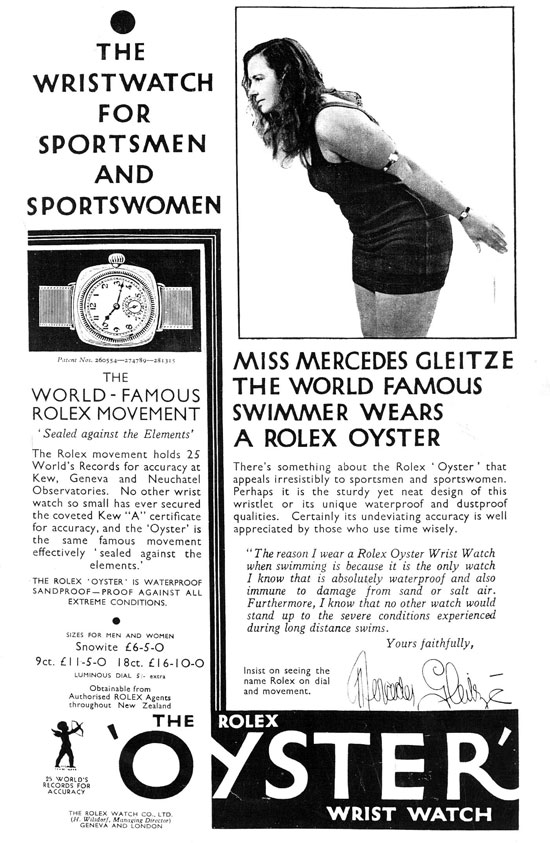
Mercedes Gleitze was an English open-water swimming pioneer who was the first British woman to swim the English Channel, which she completed in 15 hours and 15 minutes (1927). She was also the first to swim the Straits of Gibraltar (1928). She actively fundraised by selling postcards of herself, amongst other initiatives. After her retirement in 1932, she devoted her remaining fortune to her cause, setting up Mercedes Gleitze Home for Destitute Men and Women in Leicester (1933).
In 1932, she visited South Africa, where she completed the first double crossing to and from Robben Island (in two days). She also swam in various rivers around the country - Swartkops, Buffalo, Modder and Vaal, Hartebeespoortdam and Germiston Lake.
She was inducted into the Swimming International Hall of Fame in 2013.
Mercedes was a British pioneer long-distance swimmer from Brighton on the south coast of England, the youngest of three daughters of German economic immigrants. She was born into a world where sporting achievement was the prerogative of men, and women were conditioned into believing that they didn’t have the physical stamina to take part in such activities, or indeed that it was unseemly to do so. However, by the time she was a young adult, small groups of women in various countries were gradually penetrating these ‘mind barriers’ and demonstrating that women could climb mountains, fly aeroplanes, run marathons and swim across seas. Mercedes was one of these ‘new women’.
Although she had a well-paid job as a stenographer with a London-based company and was living an independent life, she harboured an ambition to become a professional long-distance swimmer. She decided to make the English Channel the platform from which to launch her new career. She obtained permission to train in the Thames (a tidal river) on Sundays, and during her summer holidays she travelled to Folkestone to acclimatise to sea conditions. It took her a while, but she persevered, and on her eighth attempt, on 7th October 1927, she became the first British woman (and third woman) to achieve this crossing. Her swim was recognised by the newly-formed Channel Swimming Association. At that point, she gave up office work and built a unique career as a professional swimmer.
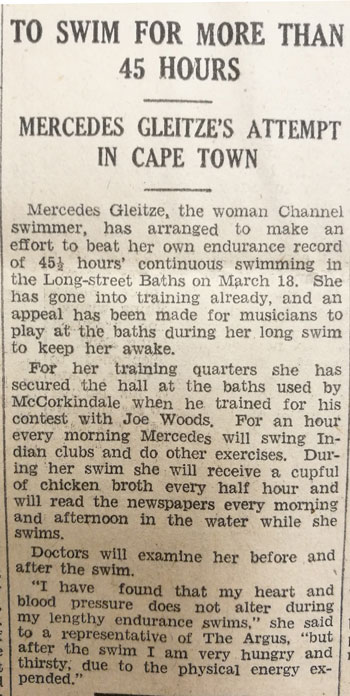
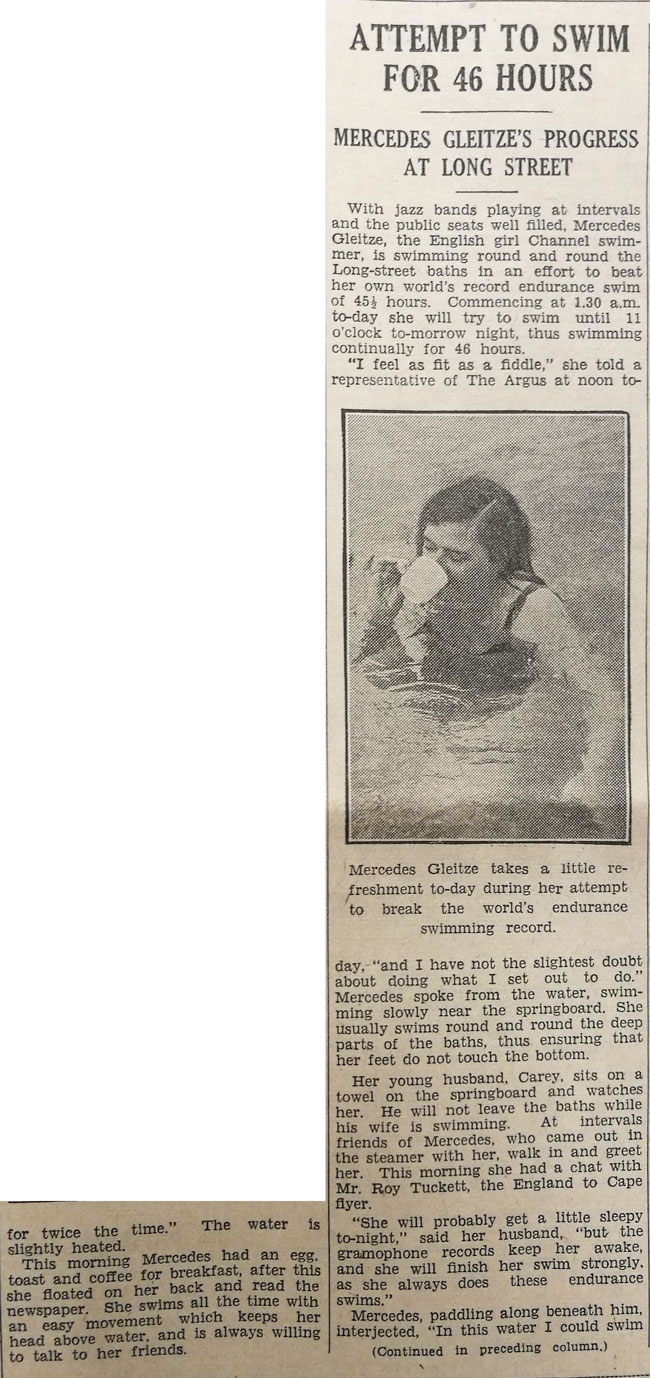
Tour of South Africa (February-July 1932): During her career, Mercedes travelled to various countries across the world to tackle unswum bodies of water previously. One of the last journeys she made before retiring into domesticity was to carry out a tour of South Africa. Her first event was an endurance swim in Cape Town’s Long Street Baths, increasing the British Record to 46 hours. A few days later she undertook her main event - a two-way crossing between Cape Town and Robben Island. The first leg of this swim was full of high drama caused by bitingly cold winds, low water temperature, and a dense fog which enshrouded the swimmer and her crew. At one stage, when her pilot boat (The Flora) had gone to refuel, Mercedes swam off course in the dark, foggy conditions. Luckily, her guiding rowing boat, which was still with her, had a rifleman on board (because of possible attacks from basking white sharks), and they were eventually located an hour later by another accompanying passenger boat (The Chance) by the firing of rifle shots. During this leg of the swim she was also badly stung by jellyfish. The return swim back to Cape Town two days later was, thankfully, a more comfortable experience.
South Africa’s own Henry Charteris Hooper and Margaret (Peggy) Duncan had both made the crossing from Robben Island to Cape Town in 1909 and 1926 respectively. However, no one had ever swum in the reverse direction from Cape Town to Robben Island. And so, in 1932, Mercedes was able to claim two new records: the first person to make the crossing from Cape Town to Robben Island and the first to achieve the double swim.
Other South African swims: Following the successful Cape Town events, Mercedes then embarked on a tour of the East Cape, carrying out pioneering swims over set distances in South Africa’s rivers and lakes. These included the Swartkops, Buffalo, Modder and Vaal rivers, Germiston Lake and the Hartbeespoort Dam. She enjoyed a friendship with her contemporary, Peggy Duncan, and Peggy’s mother during her stay in Cape Town, and Peggy was poolside supporting Mercedes during her endurance swim at the Long Street Baths.
Charitable legacy: On her retirement, Mercedes instituted a charity with the money she had earned during her swimming career to help the unemployed in the city of Leicester during the Great Depression of the 1930s. Although small, her Trust Fund is still active today and is being used to help families in poverty.
1932 All her swims in South Africa
References:
https://www.mercedesgleitze.uk/46-hours---cape-town
https://www.rolex.com/en-gb/about-rolex/history/1926-1945
https://en.wikipedia.org/wiki/Mercedes_Gleitze
https://www.openwaterpedia.com/index.php?title=Mercedes_Gleitze
https://www.countryfile.com/people/historical-figures/wild-people-swimming-legend-mercedes-gleitze
https://thehistorypress.co.uk/article/mercedes-gleitze-britains-empowering-swimming-heroine/
https://www.channelswimmingdover.org.uk/content/swimmer/gleitze-miss-mercedes





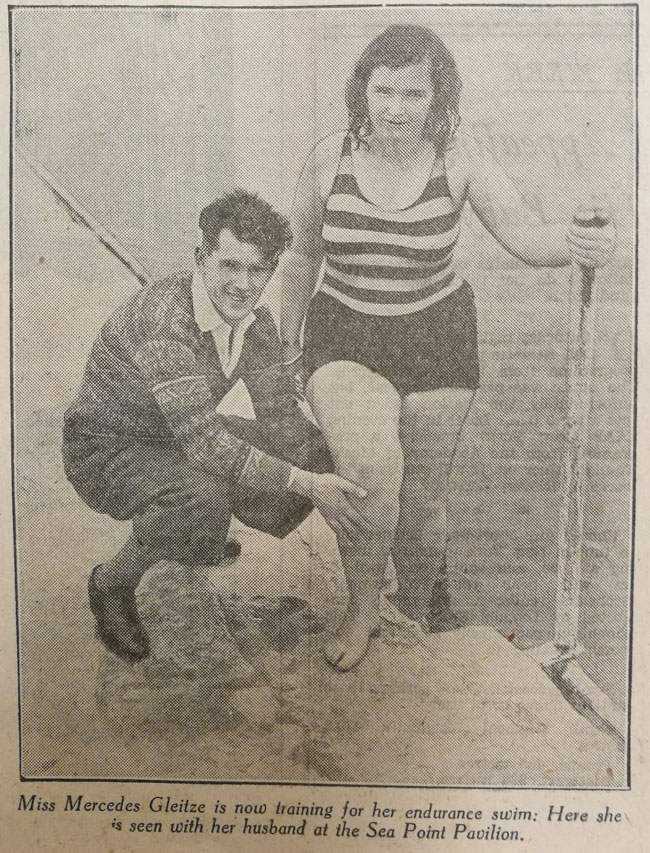


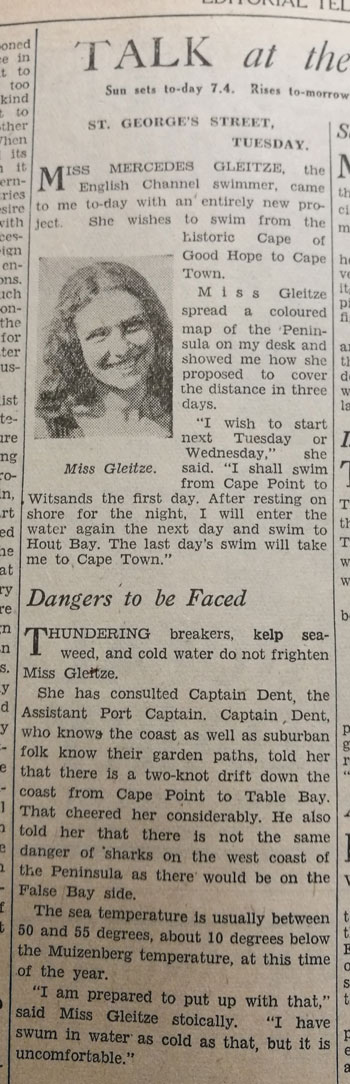


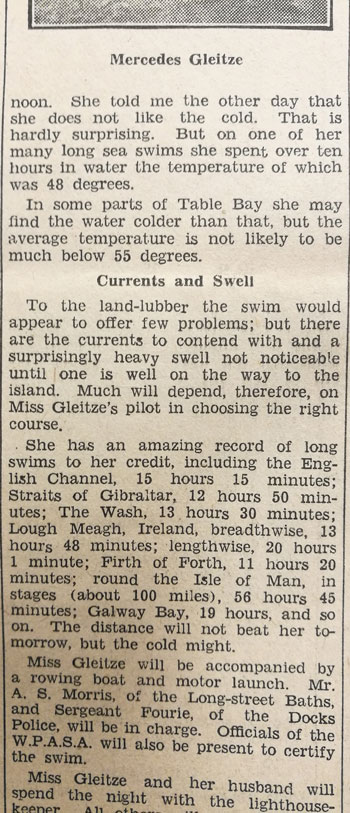


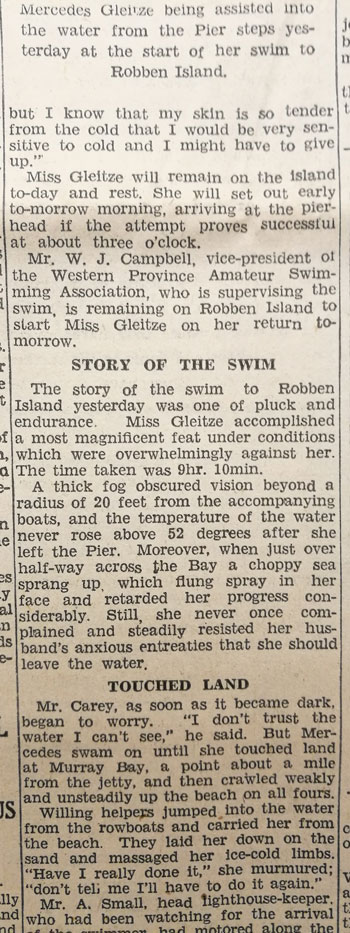


CAPE TOWN TO ROBBEN ISLAND (25 March 1932) - AND BACK (27 March 1932)
Outward Bound (25 March 1932)
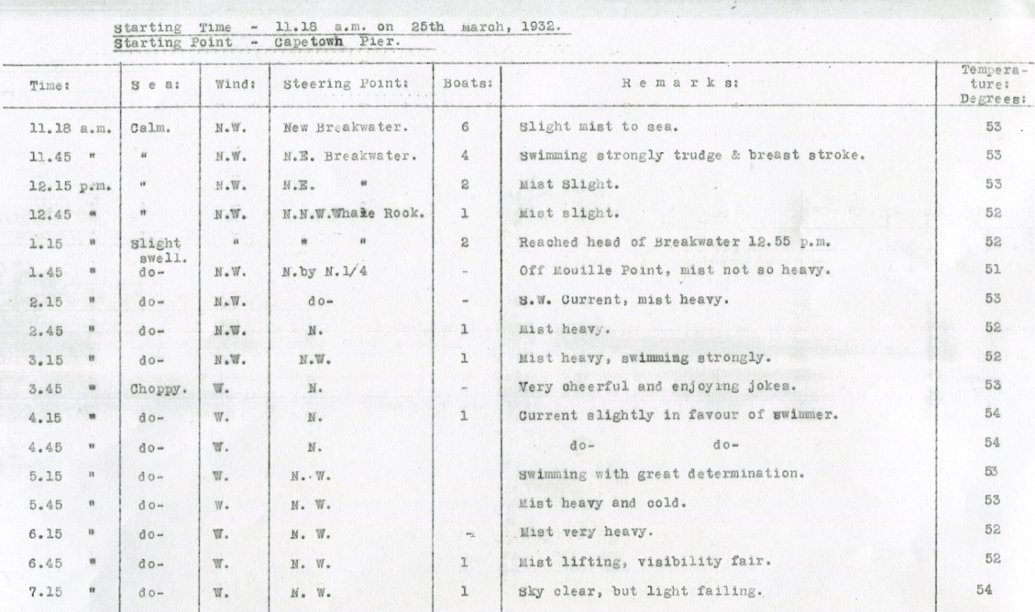
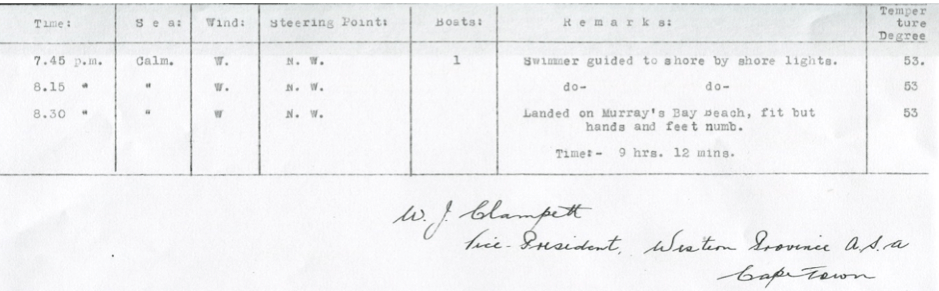
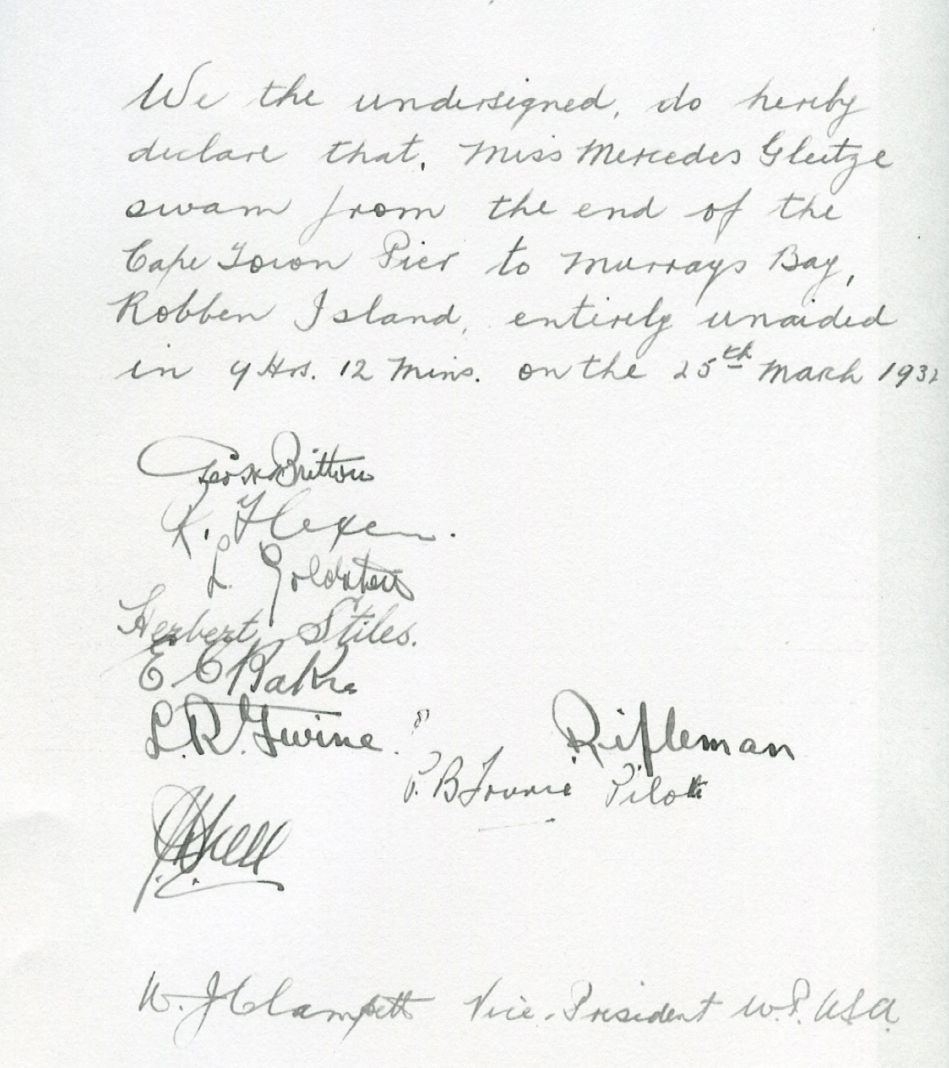
It was an ambitious undertaking and the conditions would not be pleasant. Despite South Africa’s geographical position, the waters around Cape Town are surprisingly cold. In one of her attempted swims across the Irish Sea Mercedes had spent over ten hours in waters the temperature of which was on average 48ºF. She was informed that in some parts of Table Bay she may find the water even colder than that. However it was estimated that hopefully the average temperature was not likely to be much below 55ºF. There would also be the currents to contend with, and a surprisingly heavy sea swell not noticeable until one is well on the way to the island. Much would depend on the pilot in his choice of the right course.Mr A.S. Morris of the Long Street Baths and Sergeant Fourie of the Docks Police were in charge of the organisation, and officials from the West Peninsular Amateur Swimming Association were present to certify the swim.Arrangements were made for Mercedes to be accompanied by a rowing boat and a motor launch, The Flora, and in addition the motor yacht The Chance would offer two-hourly trips “to give Capetonians an opportunity of seeing the methods and customs of that curious genus, the Channel swimmer”.Mercedes planned to spend the night on Robben Island after the initial crossing from Cape Town on Friday, the 25 March 1932, and start the return journey at 6 a.m. the following morning, hoping to reach the Cape Town pierhead between 3 p.m. and 4 p.m. in the afternoon.The start of the first lap from the pierhead was delayed for one hour and 20 minutes to allow the fog to clear. When she emerged from the cabin of The Chance, greased with oil, to start the swim, the Cape Times reported that she was greeted with rousing cheers.When she waded into the water at 11.18 a.m. the temperature was 50ºF. She wore a mosquito net over her head and face for protection from salt spray and to prevent possible sunburn. She began her swim with an easy arm crawl and the ordinary breast stroke kick. She had not gone very far, however, when the fog again settled in and enshrouded her. A bitingly cold wind made conditions all the more difficult. The siren at the breakwater and the fog horn at Robben Island sounded continually. At 12.10 p.m., after reaching the corner of the Mole, she was given her first nourishment – some hot beef tea. She was fed thereafter at half hourly intervals with hot soup and other beverages.When she was clear of the breakwater she swam north-north-west because of a cross-current. The route chosen was extremely difficult. There is apparently no sensible tidal stream between Rogge Bay and the Island. A current varying in strength from half a knot to two or three knots sets to the northward past Table Bay and Robben Island. It helped Mercedes a little that, after midday, the temperature rose from 50ºF to 52ºF. She changed her stroke at regular intervals from crawl to breaststroke in order to ease her muscles. The official motor launch was plotting her course by compass. At 2.45 p.m. it was found impossible for Mercedes to follow the set of the compass, but Captain Cruickshanks (skipper of The Chance motor yacht) intervened and put them on the correct course. At 4.30 p.m. she was still swimming strongly but the weather conditions deteriorated. The fog had increased in density and this was followed by a heavy drizzle.Fearing that Mercedes and the accompanying boats would go off course and drift past the Island with the current, Captain Cruickshanks hurried to her assistance in The Chance. It took him one hour and ten minutes to locate Mercedes, who had once again gone off her course. Darkness was approaching, and fearing that the rowing boat, the motor launch and the swimmer were lost, Captain Cruickshanks fired rockets from the mast of The Chance. No reply was received, and he stopped the engine of his yacht to listen for shots from the rowing boat. Thankfully, a few minutes later shots were heard and Mercedes and the rowing boat were located at 6.05 p.m.The swimmer was found to be accompanied only by the rowing boat – The Flora launch having gone to Robben Island to refuel. Mercedes had been steering a wrong course, but was still swimming strongly. She was then about a mile and a half from the island and the roughest passage was still ahead. At that stage she was covering just over one mile per hour, and although feeling the cold intensely after six and a half hours in freezing conditions, she refused to abandon the attempt. She relayed a message to Captain Cruickshanks saying that she would only leave the water if he thought it impossible for her to complete the swim. She followed this with a second message asking the Captain if he would stand by her until the end of the swim.There were over 120 passengers aboard The Chance, who were expecting to return to Cape Town pierhead at 6 p.m. Among them were a number of infants and school children. Captain Cruickshanks explained to them that unless they were willing to remain at sea Miss Gleitze might be compelled to give up the swim. A unanimous shout of “We’ll stay, let her carry on.” followed this announcement. When the news was conveyed to Mercedes, who had been treading water for about 15 minutes, she lifted the net from her face in appreciation and continued her swim at a very powerful pace. Her action was greeted with loud applause.The Chance kept alongside at a dead slow pace and the passengers aboard kept up a continuous refrain of old-time melodies to cheer and encourage the swimmer. Shortly after 7 o’clock, when darkness had set in, the fog cleared slightly and the dim outline of Robben Island was sighted for the first time that day. She was then a mile and a quarter from the shore and swimming powerfully.At 7.45 p.m. the official motor launch (The Flora) returned from the Island. All the lamps of The Chance were now alight, and when the crowd aboard paused in their refrain, jazz music was played on the gramophone. At 8 p.m. the launch ran short of petrol again and fell behind. About half a mile from the shore Captain Cruickshanks provided the rowing boat with a lighted lamp.At 8.30 p.m. Mercedes walked unaided out of the water on to Murray Bay on Robben Island – the first half of the double swim completed. A bonfire was lighted ashore to signal her arrival, and three hearty cheers were given by the passengers and crew aboard The Chance. She then walked from the shore to where the lighthouse keeper’s motor car waited to take her to his home. She told friends who had been waiting at Murray Bay to greet her, that she was feeling very fit but had been extremely cold. At Mr Small’s home she was given a meal of chicken, bacon, eggs and coffee, and after chatting to her friends for a few minutes she went to bed and was asleep by 10 p.m.
The return swim (27 March 1932)
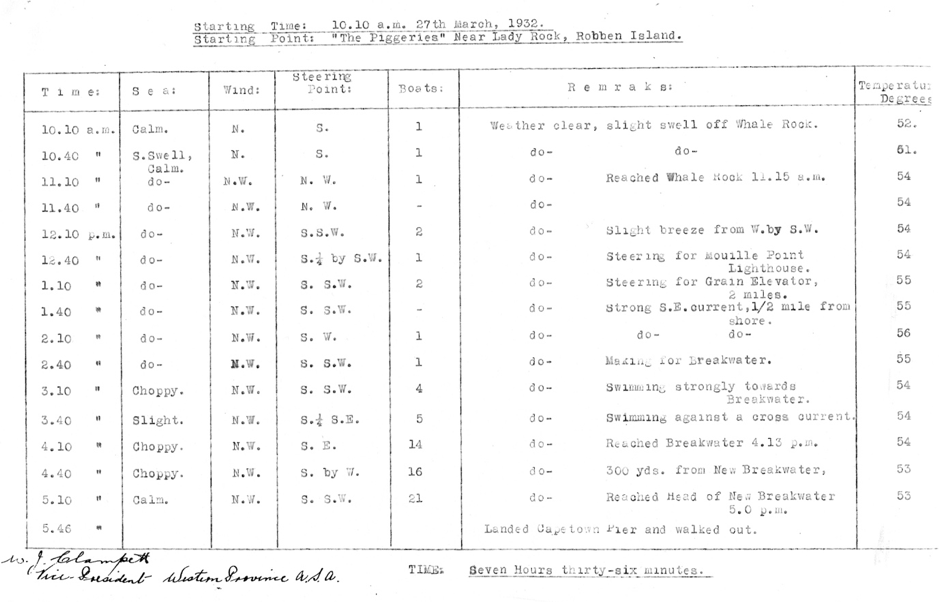
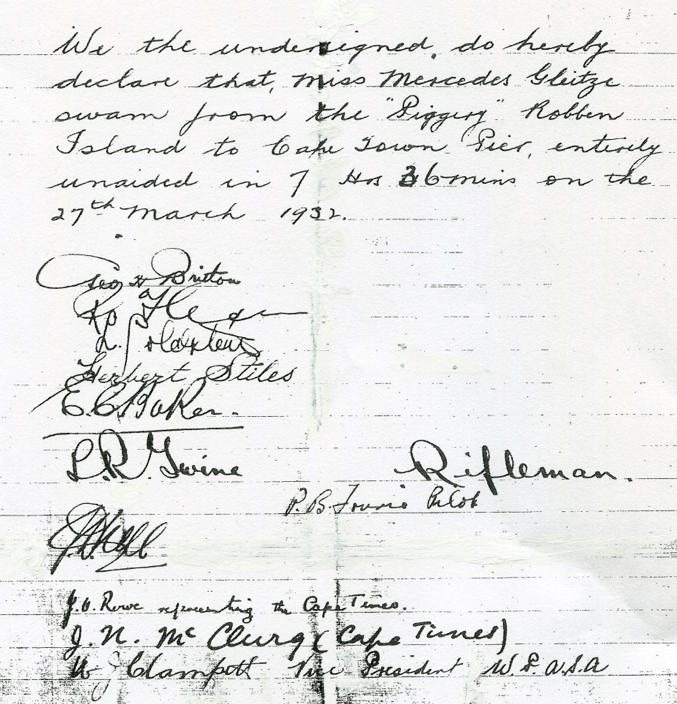
During the outgoing swim, Mercedes was bitten badly by bluebottle jellyfish (Physalia physalis) and the following morning, because the venomous stings had made her feverish, it was decided that she should postpone the planned return swim to Cape Town until Sunday, to allow 24 hours for her temperature to come down.The lighthouse keeper, Mr Small, his wife, and a Mr and Mrs Morrison, took care of her. Later on, when she was up and about, Mr Small took Mercedes and her husband for a drive around the island and showed them the deserted leper settlement. She said the enforced interlude on the island was very interesting and enjoyable.The swim back to Cape Town on Sunday was, as Mercedes described it, a pleasure, and uneventful when compared to the challenges she had faced on Friday. Except for one stretch, she enjoyed every mile of the homeward course, and said it was one of the easiest she had undertaken.She left at 10.10 a.m., two hours later than planned. There was a thick band of fog in the early hours of the morning, and at 8 eight o’clock it was feared that the attempt would have to be abandoned. However, word came from Cape Town that the fog was lifting fast, and by 9.30 a.m. Table Mountain was visible from the island.The course was set on a line from Whale Rock to a point on the Sea Point coast. Mercedes was taken down to the starting place in the lighthouse keeper’s motor car, accompanied by most of the island’s inhabitants. The surf was too rough at the suggested place of departure, and the start was delayed again until a suitable spot [The Piggeries] was found near Lady’s Rock, about 300 yards from the Robben Island jetty.When she entered the water it was icy, but after thirty minutes or so, although the temperature was a chilly 52ºF, her body began to acclimatise and she felt more comfortable. However, she had to fight against currents soon after she left the island, and again before she reached the breakwater at the pier. The fight against these currents tired her and retarded her progress. At one stage she hardly made any headway for an hour. “It is all a matter of will power to conquer the currents and not let them conquer you”, she said when interviewed after her swim. Although she only had to struggle with the currents on two occasions on this homeward leg, having to swim across them exhausted her.About 11 a.m. Captain Cruickshanks’ pleasure boat, The Chance, arrived once more on the scene carrying another boatload of spectators who cheered her on. She was fed at regular intervals with soup and other beverages, and she also managed to eat some chicken and bread. Unlike on Friday, she swam a true course, and at 11.20 a.m. she passed Whale Rock. After she had been in the water for two hours, Sergeant Fourie announced that she had covered three miles. At her request music was played on the gramophone, and those on the three accompanying boats sang to her across the water. At 12.30 p.m. she was one and a quarter miles off the mainland. Her course was then set for Mouille Point. By 1.10 p.m. she had covered four miles. Hired fishing boats and yachts had already begun to follow the progress of the swim, and the hearty refrains of their crews and passengers greatly encouraged her.At 2.30 p.m. her course was changed towards the breakwater. Shortly afterwards, The Chance arrived with another huge crowd of passengers who began singing in competition with the officials aboard the motor launch. Her acknowledgement met with rousing applause.At this stage Mercedes experienced the most difficult part of the course. At 3.15 p.m., swimming close inland, she was within 440 yards of the breakwater. A stiff breeze had risen and a severe cross-current was running. Mirrors flashing semaphore messages were seen from different points on Devil’s Peak and Signal Hill. She was cheered for the rest of the swim towards the pier by the crowds in the boats and on the shore. She removed the net from her head and kept a smiling face to the applause of the onlookers. The dinghies and rowing boats following her caused some difficulty to her progress, but when it was suggested that they should distance themselves, she interrupted with: “I am used to the boats, don’t send them away.”When she rounded the corner of the Mole she momentarily changed her breaststroke for an overarm crawl – the first time she had varied her stroke on this leg of the swim. Numbers of rowing boats from the pier, together with yachts and motor launches, surrounded her and she was spurred on by almost frantic community singing.By this time, hundreds of people had swarmed down to the breakwater to see the finishing stages of the swim. It was reported that they were not disappointed and were able to watch one of the most thrilling battles ever seen in the Cape peninsula waters. Mercedes had to fight the currents for more than an hour, but her dogged perseverance and moral courage won the battle. As she neared the breakwater the cheers of the crowd on the shore and in the boats resounded for miles around.She passed the breakwater at 5 p.m. and when within 15 yards of the pier she made a final overarm sprint, which was met with thunderous cheers from the crowd of more than 3,000 who had thronged there to see her. It was reported that there was a stampede towards the steps when she first touched the concrete, but officials barricaded the area and allowed her to escape to the dressing room.
Swimming log, Cape Town to Robben Island
Swimming log, Robben Island to Cape Town