
Percy and Ernest Cavill

The first well-known swimming tourists to South Africa were probably Fred Cavill and his sons, Percy and Ernest Cavill. They were professional swimmers and coaches who visited South Africa in the late 19th century.

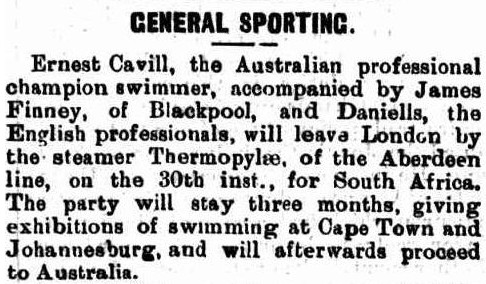
It's not clear when Fred Cavill visited South Africa, but in 1898, Ernest Cavill, and later his brother Percy, spent months teaching swimming and giving exhibitions. If he was indeed accompanied by James Finney and Charles Daniels, they would have had a significant impact on the local swimming scene.
Screenshot 2025 08 08 141618

The Cavill family were English-Australian swimmers who made significant contributions to the sport. They were collectively inducted as Honour Swimmers in 1967 into the International Marathon Swimming Hall of Fame and the International Swimming Hall of Fame.

The first notable Cavill family swimmer was Frederick Cavill (b. 1839), who attempted to swim the English Channel in 1876. As he got older, he became a swimming coach and the Kensington Swimming Baths owner. He later moved to Australia and became one of the first people to swim and develop the front crawl.

In 19th-century London, several public and private baths existed across Kensington. Cavill operated his venture before migrating to Melbourne and Sydney in the late 1878, where he continued building floating and tidal baths (such as the Lavender Bay Baths).

Ernie Cavill (b. 1868) was the eldest son and an Australian swimming champion. He set a world record for the 1000-yard freestyle and won a "World Title" series against American champion McCusker in England.In 1888, he set the 1000-yard freestyle world record with a time of 14 minutes, 41 seconds.

January 22, 1898:—Ernest Cavill (champion of Australia and America) leaves London by the Castle line steamer Hawarden Castle for Cape Town to-day (Saturday) with the intention of competing for the championship of South Africa. He is accompanied on his way by Mr. Frank Rhodes.

Percy Cavill in 1897


Return of a Famous Swimmer.

Kalgoorlie Western Argus - 1 February 1900, page 11

After an absence of over two years from Sydney, Percy Cavill, the famous Australasian champion swimmer, has returned to his home, looking taller and heavier than ever, and the picture of rugged health.

The returned champion had visited all parts of Great Britain, spent months in France and Spain, and even went to South Africa, giving exhibitions of his wonderful powers in the water.  "I went out to Cape Town, where my eldest brother Ernie, one-time champion of Australia, is doing fairly well, but never engages in matches. He carries too much tissue for that. I stayed there five months and was very successful in teaching, but could arrange no contests, as none of the South African swimmers would hear of a meeting. My fame had preceded me.

Swimming

By "NATATOR"

THE GAME OF WATER POLO.

HOW IT WAS STARTED.

(By Fred Cavill.)

As a good deal had been published in Sydney's papers lately regarding the game of water polo, now rapidly becoming as generally popular as it should be, the following communication from Mr. Fred. Cavill, the famous-long distance swimmer of a quarter of a century, or more, back, is timely, and provides very interesting reading:-
"In the month of June, 1868, I was a member of the Serpentine Swimming Club, which was at that time the oldest and most progressive club in the world. For the information of my readers, I may state that this club met every morning on the bank of the Serpentine, an ornamental lake in Hyde Park, London, 1000 yards long and 200 yards wide. I have seen over 30,000 people bathing in it at one time. Sixty years ago people were allowed to bathe on either shore from 5 to 8 in the morning, and from 7 till 9 in the evening; but in 1860 bathers were restricted to the south bank. It was there that the first display of 'swim ball,' or water polo, as it is now called, took place. Sunday morning was the great muster time of the S.S.C., and one of its members found a large India-rubber ball in the park, and threw it into the water from the north shore, at a spot about 109 yards wide. Such a scene was never witnessed before or since. Some hundreds of good swimmers made for the ball, and it gave real enjoyment for quite an hour to those who participated in the ducking and scrambling that took place.
It was from that scene that I conceived the idea of introducing the game of water polo. At the time I was engaged in organising swimming races and sports from off the West Pier of Brighton, and in order to carry out my water polo scheme I collected over £100 in prizes, and invited the S.S.C. to visit Brighton and take part in my forthcoming gala. They came, and went back to London delighted with their outing, taking a good share of the valuable prizes that were given.
The sports were witnessed by over 15,000 people from the shore and pier, and proved a great success. From that time water polo became one of the principal attractions on the South Coast.
After my Chanel swim, I started a tour around the world with my wonderful aquatic children, and in every exhibition I introduced the game of water polo, the assistance of the local swimmers being obtained to play the game.
I visited every large town in England, Ireland, and Scotland, Capetown, San Francisco and Australia. In Australia, I met with great success, visiting most of the towns as far north as Port Augusta. On my arrival in Sydney the Port Jackson Club took to the game, and played several matches with the Lavender Bay Club. Mr. W.F. Corbett was captain of the Port Jackson Club, and your humble servant skippered the Lavender Bay Club.
It is now over 40 years since I first introduced the game, and it is very gratifying to read of the progress that it is still making all over the world."
I can endorse all the Mr. Cavill says regarding the first appearance of water polo in this portion of the globe. The veteran swimmer, now lying a victim to rheumatism in its most severe form, and who has been confined to his room for some years, introduced water polo as "swim ball," and we played several matches - club against club - under his direction. I captained the old Port Jackson Club team in opposition to the Lavender Bay cracks - all strong heavy-weights - led by Mr. Cavill, who had previously coached us in the fine points of the pastime.

https://www.vicwaterpolo.com.au/single-post/2017/09/29/The-Case-for-Cavill

1904

1898 May 28

1898 May 25

1898 May 20

1897 Feb 21

1897 April 8

Lavender Bay Bath

Fred Cavill

Percy

James Finney 1

CM Daniels