Annette Cowley

Annette Cowley

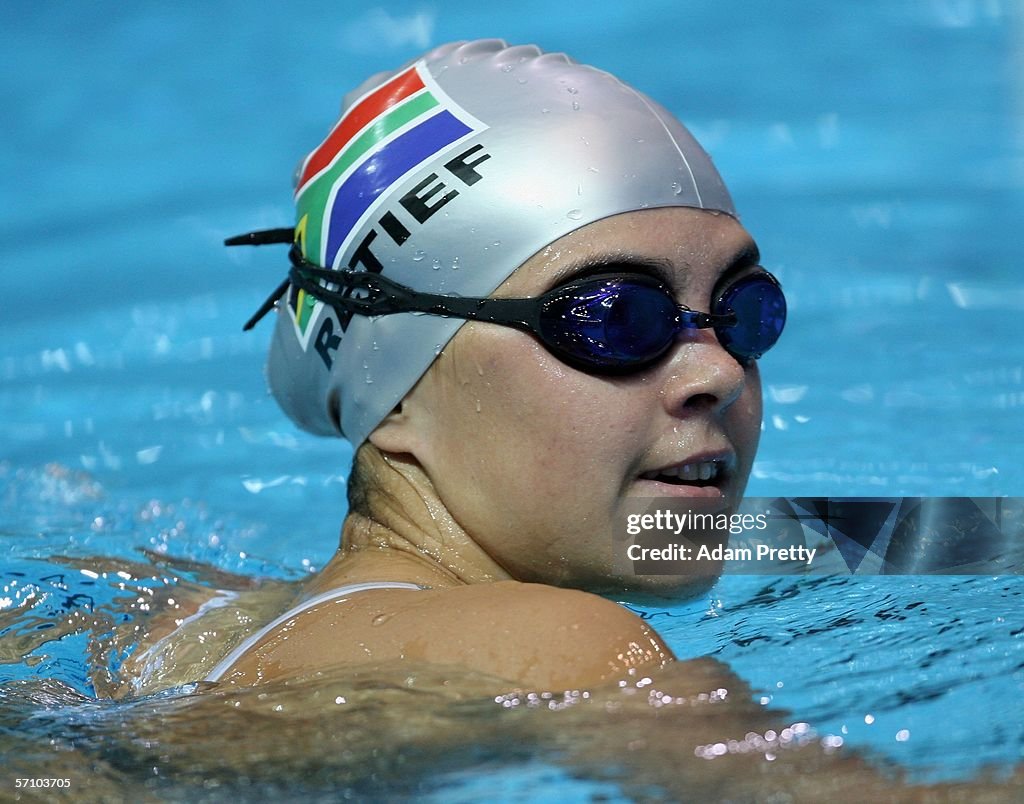
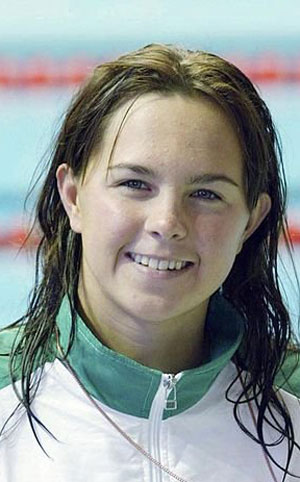
Annette Cowley was a Western Province swimmer from Bellville, where she attended Settlers High. Annette started swimming at age 9 when she was spotted by local coach Tom Fraenkel. Although he was based some distance away in Constantia, Annette had the support of her parents who transported her to training every day.

In 1981 at age 15, she finished second in the 200 freestyle at the South African swimming championships in Port Elizabeth, and in 1982 won the event, and set a new SA record in the heats.

In 1983 she won 6 events at nationals, helped perhaps by the retirement of backstroke and freestyle champion Karen van Helden. Erwin Kratz also won six events at the nationals in 1983, following Karen Muir, who achieved the same in 1969, and Paul Blackbeard in 1975.

After swimming nationals, she found time to compete in the South African still water life-saving championships, where she was awarded Springbok colours after setting a new world record in the 200m obstacle race.

In 1984 she again won 6 events, and by 1985 she won a scholarship to swim at the University of Texas, under US Olympic coach Richard Quick. 

Competing at the Texan International Invitational on 14th January 1985, Annette finished second in the 200 freestyle. By the 1st March, she became the first Texas swimmer that year to qualify for the NCAA Championships - in the 500 yards freestyle. Annette was a key member of the University of Texas team that won the NCAA Championships from 1985 - 1988. 

In 1985 Annette applied for British citizenship, through her mother's ancestry, and in May 1986, after assurances from the British Amateur Swimming Association, she swam at the British nationals, winning the 100 and 200 freestyle events. She was eligible for selection to the British to compete at the 1986 Commonwealth Games to be held in Glasgow in July.

Annette was selected, but then the anti-South African lobby threatened to boycott the Games if she and runner Zola Budd was allowed to compete in the Games. The matter went all the way to the British High Court, which ruled against the two South African athletes. Annette, already installed in the athlete's village, was forced to leave and later to sit and watch the swimming from the stands. 

At the 1987 NCAA Championships Anntee was a member of the Texas 800 yard freestyle relay that won gold. In 1988 the Texas women's team made history when they won the NCAA title four years in a row - and Annette became an 9 times All-American in helping them achieve that. Annette stayed on at Texas, competing in the NCAA championships and finishing her BSc. degree, before returning home to Cape Town in 1988.  

When South Africa was re-admitted to world swimming in 1991 Annette decided to have one more go at making it to the Olympics. The first post-boycott nationals were used as the 1992 Olympic trials in Durban. Annette won second place in the 50 and 100 - both times to WP teammate Marianne Kriel - who was later to win a silver medal at the 1996 Olympic Games.

Kriel's time for the 100 broke Annette's SA record, set in 1984. Unfortunately for Annette - and the new post-SAASU selectors - two-second places at nationals was not enough to be selected for the first South African team to compete in the Olympic Games since 1960.

Annette re-appeared in the swimming press briefly when the Commonwealth Games were once again hosted by Edinburgh, in 2014. She was featured in a BBC documentary titled Boycotts and Broken Dreams.

Today Annette runs a business in Cape Town. Her involvement in swimming centres on her twin daughters Georgina and Olivia, who attended Herschel Girls High School and swam at Swimlab Aquatic Academy (2011-21). Olivia won the 50m butterfly at the SA championships in 2018 - at age 15. In 2022 both girls won scholarships to swim at the University of North Carolina. Olivia set a new SA record for the 50m backstroke at the 2023 South African Championships. 

‘I put on a brave face but I did cry’

July 13, 2014

The South African-born Annette Cowley has finally swum in the Edinburgh Commonwealth Games pool after her boycott pain of 1986

Cowley 2014 I put on brave face

“THEY say water is a great healer,” notes Annette Cowley, having finally swum in the pool she hoped to compete in at the 1986 Commonwealth Games in Edinburgh.

Today is the 28th anniversary, right down to the day of the week, that she was escorted from the athletes’ village by police officers after the Commonwealth Games Federation ruled the South African-born swimmer would not be allowed to compete for England.

She was a 19-year-old girl who became a political pawn, caught up in a boycott by 32 countries that saw the lowest turnout since the post-war Games of 1950 in response to the Thatcher government’s attitude towards apartheid.

Now a mum of three, Cowley returned to the pool with a BBC crew recently for a documentary that will be screened this week. It brought back all the old emotions — measures of bitterness, frustration, injustice — but also some belated catharsis for being unable to compete in her prime due to the country of her birth being a sporting pariah.

“It was kind of a strange day for me because we went to the pool and I felt very emotional when I walked in. My heart was racing, but it was wonderful because they actually cleared the pool for me and I had it all to myself. I swam and felt so calm.”

Cowley’s is a complicated story but one worth listening to. She followed in the footsteps of Zola Budd, also banned from Edinburgh in 1986, as a South African of English heritage who attempted to use it to circumvent the sporting boycott, but there is one key difference.

While Budd competed in the 3,000m for Britain at the 1984 Olympics in Los Angeles, when she collided with Mary Decker, the home darling, and for South Africa at Barcelona in 1992, Cowley twice paid the price for her desire to compete on the world stage. She was not only excluded in Edinburgh but also from the South Africa team for the 1992 Olympics despite training hard to put herself in contention.

“I had quit swimming and was working full-time but when I heard South Africa had got back in I went to my boss and said, ‘listen, I have to give this a last shot, I really have to try and make this happen. If I can’t swim for England or Britain, I am going to try and swim for South Africa again’.

I went back and went to trials, probably did the best times I have ever done.” Despite them, Cowley feels the selectors were influenced not to pick her. She was to be punished again for what her critics claimed was adopting a flag of convenience.

“Politically, we’ve had the Truth and Reconciliation Commission in South Africa, but it has never happened for our sports people. I don’t think they realise how tough it is to train every day relentlessly to be at the top of your game and have those opportunities stripped away from you.” In 1986, her times in the English trials would have been good enough to take gold in Edinburgh.

She refuses to torment herself too much with what might have been but went along to watch the 100m freestyle final. “I just watched the 100m and then left afterwards. It was tough to deal with and I think enough was enough and I just needed to get out of there and have a change of scene. I had been through a lot. I did cry. I put on a brave face for the media, but sometimes I just shut the door or you take it out in the pool. It is easier to cry in the water.”

Her parents, Ron and Sue, then flew over from South Africa to support her at the centre of a media and political storm. Ron, a Cape Town doctor, who died 11 years ago, knew how many hours the youngest of his three daughters had poured into her dream. “He was so involved in my swimming and so passionate about it.

I trained on my own in the morning and my dad used to sit on the side and read the newspaper. It was freezing cold because it wasn’t heated. I would go in and turn blue and he’d say, ‘you can come home, you know’ and I’d say ‘no’. He was lovely to me.”

Sue has also passed away but kept meticulous scrapbooks of Cowley’s career and the traumatic summer of 1986. For years she couldn’t face the cuttings and the memories they invoked. “I put them in a cupboard and shut it.” Yet now she is planning a book and is glad they are there to help her with it.

She has one of the scrapbooks with her as we speak in a cafe in Edinburgh and it reminds you that this was front-page news back then, plus fodder for cartoonists and satirists inside as they showed Thatcher at odds with the Commonwealth leaders with Budd and Cowley in limbo between them. She became an unwitting and unwilling symbol of white South Africa.

“It was very hard to comprehend because nobody ever asked my personal views and opinions. I grew up in a very liberal English-speaking home and this just happened to me and I felt like an innocent victim. I just stood for a symbol of the white South African government at the time and it was also very confusing because I was being asked to do things like renounce my South African citizenship, but I was scared to do that because my family was back home and I didn’t want to be stopped from going back to see them.

It was extremely controversial and very difficult, initially, not having someone with me to help me through the process at such a young age. As a young girl, I was simply trying to get the exposure, get the competition, and maybe have the opportunity to win gold.”

Instead, her childhood dreams died on that Sunday morning in July 1986 when she was marched out of the Games village. “I don’t think anybody who has the opportunities that they have now would understand what we went through. I wasn’t exposed on an international level to anybody, to any of my heroes that I had read about in Swimming World magazine.

You did feel very isolated.” She wasn’t aware of apartheid growing up, living in a bubble well away from its many atrocities. “Where we went to school it was all white kids and now it is very different. My kids don’t know the difference between black, brown, or white, they really don’t, they are so integrated now, which is wonderful, and I feel quite sad that when I grew up in South Africa we never had that.” Her own children are strong swimmers.

“My son, who is 16, seems to prefer water polo and is doing really well. He seems more interested in swimming lately, but I am figuring that might be because there are some pretty girls at the pool. One of my twin daughters is doing really well and winning nationals in her age group. My other daughter is more into ball sports. They have to figure it out for themselves.”

She missed them during her trip to Edinburgh but it also gave her time to explore the city. “I never got to see how beautiful Edinburgh was — the history, the buildings — so this time round I have really taken full advantage. I have walked and walked and walked. There’s a lot of hills and steps.”

Yet it was the short flight down into the Commonwealth Pool at Meadowbank that was the most significant for her and, after a 28-year wait, that moment of calm isolation in its healing waters that followed.

1984 Springbok swimming team.

Coach Tom Fraenkel with star swimmer Annette Cowley

  • Hits: 5764

Cameron Bellamy

Cameron Bellamy

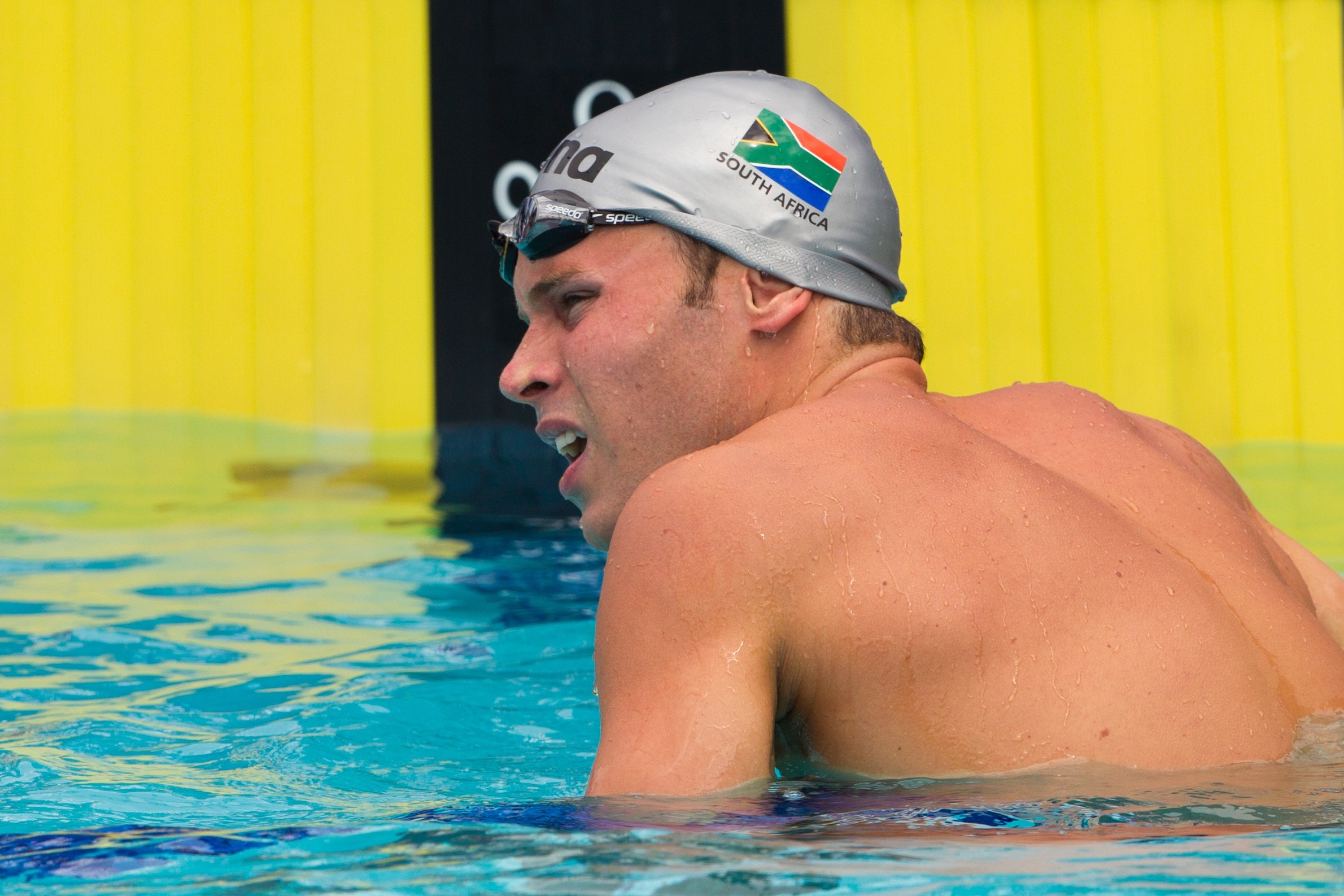
Cameron Bellay is a South African from Cape Town who specialises in endurance events - open-water marathon swimming, rowing, cyling. He is best known for the 2019 swim from Barbados to St Lucia in the Caribbean, which is the longest recorded ocean channel swim, covering the 151.7 km (94 miles) in 56 hours and 36 minutes.

The 37-year-old South African set out from St Peters Bay in Barbados at 8.20 on Saturday morning, swimming in flat seas with gentle swells but hot conditions, reaching St Lucia just before 5 p.m. local time on Sunday to be met by the country's prime minister Allen Chastanet.

Bellamy became only the 11th person (and the first from Africa) to complete the Oceans 7, open water swimming’s version of climbing the 7 highest mountains in the world. The Oceans 7 consists of the 7 toughest channel swims around the world (including New Zealand’s Cook Strait, Japan’s Tsugaru Strait, Hawaii’s Molokai Channel, The North Channel between Scotland, Ireland, California’s Catalina Channel, The Strait of Gibraltar, and The English Channel).

He graduated from Rhodes University in Grahamstown and he also obtained a Masters's degree in International Economics and Finance in 2006.

from the University of Queensland. 

He is an International Marathon Swimming Hall of Fam Honor Swimmer.

Today Cameron trains in the San Francisco Bay with the South End Rowing Club

2018 World Open Water Swimming Man of the Year Nomination

He was nominated for the 2018 World Open Water Swimming Man of the Year by the World Open Water Swimming Association:
Cameron Bellamy has cycled and rowed long distances over the course of his athletic career, setting two Guinness World Records. He only recently caught the open water swimming bug. But once Bellamy became immersed in the open water world, he was all-in and went all-out as is his innate modus operandi. He started from scratch and subsequently crossed the English Channel (16 hours 29 minutes), Strait of Gibraltar (4 hours 1 minute), Catalina Channel (11 hours 54 minutes), North Channel (12 hours 22 minutes), Molokai Channel (16 hours 1 minute), Cook Strait (12 hours 44 minutes) and Tsugaru Channel (11 hours 6 minutes) to become the first South African to achieve the Oceans Seven. But the 46-year-old did not rest on his laurels and later attempted a 96 km circumnavigation swim around Barbados, swimming for over 26 hours and 66 km before he aborted the swim. For creating a successful charitable organization called the Ubunye Challenge that raises funds for sustainable development in the poorest areas of Africa through sports challenges, for returning to Japan to tackle the Tsugaru Channel in order to achieve the Oceans Seven after an initial DNF, and for planning a second 96 km circumnavigation swim around Barbados while helping the local Caribbean swimming community and working in Silicon Valley, Cameron Bellamy of South Africa is a worthy nominee for the 2018 World Open Water Swimming Man of the Year.

Cameron Bellamy honoured by the Guinness World Records for his 40 hour 46 minute circumnavigation swim around Barbados on his second attempt.

Between 13 and 25 December 2019, Bellamy, along with five other men, (Fiann PaulAndrew TowneColin O'Brady, Jamie Douglas-Hamilton, and John Peterson) rowed across the Drake Passage in a 29 ft (8.8 m) vessel, enduring freezing temperatures, rain, snow, and waves up to 30 ft (9.1 m) in height. The rowers worked in 90-minute shifts for 24 hours a day, travelling 665 mi (1,070 km).

  • Hits: 2328

Tamsin Cook

Tamsin Cook

Tamsin Cook was born in Cape Town on 25 December 1998. She moved to Perth, Australia when she was 8. Tamsin swims with the University of Western Australia Swimming Club.

Cook participated in the 2014 Junior Pan Pacific Swimming Championships in Maui, Hawaii. She won the gold medal in the 400-meter freestyle at the 2015 FINA World Junior Swimming Championships in Singapore in a new Championships record. She also broke the Championships record in the 200-meter freestyle with her lead-off leg in the 4 × 200 m freestyle relay final. In that race, she and her teammates broke the junior world record. Cook also won a silver medal in the 200-meter butterfly

After a neck injury in 2018, she retired from swimming, but returned in 2020 and qualified for the 2020 Summer Olympics in Tokyo, winning silver (2016) and bronze medals (2020) with the Australian 4x200 freestyle relay teams.

  • Hits: 1985

Ram Barkai

Ram Barkai

Ram Barkai is Barkai is the founder of the International Ice Swimming Association, and he is a world record holder in ice swimming.

He is an Israeli-born extreme swimmer and ice swimming administrator from Cape Town. Ram was born in 1957 in Israel. Ram spent five years in the Israeli army and left in 1980 to travel and study. He was discharged as a Major. Ram enrolled in the Science university in Haifa to study computer science with a strong flavour of math. In 1987 Ram left Israel for Japan to work in computers and later on in finance.

Ram came back to South Africa in 1996 to settle down and build a home with his first wife. He joined a small financial services company and became the CEO in 2005. Ram retired in 2012 to pursue his real passion for Ice Swimming, which he founded in 2009. He completed many swims around the world, from the Arctic, Antarctica, Dead Sea, Cape Point, Cape Horn, Siberia, Alaska, Patagonia, Australia, Murmansk, Finland, Norway, Yellow River China, Sea of Galilee and many more in frozen Europe, England, Ireland & Scotland.

He takes jovial issue with his friend Lewis Pugh's claim to be the toughest, southern-most ice swimmer. "My name is in the Guinness Book of Records as having done the standard 1km, most-southerly swim. Lewis claims to have broken it but only swam a few hundred metres, so Lewis needs to do a proper swim of at least 1km to get his record back," he adds laughing.

Open Water Swimming Career Highlights

https://www.openwaterswimming.com/swim-community/ram-barkai/ 

Ice Miles

Barkai has done 11 Ice Miles to date:
1. On 31 January 2009 in Lake Zurich, Switzerland in 4.00°C water, 1.43 miles in 43 minutes 0 seconds.
2. On 17 July 2010 in Fraserburg, South Africa in 4.50°C water, 1.00 mile in 33 minutes 0 seconds.
3. On 23 July 2011 in Fraserburg, South Africa in 5.00°C water, 1.00 mile in 28 minutes 59 seconds.
4. On 4 January 2012 in Loch Fiskaley, Scotland in 2.00°C water, 1.00 mile in 28 minutes 3 seconds.
5. On 15 July 2012 in Fraserburg, South Africa in 1.70°C water, 1.00 mile in 31 minutes 33 seconds.
6. On 31 January 2013 in Lake Holborough, Kent, UK in 3.50°C water, 1.00 mile in 31 minutes 14 seconds.
7. On 23 March 2013 in Murmansk, Russia in 0.00°C water, 1.00 mile in 32 minutes 43 seconds.
8. On 31 December 2014 in Vltava River, Branik, Prague, Czech Republic in 4.60°C water, 1.03 miles in 30 minutes 0 seconds.
9. On 31 December 2015 in Aukreyri, Iceland in 4.63°C water, 1.00 mile in 32 minutes 18 seconds.
10. On 12 June 2017 in Lake Baikal, Russia in 4.70°C water, 1.00 mile in 31 minutes 45 seconds.
11. On 22 June 2017 in a glacial fjord in Svalbard, Arctic Sea in 4.61°C water, 1.03 miles in 28 minutes 16 seconds.

Ice Kilometers

Barkai has done 17 Ice Kilometers to date:
1. On 11 January 2015, 1st Aqua Sphere Ice Swimming Championships in Lake Woehrsee, Burghausen, Germany in 17 minutes 20 seconds in 4.80°C water.
2. On 20 March 2015, IISA 1st World Championships in Lake Semenovskoye, Murmansk, Russia in 16 minutes 39 seconds in 0.08°C water and -5.00°C air.
3. On 19 December 2015, River Labe CZ Ice Swimming Championships in Hradec Kralove, Czech Republic in 17 minutes 59 seconds 4.70°C water.
4. On 10 January 2016, Aqua Sphere Ice Swimming Championships in Burghausen, Germany in 17 minutes 28.0 seconds in 3.90°C water.
5. On 23 January 2016, Polish Championships in Katowice, Poland in 16 minutes 55.0 seconds in 2.00°C water.
6. On 30 January 2016, International Ice Swimming Association in Wild Water, Armagh, Ireland in 16 minutes 53.0 seconds in 4.50°C water and -8.00°C air.
7. On 7 August 2016, IISA South Africa 2016 Championships in Afriski resort, Lesotho in 25 minutes 48.0 seconds in 4.00°C water.
8. On 6 January 2017, 2nd Ice Swimming Aqua Sphere in Burghausen, Bavaria, Germany in 16 minutes 58.85 seconds in 3.40°C water and -11.10°C air.
9. On 11 February 2017, Ice Cup & GB Ice Swimming Championships in The Cruin, Loch Lomond in 22 minutes 8 seconds in 4.20°C water.
10. On 8 June 2017, 2017 Baikal Mile in Lake Baikal, Russia in 18 minutes 58.43 seconds in 4.60°C water.
11. On 7 January 2018, Ice Swimming German Open in Veitsbronn, Germany in 17 minutes 36.30 seconds in 3.80°C water.
12. On 25 February 2018, IISA GB Championships in Hatfield Outdoor Activity, UK in 16 minutes 13.44 seconds in 3.60°C water.
13. On 23 November 2018, Antarctica Ice Swimming in Port Lockroy, Antarctica in 18 minutes 47.22 seconds in -1.20°C water.
14. On 18 March 2019, IISA III World Championships in Murmansk, Russia in 17 minutes 32.61 seconds in 0.00°C water.
15. On 28 July 2019, Africa Lesotho Ice Swimming Championships in Afriski, Lesotho, Africa in 22 minutes 38.61 seconds in 2.00°C water.
16. On 6 January 2020, 6th Ice Swimming Aqua Sphere in Veitsbronn, Germany in 18 minutes 3.0 seconds in 2.80°C water.
17. On 23 February 2020, IISA GB CHAMPIONSHIPS in Sandford Lido, Great Britain in 17 minutes 4.47 seconds in 0.00°C water.

International Ice Swimming Association Administration

2012 World Open Water Swimming Man of the Year Nomination

Barkai was nominated for the 2012 World Open Water Swimming Man of the Year award. His nomination reads,

The world according to Ram is expansive and empowering. His refreshing view of human potential is without limitation. His enlightening perspective effectively utilizes the power of the mind, and extends the world of open water swimming beyond contemporary comprehension. The founder of the International Ice Swimming Association inspires swimmers to look at water in an entirely new light; temperature no longer becomes the limiting factor. If the ice has melted, Barkai considers it a potential field of play. At the same time, Barkai understands the risk of extreme swimming. He counsels individuals to proceed with mindful caution and utilizes intelligent planning. The physiological data that he compiles and analyzes, the swims that he organizes, the risks that he manages and identifies are extraordinarily useful to the open water swimming world. For his encouragement of thinking outside the norm, for his properly-managed extreme swims, for his support of ice swimmers around the world, Ram Barkai is a worthy nominee for the 2012 WOWSA Open Water Swimming Man of the Year.

2014 World Open Water Swimming Offering of the Year Nomination

Barkai’s International Ice Swimming Association was nominated for the 2014 World Open Water Swimming Offering of the Year. Its nomination reads,

Ice swimmers are extremists. These athletes come in all shapes and sizes with the unique ability to push themselves farther and colder than other humans and scientists think possible. But nothing is impossible for these hardened groups of extreme athletes. The International Ice Swimming Association, founded by Ram Barkai, promotes, advices, and ratifies individuals who attempt and achieve extreme open water swims in water temperatures under 5°C (41°F). Its standardization of rules, protocols, and procedures are helping to shape the sport of ice swimming. Its growth may someday lead to an inclusion of ice swimming in the Winter Olympics. For its emphasis on safety, for its interest in pushing the physical limits of where ice swimmers can go, for organizing the sport in a global unified manner, the International Ice Swimming Association is a worthy nominee for the 2014 World Open Water Swimming Offering of the Year.

  • Hits: 4251

Vera Tanner

Vera Tanner

Vera was selected to represent Great Britain in the 1924 Paris Olympics and won a silver medal in the 4 x 100m Freestyle Relay and was fifth in the individual 100m Freestyle winning a silver in the same relay event in the 1928 Amsterdam Olympics.

Tanner toured South Africa with a Great Britain ladies' team in 1929 and re-met Dupre Murrell, who she originally met at the Paris Olympics, when he accompanied the South African men's team. Murrell and Tanner married in South Africa in April 1930 and she continued her career as a teacher at St. Andrews College in Grahamstown. She retired from swimming in 1934 but took up golf in 1931, and a little over two years later won the South African East Province Championship.

Tanner moved to Hong Kong in the late 1930s and worked for the Hong Kong Education Department. During the War, she enrolled as a nurse in the Auxiliary Nursing Service (ANS) and consequently missed the compulsory evacuation of women and children. She later became a Japanese prisoner-of-war and interned at the Stanley Camp in Hong Kong.

It was reported that Vera swum out nearly two miles to the British Pacific Fleet on liberation on 30 August 1945 to direct the Fleet to the prisoners. She is in the Hong Kong history books, as she and a Police  Sergeant swam out to meet the first warship that entered HK after the 2nd WW to relieve it from the Japanese occupation. The warship stopped and picked them up out of the shark-infested waters. "Thin and half-starved as she was, she made the journey in 30 minutes."

Picture1

She was released in 1945 and on return to England, married her second husband, Lieutenant Colonel Ned Curran.


The British team at the 1924 Olympic Games - Florence BarkerConstance JeansGrace McKenzie, and Iris Vera Tanner.

Vera's swimming medals lost to the Japanese or other looters during WW2 in Hong Kong (Bruce Curran).

https://battleforhongkong.blogspot.com/2014/07/vera-murrell-olympic-games-swimmer-and.html 

Vera Tanner, Jabez Wolffe, Gertrude Ederle and Ishak Helmi - Dover 1925. Vera Tanner swam as a pacemaker for Ederly during her English channel crossing attempt.


  • Hits: 2701