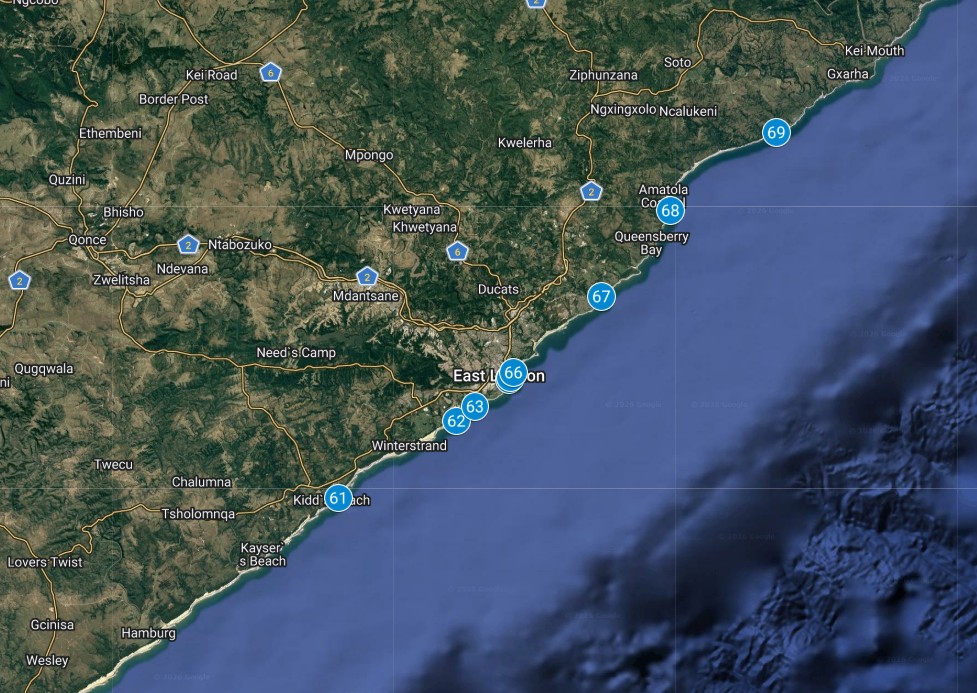
70. Kidd's Beach Tidal Pool
Kidd’s Beach, a small coastal resort town (about 28km west of East London), originated in the 1860s as a small coastal holiday retreat for farming families from the interior, named after Charles Kidd, a former mayor of King William’s Town.
By 1870, the area was under the control of the Forestry Department. Farmers were granted permission to congregate there at Christmas, living in tents and "skerms".
In 1960, Escom arrived, and street lights were installed, and many houses were lit by it. A watch scheme was considered, but it was too expensive. Under the jurisdiction of the Divisional Council, each year has seen some notable improvements.
In 1963, a fine tidal pool was opened by Mr Edgar Glass, Chairman of the Council, within a stone’s throw of the car park and in full view of the Tearoom. This pool greatly enhances the appeal as a holiday resort. Read more about the history of Kidd's Bewach here →

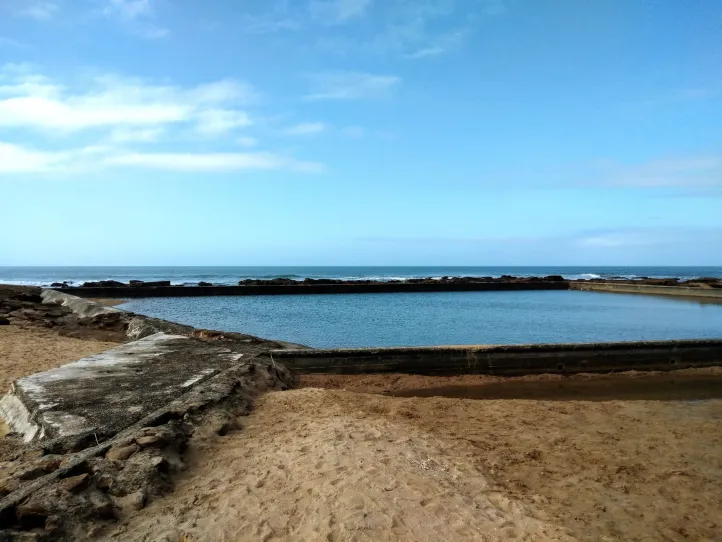
71. Leach Bay Tidal Pool
Leach Bay is likely named after a member of the Leach family, who were prominent early settlers and landowners in the East London area. The tidal pool is close to the Grand Prix race track, where the South African event was held between 1934 and 1939, and the F1 Grand Prix from 1962 to 1965. These events made East London and Leach Bay an international stage. No doubt the tidal pool provided safe swimming for the many spectators to the motor racing events held there.
Alas, today it is an abandoned facility.

72. Water World Tidal Pool
The Water World facility was a municipal project that failed.


73. Orient Bach Tidal Pools
The municipal pools were built on the rocks next to Orient Beach. The bottom image is today.
This beach boasts two exceptional pools with thrilling slides – the Quanza pool, a little further east, is perfect for older kids as it is deeper, while the Orient Beach pool provides equal enjoyment in a safer environment.


74. Orient Beach Bath
In 1904, the municipality constructed a pair of bathing pools on the rocks at the spot where the MV Quanza had run aground in 1872. The pools would be known as the Quanza Pools. They were constructed as a result of an initial accident. The Town Engineer was experimenting with explosives and had blasted a great hole in the rocks at that point. Water immediately rushed in, and the resulting pool became a popular place for women and children.
The pool was twice used to host the South African swimming Championships.


75. Beach Hotel - Aquarium
The Beach Hotel was the first to open along East London's Esplanade in 1894, including its own Beach Pool. The Beach was replaced by the Kennaway Hotel in 1964, and today the East London aquarium uses the former beach pool.


76. Gonubie Tidal Pool
There is also the lavish riverside area, which is a popular tourist destination. Gonubie main beach is a beautiful sandy beach with an international-standard boardwalk. In 2010/11 Gonubie Beach was awarded the prestigious Blue Flag beach award. The river is a great spot for activities like canoeing and kayaking.


78. Haga Haga Tidal Pool
This is the last tidal pool before the start of the Transkei coast and Port Edward.
Haga Haga’s history dates back to the early 20th century. In the early 1920s farmers from inland areas like Stutterheim would trek their livestock to the coast for winter grazing, often staying in ox wagons or tents.
Read more about the Haga Haga Hotel and also here →
