5. Graaf's Pool
The first pool from the north along the Atlantic coastline of Cape Town is a derelict site known as Graaf's Pool.
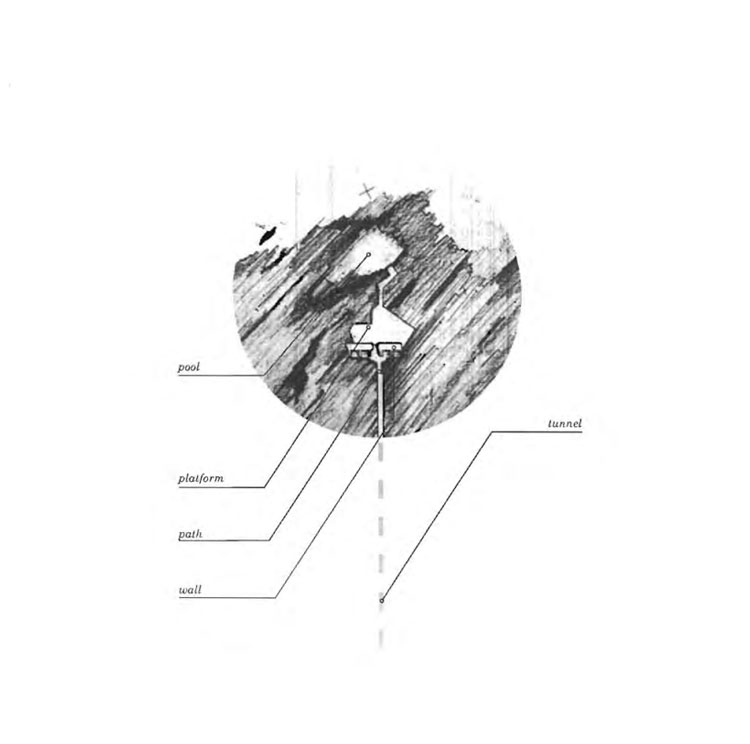
Graaf's pool has a unique place in the story of the South African tidal pool for all the fuss it has caused. The pool was built in 1910 to accommodate the needs of a paralysed woman who lived in a mansion right behind the pool. It featured a tunnel for access under the beach road, and a wall to shield the users from view. After her, the mansion and the pool were owned by a politician named Graaff, after whom the pool was named, and who later bequeathed the pool to the City of Cape Town.
It soon became a popular hangout spot for gay men, who congregated behind the wall and swam in the nude. After a number of years, some of the locals objected to this practice, and the wall was demolished in 2005. The pool was demolished in 2005, although some features have survived in 2026.


Graaff's Pool cut down to size
2005-06-09 21:59
Cape Town - Nudie landmark Graaff's Pool - labelled by a city councillor as a venue where sex was for sale, drugs were peddled and the area used as a toilet - is almost gone.
A huge bulldozer started on Thursday with the destruction of the concrete wall around the well-known pool on the Sea Point promenade.
For councillor J P Smith, representing Sea Point and Green Point and who was there to monitor the proceedings, it was the end of a three-year campaign.
He said: "We can now make an end to the abuse of Graaff's Pool."
Smith approached the council three years ago with a deposition to do away with the concrete wall protecting the historic Graaff's Pool from prying eyes on land.
He was supported by the Sea Point Ratepayers' Association, as well as the area's community policing forum.
Tunnel under the street
Smith said: "It took us a long time to weigh up the pros and cons of this move and we eventually decided the demolition of the wall was justified.
"It no longer serves any useful purpose for the community."
The pool dates from the period when the former politician and leader of the opposition, Sir de Villiers Graaff and his family had a home across the street in Beach Road.
It was even possible for them to walk along a tunnel underneath the street to the pool where bathing was strictly in the nude.
The tunnel entrance can still be seen today.
In later years the family donated the pool to the city council.
Initially, only men were allowed to use it and it was only much later that women were allowed to use it.
'A hotspot for crime'
According to Smith, the sea took its toll through the years and storm damage caused cracks in the wall and even took away sections of concrete.
Smith said: "In time, it became a hotspot for crime.
"Condoms and stolen property were found there regularly and rent boys also used the place as a hangout."
The Western Cape heritage watchdog initially gave permission for the demolition of the wall to a height of one metre.
However, Smith is presenting a further deposition to break the wall down to the rock surface and have the area restored to its original state.
https://www.news24.com/graaffs-pool-cut-down-to-size-20050609


Extracts from a Master's Thesis, by Andre Malan. Read the full Thesis here.
BELOW BORDEAUX
Hidden Histories in Sea Point design research project APG5058S
Submitted in partial fulfilment of the requirements for the degree
Master of Architecture (Professional)
by Andre Malan
Published by the University of Cape Town (UCT) in terms of the non-exclusive license granted to UCT by the author.
RAIL!
While railways were being built in and around the
city as far back as 1862, it was not until 1905 that a
passenger line to Sea Point was opened. The line ran
at a loss for many years. In 1927, it was electrified,
but soon after, in 1929, the line was closed.
"When the line was lifted, the railway property
became public land, which could not be built upon.
So the wide green lawns along the sea front, of which
Sea Point is so proud, are the only memorial to the
vanished Sea Point railway." (Burman: 1984)
DARWIN'S DISCOVERY
Rocks along the Sea Point coast are world famous in
the field of geology. A site known as the
Sea Point Contact, was visited and documented by Charles
Darwin during a geological voyage from 1832 to
1836. His observations here would later help him to
suggest that the world had been around long enough
for his natural selection hypothesis to be true.
Some 540 million years ago, at the Contact, molten
granite magma was injected into black sedimentary
rocks of the Malmesbury Group. Today Cape
Granite and the Malmesbury Group are two of the
most prolific rock type in the country. The extreme
heat of the molten granite softened, stretched and
delaminated the rocks of the Malmesbury Group. This
left a complex mixed zone stretching over 150m
along the coast.
This contact event, however, is not responsible
for the distinctly recognisable appearance of the
dark angular rocks (of the Malmesbury group)
surrounding Graaffs Pool. These are a result of
a geological process called orogeny. The orogeny
in this case, caused by pressure from a collision
between the South American, Antarctic and African
continental plates slowly colliding resulted in
dramatic deformation of the upper layer of the
earth's crust. Thus, the dark sedimentary rock
was split and folded in along a North West axis.
Today, these sedimentary layers can still be observed
as in most rocks, only in this case, they are not
parallel to the horizon but protrude diagonally
outward.
TECHNIQUE AND TOOLING
Drilling and Blasting, the dominant method of quarrying, has
changed little since its ancient inception. While manually boring
devices have been swapped out for machines and chemical
advances made in the composition of explosives, the basic
principles have endured.
The process of Blasting Rocks consists, after
selecting the most suitable position, in boring a hole
with a hammer and drill; the latter is a straight
bar or iron an inch or more in thickness, with a
steel point, widened out to the size of the required
hole; it is formed like a very blunt chisel.
Around the perimeter of the pool, many of these blasted faces can be seen
TIDE & POOL
The objective of the experimental measurements of the inflow due to wave action
was to optimize the height of the seawall so as to achieve a satisfactory fresh water
replenishment rate without the occurrence of unduly rough conditions within the
pool.
The lowering of the crest level by 200mm revealed in the experimental analysis
virtually no change to the conditions of no-inflow but did affect quite appreciably
the total inflow and bathing conditions.
A final crest level for construction purposes of 1,40m (above) M.S.L was adopted.
In his paper, 'Design of Coastal Structures for
Recreational Purposes', engineer, G H O'Connell,
tests the wall heights at 200mm intervals before
reaching the perfect measurement. Adhering to
this sort of model, nearby, Milton's Pool uses man
made walls to retain water and a manually operated
valve (or plug) to drain the pool at spring low
tides. Unfortunately, the unique rock formations
dissipate wave energy unusually fast and waves
seldom break into the pool. Consequently, the
warm water is swamped with algae, and due to
poor management is seldom emptied.
Compared to typical tidal pools, Graaffs Pool sits
dramatically lower in the tidal range. Perimeter
rocks range in height from about 1,20m - 0.40m
above mean sea level. At low tide, it is full enough
to bathe in. At high tide, waves regularly crash into
the pool and drain over large portions of the brim.
The turbulent in-flow and dangerous suction areas
make the pool treacherous at high tides.
1. G.H.O'Connell, Design of Coastal Structures for
Recreational Purposes, Proceedings of 18th Conference on
Coastal Engineering: Cape Town (1982).
2. D.E.Bosman & D.J.P. Scholtz, A Survery of Man-made Tidal
Swimming Pools Along the South Mrican Coast, Proceedings of
18th Conference on Coastal Engineering: Cape Town (1982).
With this in mind, when designing a new pool,
a system of waves and valves used for water
circulation is out of the question. Instead, the
proposed pool works on the same principle as
Graaffs Pool, but on the other end of the tidal
range. Set in a podium further inland and higher
than Milton's Pool, the new pool is protected from
most wave action. At high tide, when Graaffs Pool
is inaccessible, a gulley in the podium fills the
new pool with water. As the tide ebbs, the water
is drained completely, exposing the rocks below.
WATER. [tunnel]
The quarrymen left a pool that filled up with the natural
rhythms of the tide. Across from the pool in a winemaker's
mansion, the lady of the house was confined to a wheelchair.
A wall was erected on the rocks to hide her while she bathed.
A path connected the hidden pool to the shore, and a tunnel
continued underground to her home. The pool became an
intimate, private place- an extension of the bedroom.
RETURNING GAZE
Out of the tall, slender top windows of the Villa Bordeaux,
the Lady of the House could see out of her room. From
this vantage point, she could survey the street and the
public passersby in concealment. In her practice of
voyeurism she established a gaze from the house, over
the outside world, terminating the pool.
As an audience member in a theatre looks out
from a dark concealed position to the open stage (of
infinite possibility and expanse), Lady Wheelchair
would've looked out upon the pool from her dark
house. Hence, if only in her own mind, she would have
established something akin to the relationship between
the stage actor and the audience. With this in mind, it
is easy to imagine the anxiety that might arise upon
visiting the pool. By crossing over the proscenium, an
invisible screen, and arriving on the stage as a reluctant
actor - forced into the gaze of an unknown voyeurl.
In the 1920's, stigmas and misunderstandings about
disability would have been far more pronounced
than today. Whether from prejudice against her or a
personally constructed self-image, it is assumed that
Lady Wheelchair was self-conscious of her physical
embodiment.
The voyeur, of course, was herself. The gaze came
from a private place, one where she was exposed in her
most intimate and vulnerable ways.
In an essay ''The Split Wall: Domestic Voyeurism", theorist Beatriz Colomina
embarks on a rigorous analysis of interior spaces created by Adolf Loos and
Le Corbusier, respectively. Through strictly spatial and experiential terms
Ms Colomina explores notions of voyeurism, the body, the eye, and the skin in
conjunction with interior domestic spaces.
The reading offered above of the relationship between Graaff's Pool,
the Villa Bordeaux, and the Lady in the Wheelchair, is rooted in this mode
of investigation.
LADY WHEELCHAIR
The story of a lady in wheelchair has been attached
to the mysterious, inaccessible tunnel for years.
Inherited as folklore in the area, it has been retold,
and reshaped countless times.
Exactly how much is truth and how much is fantasy
is not as important as the existence of the story
itself, so tightly bound to these hidden and strange
spaces.
The tunnel and pool is often thought to have been
built by Mr Jacobus Graaff, after whom the pool
now take its name. And it is described so in a
Lawrence G. Green's I Heard the Old Man Say, a
key source of histories written about the Sea Point
area. It was built, the story goes, so that the wealthy
Graaff family could walk down, in silks, from their
palatial villa to bathe in the ocean without having
to interact with common members of society. No
doubt at one point this could have been the case
but pool is recorded as being in existence as far
back as 1910.
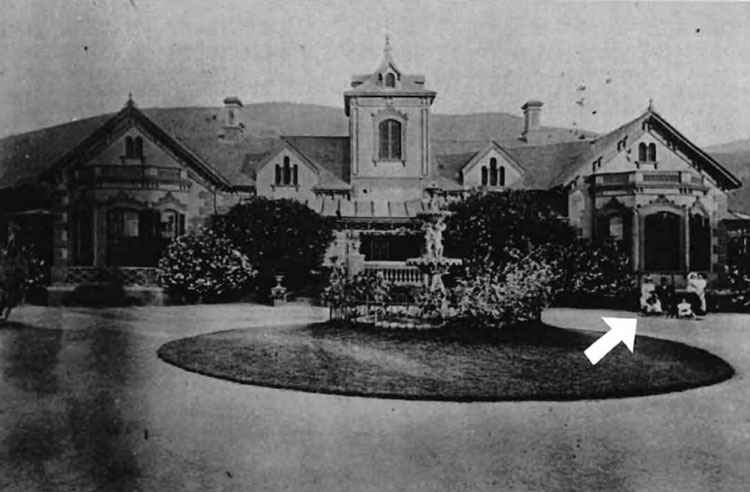
Bordeaux, a seafront mansion, was
built in 1903 for Mr. Pieter Marais,
a wine merchant. Sir Jacobus
Graaff bought it some years later.
Thousands knew Bordeaux as an
hotel with panelled rooms, a wide
stairway, Edwardian chandeliers,
mosaic floors, many stained-glass
windows, marble fireplaces and
other signs of wealth. Some of the
less bizarre furnishings were built
into the entrance of the millionpound block of flats which replaced
Bordeaux. Graaff’s Pool, originally a stone
quarry, gained its world famous
name when Sir Jacobus provided
most of the money for blasting a
channel in the rocks and building a
wall. Other bathers subscribed one
pound a head. According to legend,
Sir Jacobus had a secret passage
built so that he could walk
unobserved in bathing costume
from Bordeaux to the beach.
Demolition men found evidence of
a bricked-up tunnel when Bordeaux
was pulled down. However, the
truth is different. Sir Jacobus was
afraid that his children would be
run over while crossing the railway
line. He asked for a subway, and
when his request was turned down
he started building the tunnel. Then the subway was built, and the
tunnel was abandoned.
A more plausible account denies that the tunnel
ever reached the villa Bordeaux. Cape Argus
journalist John De Nobrega wrote an attempted
debunking of the tunnel story in 1966. The Tunnel
that Never Was, claims that the partially covered
archway served as a subway for the old rail line
and terminated on the other side of the tracks.
The Lady, however, almost certainly did exist,
and was certainly the wife of Mr Pieter Marais.
Marais, a prominent member of the Round Church
in Sea Point was a wealthy man with ties to the
wine industry. He is credited with building the
mansion at Villa Bordeaux in 1903 and naming it
after a popular wine farming region in France.
Lady Marais fell into poor health following the
death of her only child shortly after childbirth.
Marischal Murray in Under Lion's Head writes
the following:
"Mrs Marais, for some years remained in poor
health. Her husband now arranged for an approach to be
made, from the front gates ofBordeaux, leading down to
the small pool in the rocks below Bordeaux. Such stones
as could be removed were carted away, and during the
hot weather the invalid was periodically wheeled down
to have sea-water bath."
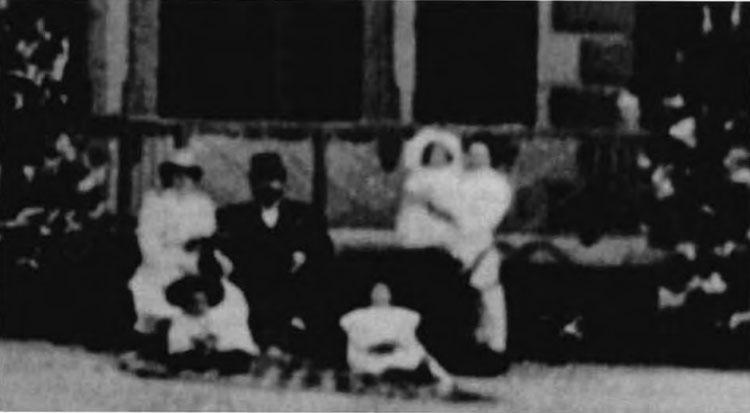
In conclusion, the accompanying photograph shows
Mr and Mrs Marais, seated. A black object, perhaps
handlebars, appears from between the Lady's
knees. A curious shadow to Pieter's left seems, too
to have handles extending in front of the standing
lady's waist. Lastly, while one mystery is solved
three others arrive - whose are these children?
One can only declare that the value of this story is
housed in the power of this unknown.
PARTI
There is a sense of ambition and determination
against nature pervading the design of Graaffs
Pool. Jacobus Graaff served in the 1920's as a
Minister of Public Works, Posts and Telegraphs.
Here, he would have overseen and maintained
vast developments in the Province. His old brother,
Sir David Pieter de Villiers Graaff, previously in
the same Cabinet position, had been involved in
realizing Cape Town's first electric power station
at Molteno Reservoir; the Sea Point Sea WaIP;
and with haunting similarity, Cape Town's pier
extending from Adderly Street into the bay.
Although physically smaller, Graaffs Pool was
conceived and built in the same era as these large
scale public amenities. And consequently imbued
with a similar sense of boldness.
Aspiring to transform Graaff's Pool into a more
public place, initial urban responses reached out
to the site's dimensional limits through a series of
sketches. Building on a satellite location was out
of the question; so was building upward, above
the promenade or further out to sea. Venturing
over the rocks, however, would resonate with the
previous building techniques. By digging into the
earth, one could begin to modify the preexisting,
creating new meaning and value in the same way
the rock void bore the original pool.
The first sketch suggested a sort of endless copying
of the pool-platform-path assemblage which would
cover the coastline in a mat of accessibility. A
move away from one singular object seemed
more democratic, but unbridled openness would
obliterate the special isolation and intimacy that
were so significant here.
BORDEAUX AND BELOW
The Villa Bordeaux was built in 1903 by Pieter
Marais, who lived there with his wife and
bachelor brother, Arnoldus Marais.
Later, after falling on hard times financially, the mansion was
sold to Mr Graaff. Who added a second story and
extended the tower at the entrance.
Graaff, known affectionately as Koos or most
formally as Sir Jacobus Arnoldus Combrinck
Graaff was born in Villiersdorp in 1863. He later
moved to Cape Town and made his fortune in the
Cold Storage industry along with his older, better
known brother, David Pieter de Villiers Graaff.
Graaff later took an interest in politics and worked
in various positions until becoming the minister of
Public Works, Posts and Telegraphs.
At Bordeaux, he is described as being graciously
hospitable and unostentatiously philanthropic?
Around 1929 the pool opposite the mansion was
given over to the public, and from then on it became
known as Graaffs Pool, but for many years prior it
had been named Below Bordeaux.
From then on, the old manor house was converted
and used as a hotel. It remained this way for 30
years until, in 1959, the structure was demolished
to make way for what is still today the largest
block of flats in Sea Point.
As buildings usually seems to be named after
the thing they destroy, this one is no exception.
Bordeaux, the immense block of flats that looks
over Graaff's Pool would later re-shape the way
the pool is inhabited and experienced.
1. Green claims the mansion was built in 1903 by P. Marais but
Murray claims the Marais estate was sub·divided and portions sold
following the Cape Bank failures of the 18805 and 18905. Also that
Marais died in 1901 on a nearby property named Marseilles.
COAST
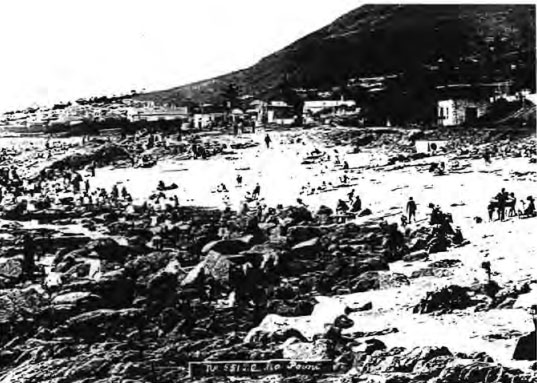
Before the sea wall, Sea Point's coastline was very different. Beach Road sat on a mound
of sandy soil which dipped down to the 'bleak rockscape'l and into the sea. The wall was
conceived to provide a neat edge to the coast, help kelp return to the water and provide a
dumping ground near the city. After the wall was built, refuse and rubble filled up behind it
it. For some time, it was an eyesore
SUN
A new owner gave the pool to the public. But the space's
exclusivity continued. Obscured from sight, wealthy men
sunbathed nude. Liberated from their confines, the group grew
larger and expanded the pool, too.
For those outside, it was a sign that forbidden practices
were concealed here. The excluded were forced to imagine
what happened behind the clean white walls. Projections of
their forbidden desires overflowed into conversations, novels
and newspapers.
The tension from not seeing became unbearable.
After Graaff's Pool had been opened to the public, it witnessed
a large influx of visitors. Around this time it became desirable
to expand the pool. Having undergone previous expansions,
this was not unthinkable, but now the onus was on the City
Council. Or rather, it was the duty ofthe public to insic:;t on these
expansions. Below are excerpts from two letters to the Town
Clerk. They offer a window into two, or more fundamental
ways in which architecture is framed in discourse.
I take the liberty of addressing you in regard to the above
mentioned resort at Sea Point. Your Council may not be aware
of it, but Graafl's pool, owing to its sunbathing facilities, has
become exceedingly popular, and is the resort of men drawn
from all ranks of life. Daily you can see the members of
Parliament, advocates, medical practitioners, attorneys, civil
servants of high standing, architects and councilmen. 1 might
add that a certain Minister of the Crown is a regular visitor.
1 know too that last year there was a gentleman from
abroad who told us that he had heard of Graaff's Pool in
England, and during his visit to the city, he spent a great deal
of time there. Doubtless too, he has spread its fame abroad.
Then recently, the representative in Cape Town of a
gigantic American tourist concern, was himself a visitor.
The place is therefore worth some consideration ...
...1 trust the council will read my letter in the spirit in which
it is written. 1 merely wish to bring to your notice the fact that
Graaff's Pool is a far more important bathing resort that is
generally recognised...
1 am prepared at any time to meet a representative of
the Council on the spot and explain the position there.
- Daniel F. Bosman (28th February 1929)
In the 1927 petition to expand the pool, the ratepayers'
position is that the pool must be expanded to accommodate
more sunbathers since sunbathing has been medically proven
to improve one's health.
Daniel F. Bosman's dream is articulated less through
practical considerations and more through a description of
how much he, and others, like it. They all really like it. He
doesn't are argue for the pool's usefulness, rather he simply
derives pleasure from the space.
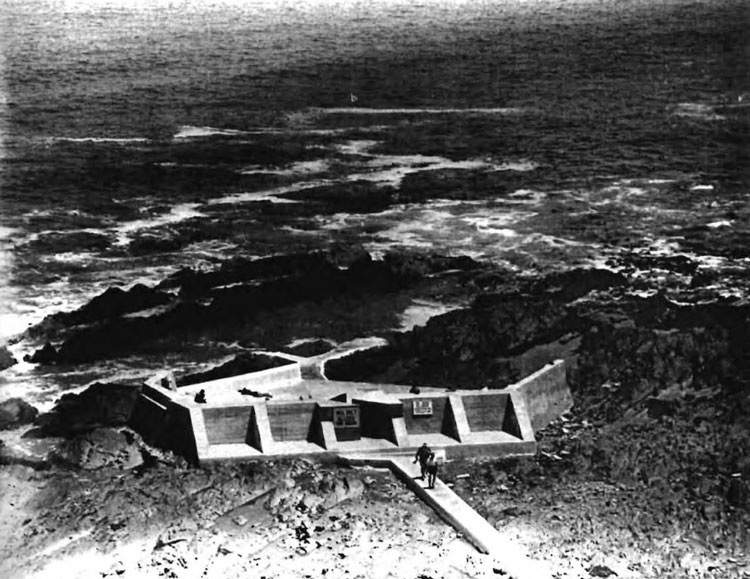
In 1930, extensions were approved, and the Pool expanded along with its history.
Of the three drawings, two from 1929 and one from 1961, the
latter is the most interesting. This document was drafted to
recorded repair works done on the pool following a massive
storm in 1961. The rear wall suffered the most damage in
the storm (Interestingly, it was the 1929 height extensions
that failed rather than the preceding construction. And still
today, after most of the walls were demolished, the surviving
uprights are those from before 1929.)
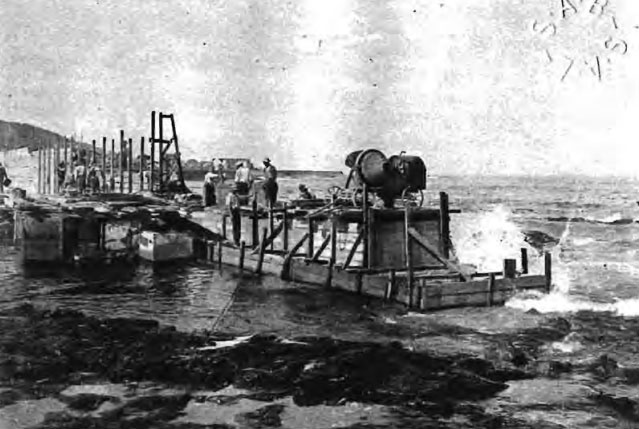
BUILDING UPON
Moulded, poured and set concrete is the dominant material of Graaff's Pool.
And the only operation that involved creating space was adding to the site. In
this sense, it constitutes the key act of building upon datums.
Besides the engineer's drawings and archived letters, this photo is the only
visual record of the construction process. It was taken at Mouille Point as the
progress of the sea wall neared the lighthouse. This is the very beginning of
the sea wall, which was built soon before Graaffs Pool. It relies on a similar
mass gravity approach to overcoming wave forces. At the base of the form
work, the thicker part shows the extent of the foundations, which rest directly
upon exposed rock. To the left of the picture frame, a buttress has begun to be
cast.
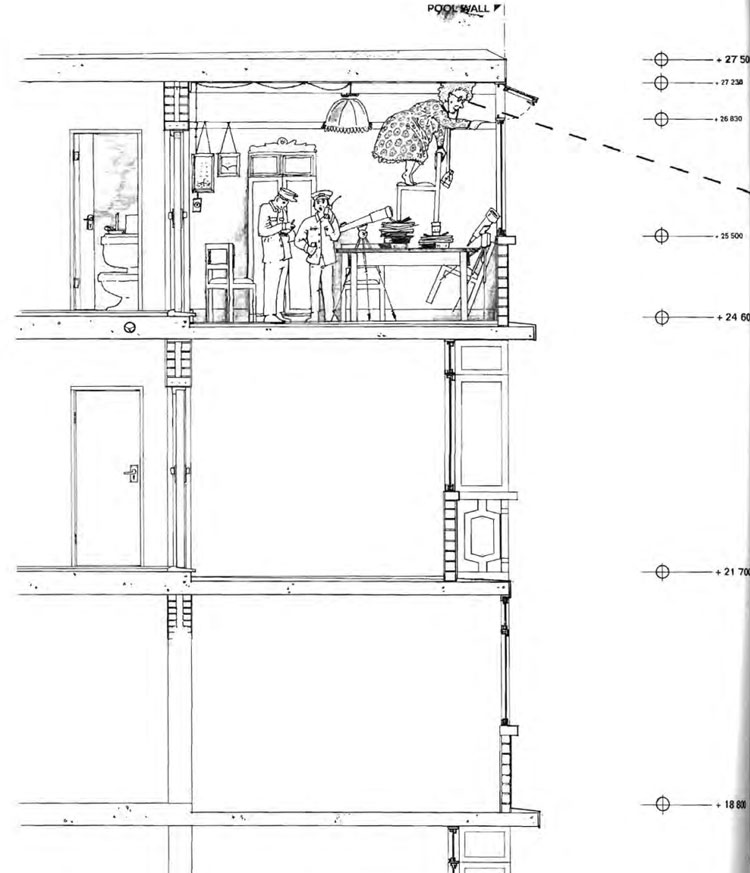
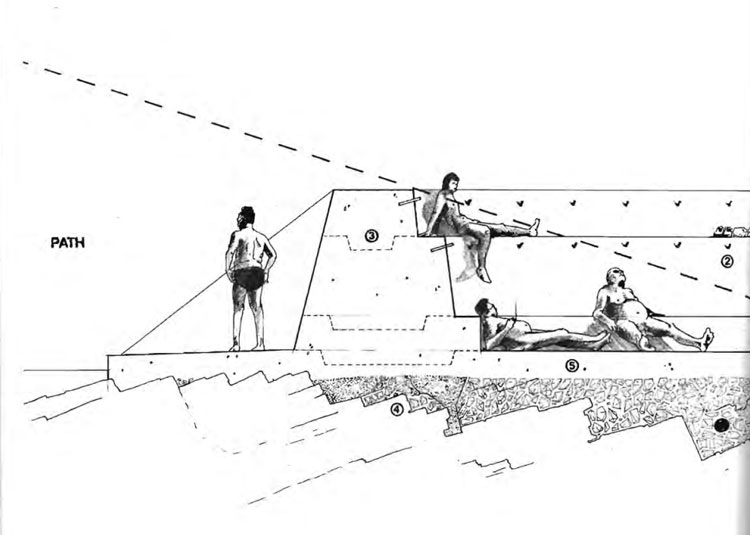
Many stories told about the nude bathing in Graaff's Pool have
captured the public's imagination over the years. One of the favourite
fables manages to frame a broader moral question.
THE ONE ABOUT THE OLD, PEEPING LADY
started when the city's chief engineer (and strong supporter of the pool, no doubt)
Dr S.S. Morris received a phone call from a disgusted lady complaining about
nude men exhibiting themselves on the Sea Point coast.
Dr Morris sent a man to meet with the old lady and investigate the complaint. He
arrived at the old lady's top-story flat, nearly half a kilometre from the pool, and
looking through the window, could see nothing but a blurred sea.
Confused, he turned to the little lady who said: "You can't see much now, but wait
until you climb onto the table and focus through the binoculars!"
MASSIVE ASSEMBLY
Graaff's Pool is almost a hundred years old,
and curiously, it is the oldest parts which have
weathered most gracefully. Barring the 2005
bulldozing, the main cause of structural failure
is steel reinforcement. The structural efficiency
of steel is impressive, but if compromised by
exposure to the sea air, oxidation begins. The
steel reinforcing expands within its concrete
casing, causing internal fracturing which leads
to dramatic structural failures. The most hardy
parts of Graaff's Pool, which still exist, are, of
course, those without steel reinforcing. Typical
walls translate horizontal loads down to their
foundations by resisting a bending moment. But
here, the mass gravity principle is employed.
The structure is simply so massive that it can't
be moved. This is aided by broad foundations
and a small amount of cantilevering afforded by
buttresses but the key to the old wall's resilience
is in its proportion: roughly as broad as it is high,
tapering to two-fifths of this dimension at its
highest point, with a footing behind that extends
the same distance again. These proportions can be
scaled up or down uniformly in the design of new
members.
Today, remnants of old events exist. Some people swim in
the pool or bath in the sun; romantics occasionally meet on
the spot.
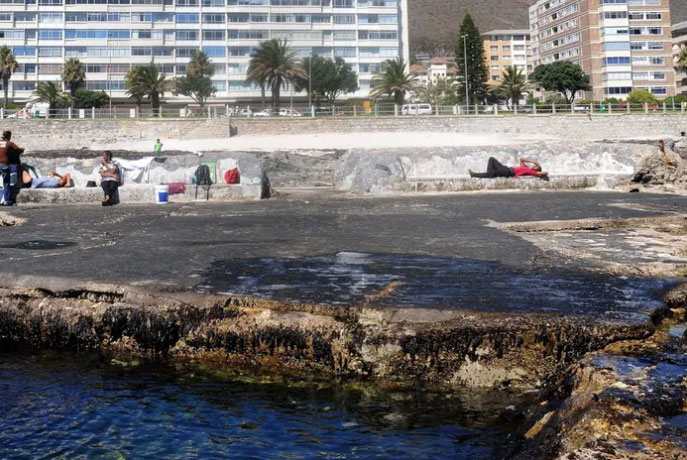
But these experiences have been stripped of their purpose and
potency. And continue to be washed away by the ceaseless
forces of the sea.
CONCLUSION
Originally, this was a place of respite for those excluded in a social landscape
of prejudices. Paradoxically, after the transition into an ever more accepting
government, this space was destroyed. This derailment can only be set straight
by architectural intervention.
The danger of playing in this field is that one is compelled to resolve
conflict, cut through confusion with a clear voice and fix things to their
proper position. Rather, the design proposal presented here celebrates this
de-centered position by remembering local folk tales and understanding the
injustices. The spaces designed are focused on offering new pleasures to the
city by springboarding off the unique positions of the past. These are pleasures
of nature- the ocean, tides, rock, and pleasures of the body- submersion in
water, tactile textures and intimate interactions.
BIBLIOGRAPHY
A Betsky. Queer Spcree. William Morrow and Company Inc.: New York. (1997)
C. Blignaut. End of the Road for Happy Campers at Graaffs Pool, in Cape Argus (09/05/1999)
D.E.Bosman & D.J.P. Scholtz. A Survey of Man-made Tidal Swimming Pools Along the South African Coast. 18th Conference on
Coastal Engineering: Cape Town (1982).
A.B.A Brink. Engineering Geology of Southern Africa: Rocks of 2000 to 300 million years in age. Building Publications Pretoria. (1981)
J. Burgoyne. A Treatise on the Blasting and Quarrying ofStone, Weale's Scientific and Technical Series: London (1874)
J. Burman. Early railways at the Cape. Human & Rousseau: Cape Town (1984)
B. Colomina. The Split Wall: Domestic Voyeurism in Sexuality & Space. Princeton Architectural Press: New York (1992)
G.H.O·Conneli. Design of Coastal Structures for Recreational Purposes. 18th Conference on Coastal Engineering: Cape Town (1982).
C. Darwin. Volcanic Islands: Visited During the Voyage of HMS Beagle. Smith. Elder and Co.: London (1844)
W. J. De Kock. Doctionary ofSouth African Biography, National Council for Social Research: Pretoria (1968)
E. Dommisse. Sir David Pieter de Villiers Graaff: first Barronet of De Grendel, Tafelberg Press: Cape Town (2011)
R. Evans. Translations from Drawings to Building and Other Essays. Architectural Association Publications: !--ondon (1997)
R. Evans. The Projective Cast: Architecture and its Three Geometries, MIT Press: Cambridge. Mass. (1995)
A. R. Fairweather. Sea Wall, Sea Point, from the South African Society of Civil Engineering Journal. Vol. 1. (1936)
1. Green. Poetical Dictionary (abridged), Atelos: Berkley. California (2003)
1. G. Green,I Heard the Old Men Say. Howard Timmins: Cape Town (1964)
Government publication. Report of the Railways and Harbours Board, [U.G. 141- 291. Cape Times: Cape Town (1929)
J. S. Hemming, A Short Account of Blasting Rocks at the Quarries in the Neighbourhood of Cape Town, G. J. Pike: Cape Town(1885)
M. de Landa. A Thousand Years of Non-Linear History. Zone Books: New York (1997)
M. Murray. Under Lion's Head: Earlier Days at Green Point and Sea Point, AA Balkema: Cape Town (1964)
K Nesbit ed.• Theorizing a New Agenda for Architecture: An Anthology of Architecture Theory 1965-1995. Princeton Architectural
Press: New York (1996) which contains the following essays:
B. Tschumi. Pleasures of Architecture, (1977)
B. Tschumi.Architecture and Limits I, (1980)
B. Tschumi. Architecture and Limits II, (1981)
B. Tschurni. Architecture and Limits III, (1981)
B. Tschumi. Introduction: Notes Towards a Theory of Architectural Disjunction. (1987)
J. D. Nobrega. The Tunnel that Never Was, in Cape Argus (09/041 1966)
G. Owens, ed. • Fundamentals of Concrete, Second Edition. Cement and Concrete Institute: Midrand. South Africa (2012)
J. Rahn. Music Inside Out: Going Too Far in Musical Essays. G+B Arts International: Amsterdam (2000)
P. B. Smons. Ice Cold in Africa: the history of the Imperial Cold Storage & Supply Company Ltd., Fernwood Press: Cape Town (2000)
B. Tschumi. Architectural Manifestoes, Architectural Association: London (1979)
interview with Bob Smith. Structural Engineer. Ingerop Engineering
interview with Gerrit Strydom. Landscape Architect. City Council
Interview with Dr. Hans-Dieter Beushausen. Engineer. Concrete Specialist
interview with Brian Rihcardson. Structural Engineer
National Archives of South Africa (NASA) documents (syntax: source; volume number; reference code)
3/CT; 4111111770; G65/6/26717;
3/CT; 412/111/185; A72;
3ICT; 411/5/91; B370/5; - closing of the subways. Rocklands •.... Graaff's Pool
3ICT; 411/5/144; B763/5;
3IeT; 412/1141226; 61125; -*contains drawings
3ICT; 411/1/41; A413/1; - Foreshore improvements•.... interview with Sir Dawid Graaff. 17/2/1911
3ICT; 411/2/18; A29412; - Suggested disposal of city refuse etc. on the property of Sir Dawid Graaff
T; 1070; 4003; - Cape.... building of sea wall and erection of a refuse destructor... Sea Point
(all images, unless otherwise stated, are the author's own; GIS data courtesy of Cape Town City Council)