Kalk Bay Tidal Pools and the Brass Bell Restaurant.

Kalk Bay (including Muizenberg and St James) was a municipality from 1895 to 1913. The Wynberg Railway Company extended the Southern Railway Line to Muizenberg on 15 December 1882 and a further extension to Kalk Bay on 5 May 1883. The railway line was built across the beach, which "jeopardised" the traditional practice of launching small fishing boats from the shore. This physical barrier was a major factor in the eventual push to build the artificial Kalk Bay Harbour (completed in 1918). In 2026, it is still a working fishing harbour, where boats bring in hauls of snoek and yellowtail.
In 1907, there were still no public bathing facilities, and in 1908, men's and women’s bathing screens, hangers, shower baths, and floor mats were provided.
In 1911, the Kalk Bay Muizenberg Municipality contracted Charles McGhie to formalise the walling of Bishop’s Pool, thereby creating a long rectangular pool that bathers walked into over a sloping sand beach.
However, these early structures were destroyed by high tides. In response, a concrete pavilion was built in 1913 for £420.
The previous structures served bathers until 1939, when they were demolished to make way for a third, more permanent pavilion. This building, which opened on the 9th November 1939, remains the core of the current Brass Bell complex.
Conflict with local residents arose when the restaurant tried to restrict public access to the pools. Read more about the access dispute below.


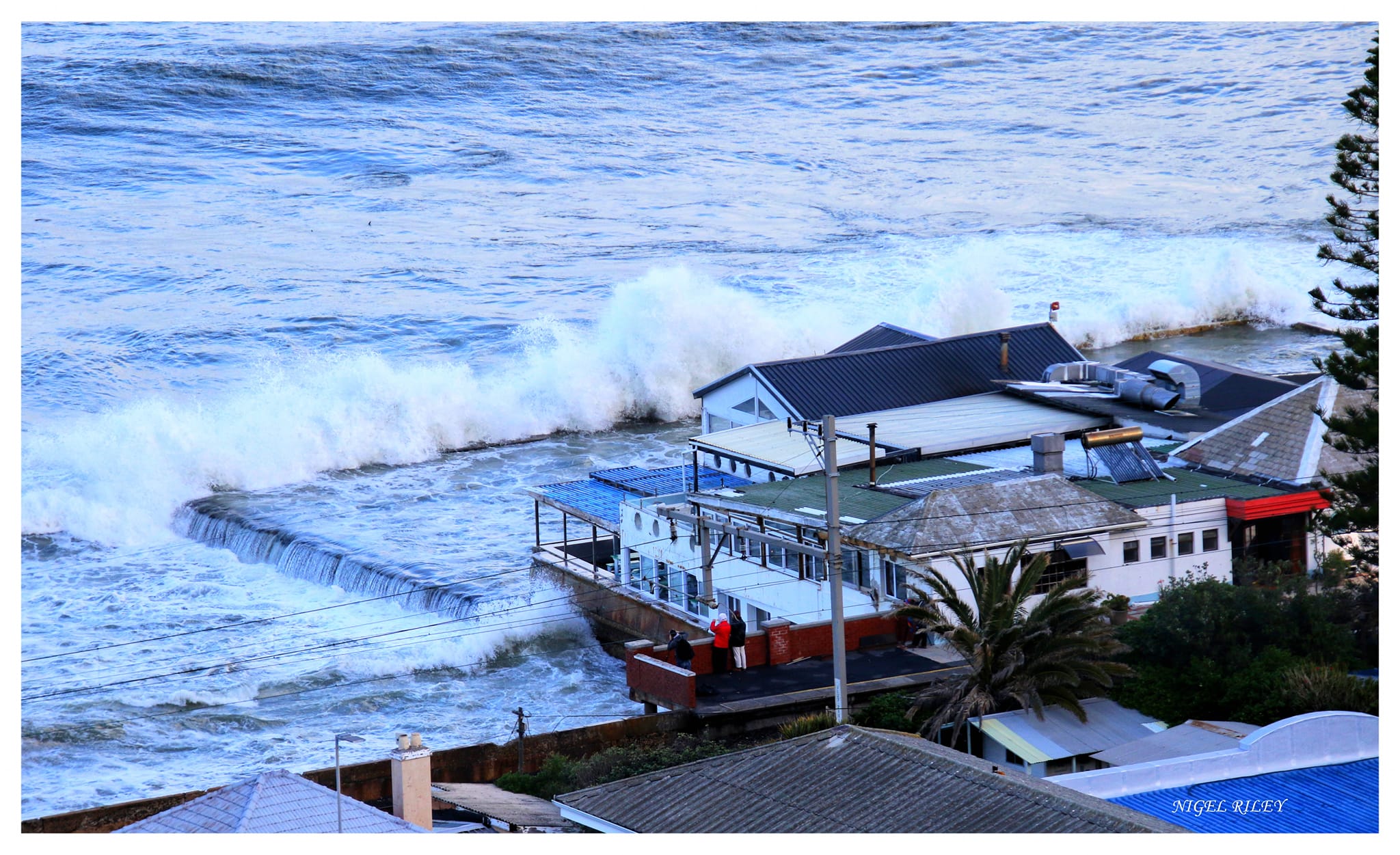
Echoes of bygone beach days ring out at Brass Bell
YOLANDE DU PREEZ 2025
https://falsebayecho.co.za/news/2025-01-24-echoes-of-bygone-beach-days-ring-out-at-brass-bell/
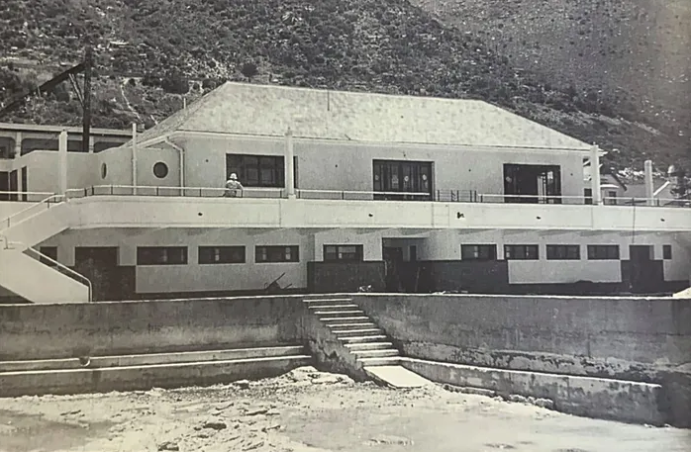
An undated picture of the Kalk Bay pavilion. Picture: Kalk Bay Historical Association.
Originally, two pavilions were built on the site to serve bathers using Bishop's Pool, a natural rock pool named after Bishop Gray, who frequented the area in the 1860s.
The Dalebrook tidal pool, further up the line, was the first of the pools to be built in Kalk Bay. It was illegally built in 1903 as a private undertaking by Mr F B Steer of Douglas Cottage.
According to the association’s records, the foreshore from Dalebrook southwards to Kalk Bay, though rocky, had a more gradual slope and broader and longer stretches of sand. Bathing was possible in many places, but the area was monopolised by boats, and fish cleaning that had polluted the water.
Instead, swimmers took to the rock pools and gullies near the station, one of which became known as Bishop’s Pool as Bishop Gray had often bathed there.
In 1907, there were still no public bathing facilities, and in 1908, men's and women’s bathing screens, hangers, shower baths, and floor mats were provided.
In 1911, the Kalk Bay Muizenberg Municipality contracted Charles McGhie to formalise the walling of Bishop’s Pool thereby creating a long rectangular pool that bathers walked into over a sloping sand beach.
However, these early structures were destroyed by high tides. In response, a concrete pavilion was built in 1913 for £420 which became the foundation of what is now the Brass Bell Restaurant.
It was situated south of the railway footbridge (today’s subway entrance) and provided bathing cubicles for men and women, as well as freshwater showers and toilets.
However, the following year, facilities were bursting at the seams, and Mr Dellbridge built a second pavilion north of the railway footbridge, which included a tea room.
This became the new women’s pavilion while the first pavilion became the men’s pavilion. Both offered the same facilities of seven freshwater showers and toilets, except that the men’s was larger with 44 cubicles compared to the 24 for women.
Together they catered for 700 bathers a day.
In the same year, a low wall was built across the beach end of the pool to prevent sand from silting it.
In 1914, all bathing boxes that had stood against the rail embankment were removed to open up more beach space, and the city council built 60 metres of sea wall to prevent the sea from scouring the beach sand.
In 1905, the Cape Government Railways had built a 150-metre long and 5-metre-wide wooden sea-side platform, which allowed Kalk Bay to also boast of having a promenade in addition to two pavilions and a pool.
In 1922, a new square pool, named Kalk Bay Pool, was built onto the north side of Bishop’s Pool, substantially enlarging the area available for safe bathing. A new children’s pool was also built at the end of Bishop’s Pool.
During the 1930s, seawalls were built to protect the beach areas. In 1938, a sea wall was extended southwards to enclose a sand beach, and a new children’s pool was built to replace the former one.
These pavilions served many thousands of bathers until they were demolished in 1939, and a new pavilion, the third on this beach, opened on November 9, 1939.
It is this structure that forms the core of today’s Brass Bell Restaurant, which has leased the premises, once the tea room, since the early 1970s, when the pavilion and the station milk bar were renovated and rebuilt to form a restaurant.
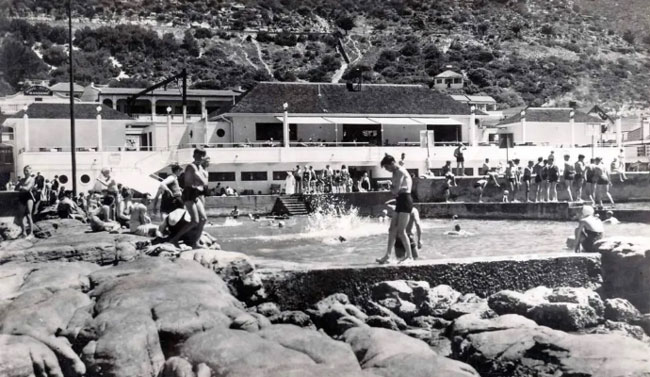
Bathers enjoying the facilities at the pavilion. Picture: Kalk Bay Historical Association.
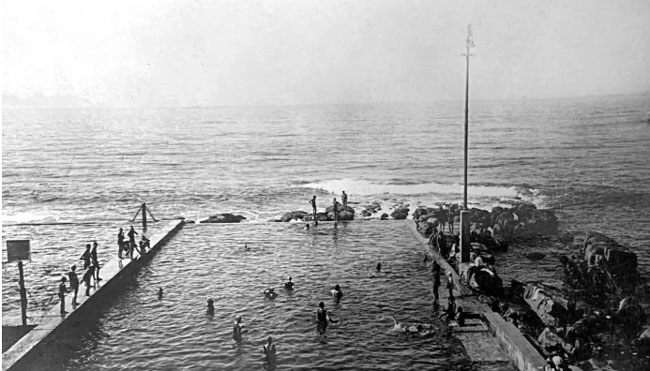
An undated picture of Bishop’s Pool in Kalk Bay. Picture: Kalk Bay Historical Association
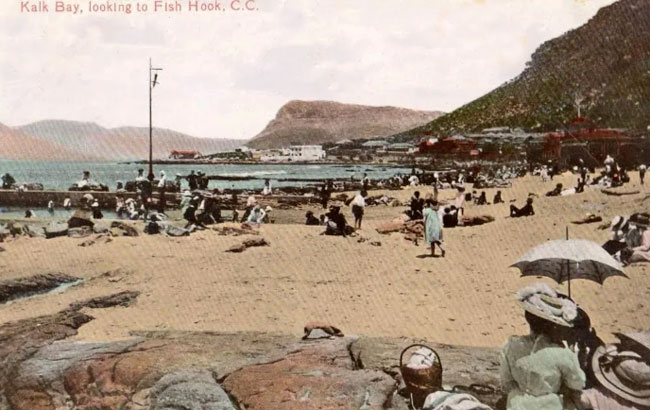
An undated postcard of the man-made beach before the pavilion was constructed. Picture: Kalk Bay Historical Association.
Kalk Bay restaurant owner halts expansion after outcry from residents and intervention by city
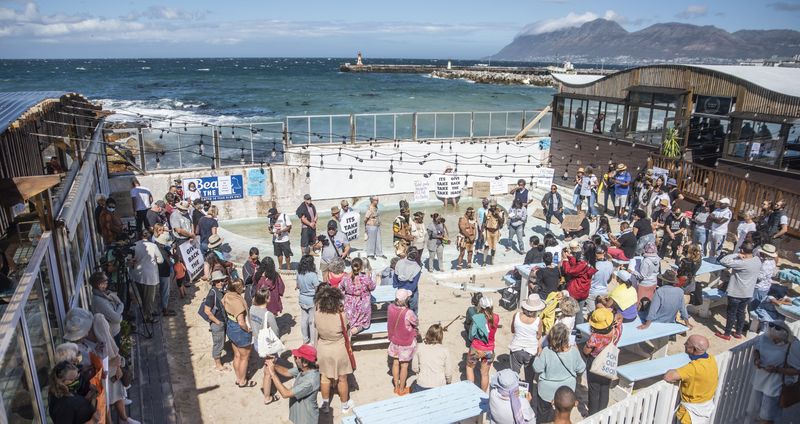
“I do not intend at this stage to proceed with the small wooden platform,” Brass Bell owner Tony White told Daily Maverick on Tuesday.
White began construction last month on an intended 3x7m wooden deck to “enhance the experience of patrons to the Brass Bell” by providing them with an area to sunbathe without getting covered in sand. The area had already been cleared and eight concrete footings installed on the beach when Daily Maverick visited on 31 March.
White’s expansion of the restaurant’s premises into the public space sparked an outcry from Kalk Bay residents, who called for an end to the construction that would expand the deck over a large area surrounding the children’s tidal pool.
Protests by residents took place on 30 March and 2 April at the Brass Bell, and the City of Cape Town, with a representative from Oceans and Coasts Environmental Compliance, inspected the site on Wednesday, 30 March after being alerted about the construction the previous day.
Read in Daily Maverick: Kalk Bay residents move to block businessman from ‘privatising historic public beach area’
The land is owned by Prasa and is leased to the Brass Bell for commercial purposes. Cape Town’s deputy mayor, Eddie Andrews, previously confirmed to Daily Maverick that the city does not have a copy of the lease agreement or the conditions.
The land contains the Kalk Bay tidal pools, which consist of two large adjoining pools and a smaller children’s pool, and the Brass Bell restaurant. To get to the pools, swimmers need to walk through the Brass Bell, which has expanded over the years and now covers most of the area around the pools.
At the meeting on Tuesday, 5 April, “It was confirmed that Prasa Cres requires, in terms of the lease agreement, that the tenant must be aware of and meet all of the statutory requirements, such as an Environmental Impact Assessment (EIA), building plan approvals, health and safety compliance and fire safety where applicable,” Andrews said.
“Should the lessee be found to be in breach of this requirement, he will be provided with the opportunity to comply with the applicable statutory requirements.”
On Friday, 1 April, the city’s building inspector served notices in terms of the national building regulations to White to cease building work to comply with section 4 (to obtain written approval for unauthorised building work within 60 days) and section 12 (to secure the building, ensure public safety and appoint fire and structural engineers).
“The city’s building inspector also served additional and separate notices on Prasa Cres as the landowner at the meeting on 5 April,” said Andrews.
If construction should proceed, building plans must be submitted to the city’s Development Management Department and assessed for compliance with the Development Management Scheme, which determines the use of the land.
“A land use application would need to be submitted to the city if the intended use of the erf requires consent or is not in line with its zoning rights, which may require the application to go through a public participation process prior to its consideration by the delegated authority,” said Andrews.
The construction took place within 100m of the high-water mark, which in terms of the National Environmental Management Act (Nema) would require an EIA. Andrews previously told Daily Maverick that “the determination as to whether an EIA is required depends on many factors, not only proximity to the high-water mark.
“Pre-constructed or pre-disturbed areas may not need an EIA — in this case, it is a determination that the national government will make.”
In terms of environmental compliance, Andrews said the following actions would be taken:
- Oceans and Coasts Environmental Compliance will engage with Prasa Cres and the Brass Bell to determine whether any NEMA regulations had been transgressed over the past eight to nine years.
- Oceans and Coasts Environmental Compliance will notify Prasa Cres and White that if no approved/authorised building plans are available, it might invoke section 60 of the Integrated Coastal Management Act (Icma) with regard to an illegal structure in the coastal zone. Both parties will have the opportunity to respond.
- The city’s Coastal Management Branch will write a formal letter to Prasa Cres, informing it that public access to the tidal pools via both access points is protected by both the Icma and the city’s coastal bylaw.
- This access right by the public is effective 24/7, but for security and operational reasons, the stipulation is that both access points must be open and accessible to the public from 6 pm to midnight, every day. This letter was sent to Prasa Cres on 6 April; and
- Prasa Cres will require these remedial actions, and for White to comply with the public’s right to access the tidal pools.
Andrews said White “is required to excavate and remove the eight concrete footings that he installed on the beach”.
However, White claims he had not been asked to remove remnants of the construction.
“I have not been requested to excavate and remove the concrete,” he said.
Faez Poggenpoel, a fifth-generation fisherman in Kalk Bay and a representative of the small-scale fishing community, told Daily Maverick that while this is progress, “it needs to be a statement to the government as well as to the city that they need to do more to protect these spaces — not only deal with the problem when communities rise up”.
Prasa Cres denied multiple requests for comment and maintained that this was not a Prasa issue, despite Prasa’s position as the landowner and its attendance at the meeting on 5 April.
The acting Metrorail Western Cape spokesperson, Nana Zenani, said the Brass Bell had carried out the renovations without informing Prasa Cres, and therefore the establishment had to respond to queries, not the railway agency.
“Prasa was not aware of the renovations by Brass Bell,” said Zenani.
Prasa’s spokesperson, Andiswa Makanda, previously told GroundUp that when the construction was brought to their attention, a letter had been issued to the Brass Bell requesting approval documents. DM