Strand

The Strand area was first mentioned in 1696 when a certain corporal Muller working for the Dutch East Indian Company set foot on the white beaches of Milk Bay. In 1714, a farm called Vlooibaai was granted to a French Huguenot, David du Buisson. David du Buisson at a certain stage, was a tutor for the children of Pierre Joubert in the Drakenstein (Close to Paarl) area. David du Buisson married the 17-year-old Claudine Lombard in 1707. The farm Vlooibaai stretched from the Lourens River to the Farm Onverwach that belonged to Phillip Morkel. In 1717 David Buisson and his family were attacked by fugitive slaves but escaped with their lives. When David du Buisson died in 1722 the farm was transferred to his widow. In 1748, the farm was sold to Olof de Wet. Later, the farm Vlooibaai was also bought by the Morkel family, and the Morkel family owned three farms: Vlooibaai, Onverwacht and Voorberg. These farms probably formed the biggest part of what is today known as the Strand.
A magistrate from Stellenbosch named Daniel van Ryneveld owned this seaside property in the early 1800s, where he allowed local farmers to camp. This informal holiday spot eventually grew into a permanent settlement. Originally called Somerset Strand, the area was proclaimed a municipality in 1897. In 1918 is was named Die Strand (the name which is still commonly used in the Afrikaans community), before becoming officially known as Strand in 1937.
Melkbaai is the main and most popular beach in Strand. It is renowned for being one of the safest and best bathing areas in the country due to its flat, white sandy shore and shallow waters that remain waist-deep for a significant distance.
Despite the shallow beach, the Stand Surf Lifesaving Club has operated there since 1958. There have been shark attacks at Strand in South Africa. Notable incidents include a 14-year-old surfer being attacked in November 2007, suffering leg injuries, and another attack in October 2010 at Melkbaai in Strand, where a teenager sustained serious foot lacerations. Both victims survived, with at least one attack attributed to a Great White shark.
A pavilion was built along the 5km beach in 1913, creating a popular attraction, which began to decline when a tidal swimming pool was built at Melbaai, about 1km away. Today, the pavilion has been rebuilt twice, and it now features a 50m indoor swimming pool.


Back in the day: The Strand Pavilion complex, more than 90 years later
17 April 2025
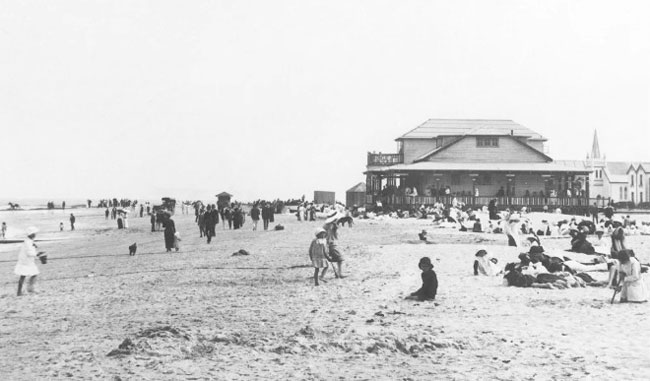
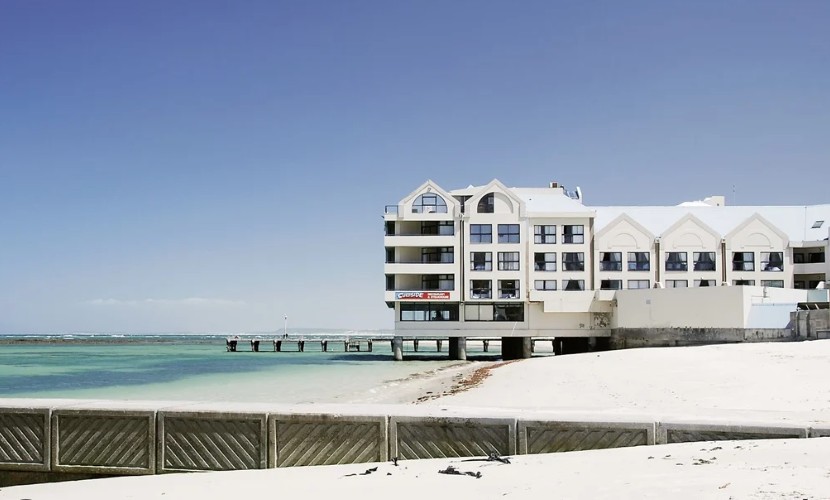
From the archives: It's difficult to believe that the modern timeshare building that now stands proudly next to the Strand's well-known pier had its origin in 1914 as a wooden structure where bathers could change into their swimming costumes.
The Strand is one of the oldest holiday towns in South Africa, and the structure in the black-and-white photo (taken between 1914 and 1920) was built specifically for the sake of holidaymakers and bathers.
Back then eyebrows were raised if you simply arrived at the beach in your swimwear, so bathers were very grateful when this first wooden pavilion was completed in 1914, complete with changing cubicles and showers.
Barely four years later, the wooden structure was damaged in a fire. It was repaired, but was reduced to ruins in 1923. In 1929, a brick pavilion was built more or less in the same place, with a playground and a cinema.
The Strand's famous wooden pier was only built next to the Pavilion in 1934. (This pier has since been closed to the public for safety reasons.)
The Pavilion's popularity began to wane when Melkbaai, a kilometer or so away, was opened as a swimming spot and people rather sought refreshment there. The Pavilion was later declared unsafe and demolished in 1972.
The Strand Pavilion complex as it looks today, with a restaurant over the water and an Olympic-sized swimming pool, was erected in 1990 on the foundations of the earlier building
.
The first Europeans who left their footprints on the Strand's white beaches were presumably four deserters who planned to walk along the coast to Mozambique to escape Jan van Riebeeck's oppression. However, they didn't get far and had to turn back with their tails between their legs.
In the early 1800s, the Stellenbosch magistrate Daniel van Ryneveld allowed farmers to camp on his farm, Somerset Strand. They could later build holiday homes.
Later, after the Anglo-Boer War, many citizens settled here.
This article originally appeared in April 2007. Facts may have changed since then.
Sources: The Story of Hottentots-Holland by Peggy Heap
Die Strand en sy mense deur Faure de Kock


The Strand Jetty was a prominent feature of the Strand beachfront. The jetty was built by Murray and Stewart in 1934. It featured a 70-meter-long, 2.5-meter-wide walkway extending into the sea, ending in a larger 7.5 x 9-meter platform, constructed using large square Australian Jarrah timber log columns, which were driven into the seabed. Over time, the structure became derelict and broken, with its weathered beams remaining as a landmark, often described as a "skeleton" or broken structure on the beach.


